

The Enduring Quest: Unpacking the Hypotheses of the Origin of the World
From the earliest whispers around ancient campfires to the sophisticated equations etched into blackboards today, humanity has wrestled with one of its most profound questions: Whence came the world? This isn't merely a scientific inquiry, but a philosophical one, deeply entwined with our sense of purpose, place, and being. This pillar page delves into the grand tapestry of hypotheses that have sought to explain the world's genesis, charting a course from mythic creation stories to the intricate models of modern astronomy and evolution. We will explore how different eras and thinkers, drawing from observation, faith, and reason, have constructed their explanations, each adding a unique layer to our collective understanding of origins.
From Mythic Eddies to Philosophical Currents: Early Hypotheses of Creation
Before the advent of systematic scientific inquiry, the origin of the world was primarily the domain of myth and religion. These early narratives, often passed down through oral tradition and later codified in sacred texts, served as humanity's first grand hypotheses about existence.
Ancient Cosmogonies: The Dawn of Explanation
Across diverse cultures, creation myths shared common threads: a primordial chaos, a divine progenitor, or a cosmic egg from which order emerged. These stories were not just fanciful tales; they were comprehensive frameworks for understanding the universe, its forces, and humanity's role within it.
- Mesopotamian Narratives: Texts like the Enuma Elish describe a chaotic watery abyss from which gods arise, culminating in the creation of the world from the slain body of Tiamat.
- Egyptian Cosmogony: Often centered around the primeval waters of Nun, from which a creator god (like Atum or Ra) emerged to bring forth the universe through self-creation or utterance.
- Greek Myth: Hesiod's Theogony, a foundational text in the Great Books of the Western World, presents a lineage of gods emerging from Chaos, Gaia (Earth), and Ouranos (Sky), leading to the Olympian order.
These myths, while not empirical, represented humanity's earliest attempts to formulate a coherent hypothesis about the world's beginning, often imbued with moral and societal lessons.
The Presocratic Revolution: Seeking Natural Principles
The ancient Greeks marked a pivotal shift, moving beyond purely mythic explanations to seek natural, rational principles for the world's formation. These Presocratic philosophers, many of whose fragments are preserved through later philosophical works in the Great Books, offered groundbreaking hypotheses.
- Thales: Proposed water as the fundamental arche or originating substance of all things, suggesting a natural rather than supernatural origin.
- Anaximander: Postulated the apeiron (the boundless or indefinite) as the ultimate source, a concept more abstract than a tangible element. His ideas also touched upon the evolution of life from water.
- Heraclitus: Emphasized fire and constant change as the underlying reality, suggesting a dynamic, ever-transforming world.
- Empedocles: Introduced the four elements (earth, air, fire, water) and the forces of Love and Strife as the movers of cosmic creation and destruction.
These thinkers laid the groundwork for philosophy and science by positing that the world operated according to discernible, internal principles, rather than solely at the whim of deities.
Classical Philosophy and the Architect of Being
The towering figures of classical Greek philosophy, Plato and Aristotle, further refined and expanded the hypotheses concerning the world's origin, imbuing them with profound metaphysical significance.
Plato's Demiurge: Order from Chaos
In his dialogue Timaeus, a cornerstone of the Great Books, Plato introduces the concept of the Demiurge. This divine craftsman, not an all-powerful creator ex nihilo, fashioned the ordered world from a pre-existing, chaotic matter by imposing form and structure upon it, guided by the eternal Forms. This hypothesis posits an intelligent design, but one that works within the constraints of existing material, making the world a beautiful, intelligible, but imperfect copy of a perfect blueprint.
Aristotle's Unmoved Mover: The Eternal Cosmos
Aristotle, in works like Physics and Metaphysics, offered a different hypothesis. He posited an eternal, uncreated world, rejecting the idea of a temporal beginning. For Aristotle, the universe was always in motion, and this motion required an ultimate, primary cause – the Unmoved Mover. This entity, pure actuality, causes motion not by direct intervention but by being the object of desire or thought, drawing everything towards itself as a final cause. This hypothesis emphasizes an eternal, self-sustaining cosmos, driven by inherent teleology.
Theological Foundations: Creation Ex Nihilo
The Abrahamic traditions, particularly articulated in the Hebrew Bible and later elaborated by Christian and Islamic scholars (whose foundational texts and commentaries are also found in the Great Books), introduced the radical hypothesis of creatio ex nihilo – creation out of nothing.
The Genesis Narrative: A Divine Fiat
The opening verses of Genesis present God as an omnipotent being who, by divine decree, brings the entire world into existence. This hypothesis differs fundamentally from Plato's Demiurge, as it posits no pre-existing matter or chaos for God to shape. It emphasizes absolute sovereignty and an intentional act of will, establishing a temporal beginning for the universe and humanity.
Medieval Synthesis: Faith Meets Reason
Medieval philosophers and theologians, such as St. Thomas Aquinas (whose Summa Theologica is a monumental inclusion in the Great Books), sought to reconcile the Genesis account with Aristotelian philosophy. Aquinas argued that while reason could demonstrate the existence of a First Cause (echoing Aristotle's Unmoved Mover), the idea of a temporal beginning of the world (creation ex nihilo) was a truth revealed by faith, not demonstrable by reason alone. This intellectual synthesis attempted to provide a comprehensive hypothesis that honored both revelation and philosophical inquiry.
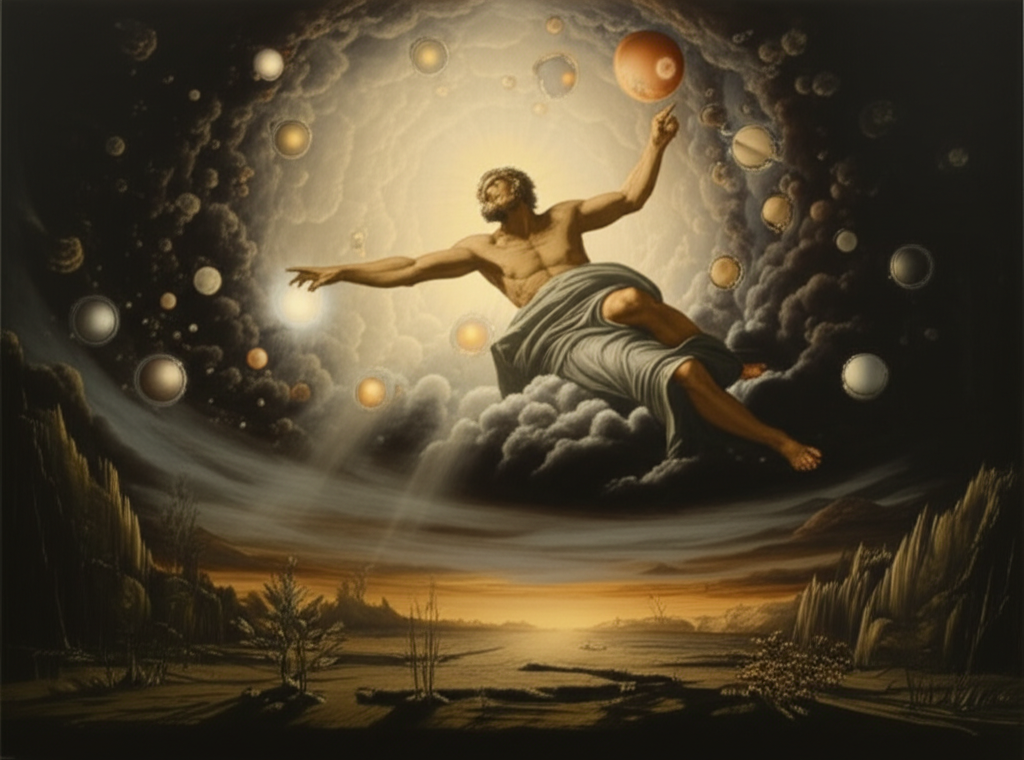
The Scientific Revolution and the Rise of Empirical Hypotheses
The Scientific Revolution marked a profound shift in how humanity formulated hypotheses about the world's origin, moving towards empirical observation, mathematical modeling, and testable predictions.
Astronomy's New Vista: A Heliocentric World
The likes of Copernicus, Kepler, and Galileo, through their revolutionary work in astronomy, shattered the geocentric model of the universe. Their observations and mathematical insights reshaped our understanding of the world's place within the cosmos, demonstrating that Earth was not the center, but merely one planet orbiting the sun. This laid the groundwork for a more objective, less anthropocentric view of cosmic origins.
Newtonian Mechanics: A Clockwork Universe
Isaac Newton's laws of motion and universal gravitation provided a powerful framework for understanding the mechanics of the universe. His work suggested a grand, orderly, and predictable world, operating according to immutable laws. While Newton himself believed in a divine creator who set these laws in motion, his system allowed for a scientific hypothesis of cosmic evolution based on physical principles.
Geological Deep Time: Unveiling Earth's History
Geologists like James Hutton and Charles Lyell introduced the concept of "deep time," demonstrating through observable geological processes that the Earth was far older than previously imagined. Their principle of uniformitarianism – that the same geological processes observed today have operated throughout Earth's history – provided a scientific hypothesis for the gradual formation of the world's landscapes over immense spans of time.
Modern Cosmology and Evolutionary Hypotheses
The 20th and 21st centuries have witnessed an explosion of scientific understanding, leading to highly sophisticated hypotheses about the world's origin, integrating physics, astronomy, and biology.
The Big Bang Theory: A Cosmic Genesis
The prevailing scientific hypothesis for the origin of the universe is the Big Bang theory. Supported by a wealth of observational evidence (like the expansion of the universe, cosmic microwave background radiation, and the abundance of light elements), this theory posits that the universe began from an extremely hot, dense singularity approximately 13.8 billion years ago and has been expanding and cooling ever since. This expansion led to the formation of stars, galaxies, and eventually, our own solar system and world.
Stellar Evolution and Planetary Formation
Modern astronomy explains how the heavy elements necessary for planet formation were forged within stars through nuclear fusion and subsequently dispersed into space by supernovae. Our solar system, including Earth, is understood to have formed from a rotating cloud of gas and dust (a solar nebula) that collapsed under gravity, with the sun forming at the center and the planets accreting from the surrounding material. This detailed hypothesis provides a naturalistic account for the physical origin of our world.
The Evolution of Life: Darwin's Profound Hypothesis
Charles Darwin's On the Origin of Species, another transformative work in the Great Books, presented the hypothesis of evolution by natural selection. This theory explains how the incredible diversity of life on Earth, including humanity, arose from common ancestors through a process of gradual change and adaptation over vast periods of time. While not directly addressing the origin of the universe or Earth, Darwin's hypothesis provides the foundational explanation for the origin and development of life on the world, completing a comprehensive scientific picture of our existence.
Here's a simplified timeline of key hypotheses regarding the world's origin:
| Era/Thinker | Primary Hypothesis | Key Concept |
|---|---|---|
| Ancient Myths | Divine creation from chaos or primordial elements | Mythic narrative, divine intervention |
| Presocratics | Natural principles (water, apeiron, fire) | Rational inquiry, fundamental substances |
| Plato | Demiurge shaping pre-existing matter | Intelligent design, Forms, imperfect copy |
| Aristotle | Eternal, uncreated cosmos with Unmoved Mover | Eternal motion, teleology, First Cause |
| Monotheistic Religions | Creation ex nihilo by an omnipotent God | Divine will, absolute beginning |
| Scientific Revolution | Heliocentric model, mechanical laws, deep time | Empirical observation, testable laws, gradual change |
| Modern Cosmology | Big Bang, stellar and planetary formation | Expanding universe, natural processes |
| Darwinian Evolution | Natural selection leading to life's diversity | Adaptation, common descent, biological change |
The Enduring Philosophical Questions
Even with the triumphs of modern science, the hypotheses of the world's origin continue to fuel philosophical inquiry. Science tells us how the universe began and evolved, but philosophy often probes the why.
The very existence of a universe governed by laws, the fine-tuning of cosmic constants, and the emergence of consciousness within it, all spark further questions that transcend empirical measurement. Is there a deeper meaning behind the Big Bang? Does the evolution of life imply purpose, or is it a grand accident? These are the frontiers where science meets metaphysics, and where the human mind continues to formulate new hypotheses, grappling with the ultimate nature of reality.
The journey to understand the world's origin is far from over. Each new discovery refines our hypotheses, pushing the boundaries of our knowledge and revealing the astonishing complexity and beauty of existence. The quest is a testament to the enduring human spirit of curiosity, forever seeking to comprehend the profound mystery of our cosmic home.
📹 Related Video: What is Philosophy?
Video by: The School of Life
💡 Want different videos? Search YouTube for: "Philosophy of Cosmology Great Books"
📹 Related Video: KANT ON: What is Enlightenment?
Video by: The School of Life
💡 Want different videos? Search YouTube for: "Big Bang Theory Explained Philosophical Implications"