

The Unfolding Tapestry of Understanding: A Historical Progress of Human Knowledge
Human knowledge has undergone an extraordinary evolution throughout history, marked by periods of profound progress and transformative shifts in understanding. From the earliest attempts to comprehend the cosmos to the intricate scientific theories of today, humanity's intellectual journey is a testament to an insatiable curiosity and a relentless drive to decipher the mysteries of existence. This article explores the historical progress of human knowledge, tracing its evolution through pivotal eras and highlighting the mechanisms that have propelled our collective understanding forward, drawing implicitly from the rich intellectual heritage preserved in the Great Books of the Western World.
From Myth to Logos: Ancient Foundations of Inquiry
The genesis of human knowledge begins not with definitive answers, but with fundamental questions. Early civilizations developed complex mythologies to explain natural phenomena and the human condition, representing the first structured attempts at understanding. However, true philosophical inquiry – the shift from mythos to logos – began in ancient Greece, marking a significant leap in the evolution of thought.
- Pre-Socratics (6th-5th Century BCE): Thinkers like Thales, Anaximander, and Heraclitus sought rational principles (arche) underlying the universe, moving beyond supernatural explanations. This was the birth of theoretical progress.
- Classical Greek Philosophy (5th-4th Century BCE): Socrates introduced ethical inquiry and critical self-examination. Plato, with his theory of Forms, explored the nature of reality and ideal societies. Aristotle, a colossal figure, systematized knowledge across an astonishing array of fields – logic, physics, metaphysics, ethics, politics, and biology – laying foundational frameworks that would influence Western thought for millennia. His emphasis on observation and classification was a crucial step in the progress of empirical understanding.
- Hellenistic Period (3rd-1st Century BCE): Schools like Stoicism, Epicureanism, and Skepticism further diversified philosophical inquiry, focusing on ethics, logic, and epistemology.
The Roman Empire, while not primarily a source of new philosophical systems, excelled in applying and preserving Greek knowledge, particularly in law, engineering, and governance, demonstrating a different form of intellectual progress: practical application and codification.
The Scholastic Bridge: Preservation and Synthesis in the Middle Ages
Following the decline of the Roman Empire, much classical knowledge was preserved and reinterpreted within the Islamic world and later, within the monastic and scholastic traditions of medieval Europe. This era, often mischaracterized as stagnant, was crucial for the evolution of knowledge through preservation, commentary, and synthesis.
- Islamic Golden Age (8th-13th Century CE): Scholars like Avicenna and Averroes meticulously translated, commented on, and expanded upon Greek texts, particularly Aristotle. They made significant progress in mathematics (algebra, algorithms), astronomy, medicine, and optics, often integrating empirical observation with theoretical frameworks.
- Medieval Scholasticism (11th-15th Century CE): European scholars like Thomas Aquinas engaged in monumental efforts to reconcile classical philosophy (especially Aristotle) with Christian theology. This rigorous intellectual discipline honed logical reasoning and systematic argumentation, fostering a critical approach to knowledge that would pave the way for later scientific developments. The establishment of universities during this period institutionalized the pursuit and dissemination of knowledge, a vital step in its history.
The Dawn of Empirical Inquiry: Renaissance and Scientific Revolution
The Renaissance (14th-17th Century) marked a "rebirth" of classical learning and a renewed focus on humanism, art, and the natural world. This cultural shift provided fertile ground for the most dramatic leap in the progress of knowledge – the Scientific Revolution (16th-18th Century).
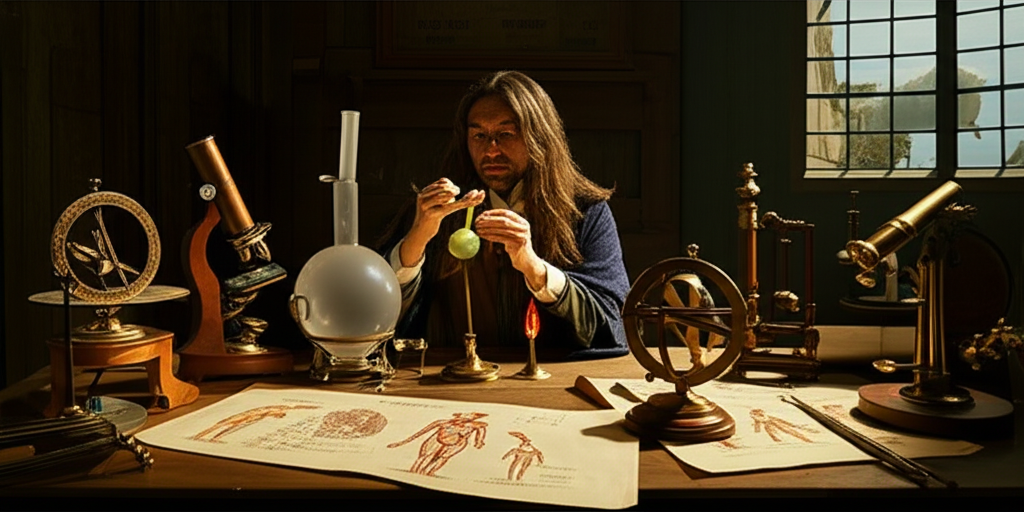
Here, the evolution of knowledge accelerated dramatically:
- Nicolaus Copernicus (1473-1543): Proposed the heliocentric model, challenging the geocentric worldview and fundamentally altering humanity's understanding of its place in the cosmos.
- Galileo Galilei (1564-1642): Pioneered experimental physics and used the telescope to make groundbreaking astronomical observations, demonstrating the power of empirical evidence over dogma.
- Francis Bacon (1561-1626): Championed the inductive method, emphasizing observation and experimentation as the cornerstone of scientific progress. His work was instrumental in formalizing the scientific method.
- René Descartes (1596-1650): His philosophical method of systematic doubt and emphasis on reason ("Cogito, ergo sum") laid foundations for modern rationalism and analytical geometry.
- Isaac Newton (1642-1727): Synthesized the work of his predecessors, formulating laws of motion and universal gravitation, providing a comprehensive mechanistic explanation of the universe that dominated scientific thought for centuries. This was an unprecedented moment of progress in unifying diverse phenomena under a single theoretical framework.
This period fundamentally changed how knowledge was acquired, shifting from reliance on authority and pure reason to systematic observation, experimentation, and mathematical analysis.
The Enlightenment's Luminous Path: Reason, Rights, and Republics
The Enlightenment (18th Century) built upon the scientific revolution, extending the principles of reason and empirical inquiry to human society, politics, and ethics. This era saw immense progress in social and political thought, advocating for individual rights, liberty, and the pursuit of happiness.
Key Enlightenment Contributions:
- Political Philosophy: Thinkers like John Locke, Jean-Jacques Rousseau, and Montesquieu developed theories of natural rights, social contract, and separation of powers, profoundly influencing modern democratic governance.
- Encyclopedic Projects: Denis Diderot's Encyclopédie aimed to compile all human knowledge, making it accessible to a wider public and fostering widespread intellectual progress.
- Economic Theory: Adam Smith's The Wealth of Nations laid the foundation for modern economics, analyzing market forces and the benefits of free trade.
- Critical Philosophy: Immanuel Kant sought to reconcile rationalism and empiricism, exploring the limits and possibilities of human reason and moral autonomy. His work represents a towering achievement in the evolution of philosophical thought.
The Enlightenment emphasized the power of reason to overcome ignorance and superstition, believing that progress in knowledge would inevitably lead to a better, more just society.
The Modern Kaleidoscope of Knowledge: Specialization, Globalization, and Technology
The 19th and 20th centuries witnessed an explosion of specialized knowledge and unprecedented technological progress. The evolution of knowledge became increasingly complex, characterized by:
- Industrial Revolution: Transformed production, communication, and transportation, creating new scientific and engineering challenges and solutions.
- Biological Evolution: Charles Darwin's theory of natural selection revolutionized biology, offering a powerful explanatory framework for the diversity of life.
- Physics Revolutions: Einstein's theories of relativity and quantum mechanics fundamentally reshaped our understanding of space, time, matter, and energy, pushing the boundaries of human knowledge into previously unimaginable realms.
- Social Sciences: The systematic study of human behavior and societies emerged, with figures like Karl Marx, Émile Durkheim, and Max Weber laying the groundwork for sociology, anthropology, and psychology.
- Information Age: The advent of computers and the internet has revolutionized the storage, access, and dissemination of knowledge, leading to an accelerated pace of discovery and global collaboration. The progress of knowledge is now intrinsically linked to technological advancement.
The Mechanisms of Intellectual Progress
The historical progress of human knowledge is not a linear march but a dynamic, often circuitous evolution driven by several recurring mechanisms:
- Accumulation: Building upon previous discoveries and insights.
- Correction and Refutation: Old theories are refined or replaced by new, more accurate ones through critical inquiry and empirical testing.
- Technological Advancement: New tools (telescopes, microscopes, computers) enable new observations and experiments.
- Dissemination: The printing press, libraries, universities, and now the internet facilitate the spread of knowledge across cultures and generations.
- Interdisciplinary Synthesis: Combining insights from different fields to create new understandings (e.g., biophysics, cognitive neuroscience).
- Skepticism and Critical Thinking: A willingness to question assumptions and established beliefs is fundamental to intellectual progress.
The history of knowledge is a testament to humanity's enduring quest for understanding. Each era builds upon the last, refining, challenging, and expanding the boundaries of what is known. This ongoing evolution, fueled by curiosity and critical inquiry, ensures that the progress of human knowledge will continue indefinitely, a truly remarkable journey of the mind.
Key Drivers of Knowledge Evolution
- Curiosity and Wonder: The fundamental human urge to understand the world.
- Problem Solving: Practical necessity driving innovation and discovery.
- Communication: Sharing ideas through language, writing, and technology.
- Institutionalization: Universities, academies, and research centers fostering intellectual communities.
- Cross-Cultural Exchange: The movement of ideas and texts across civilizations.
📹 Related Video: What is Philosophy?
Video by: The School of Life
💡 Want different videos? Search YouTube for: ""The History of Western Philosophy Explained""
📹 Related Video: PLATO ON: The Allegory of the Cave
Video by: The School of Life
💡 Want different videos? Search YouTube for: ""The Scientific Revolution: Crash Course History of Science""