

The Historical Evolution of Government Forms
The journey of human societies is intrinsically linked to the Evolution of their governance. From the rudimentary social structures of prehistory to the complex nation-states of today, the form of Government has undergone continuous Change, shaped by philosophy, necessity, and the enduring quest for order and justice. This article traces the History of these transformations, drawing insights from the foundational texts that have pondered the nature of power and the best way to live together.
The Genesis of Governance: From Tribe to Kingdom
At its most nascent, Government emerged from the need for collective decision-making and defense within small, kinship-based groups. Early human societies, often nomadic hunter-gatherers, likely operated with decentralized authority, where elders or skilled individuals might hold sway through influence rather than formal power.
Early Structures and the Dawn of Authority
As societies settled and agricultural practices developed, the increasing complexity of life—resource management, property disputes, and larger populations—necessitated more structured forms of leadership. This period saw the Evolution of:
- Tribal Councils: Groups of elders or respected members who made decisions for the community.
- Chieftainships: A single leader, often chosen for prowess, wisdom, or spiritual authority, whose power was still largely consensual.
- Early Monarchies: As power became hereditary or based on conquest, the figure of the king or queen emerged, often imbued with divine right or mythical legitimacy. This represented a significant Change towards centralized authority.
These early forms, while varied, laid the groundwork for the more elaborate political systems that would define subsequent eras in History.
Classical Ideals and Practicalities: The Greek Polis and Roman Republic
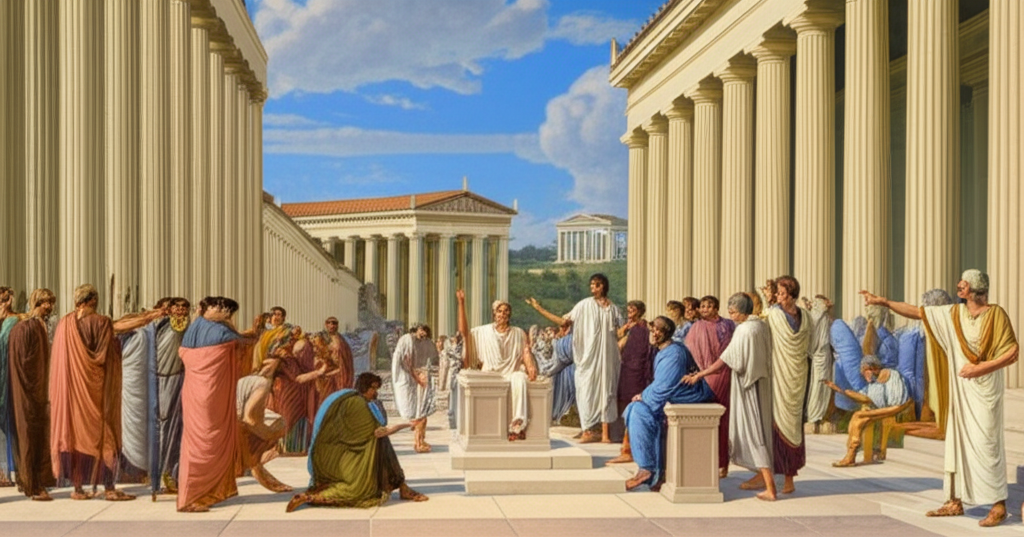
The ancient world, particularly the civilizations of Greece and Rome, provided the first systematic philosophical inquiries into the nature and best forms of Government. Here, the Evolution of political thought truly began to mirror the Change in societal structures.
Plato's Republic and Aristotle's Classifications
In the Greek city-states, or poleis, a dynamic cycle of Change in Government forms was observed. Philosophers like Plato and Aristotle meticulously analyzed these transitions. Plato, in The Republic, explored ideal states and their inevitable decay, describing a progression from aristocracy to timocracy, oligarchy, democracy, and finally tyranny.
Aristotle, in his Politics, offered a more empirical classification, distinguishing between good and corrupt forms based on who holds power and for whose benefit:
| Form of Government | Rule By | For Whose Benefit | Corrupt Form |
|---|---|---|---|
| Monarchy | One | All | Tyranny |
| Aristocracy | Few | All | Oligarchy |
| Polity | Many | All | Democracy |
Note: Aristotle considered "democracy" (rule by the poor majority for their own benefit) a corrupt form, preferring "polity" (rule by the many for the common good).
The Roman Republic, meanwhile, exemplified a mixed constitution, combining elements of monarchy (consuls), aristocracy (Senate), and democracy (assemblies), a structure praised by thinkers like Polybius for its stability and checks on power. This complex system represented a sophisticated Evolution from simpler models.
Medieval Realms and the Feudal System
Following the collapse of the Western Roman Empire, Europe entered a period of decentralized power known as the Middle Ages. Feudalism became the dominant political and economic system, fundamentally altering the nature of Government.
The Fragmentation and Consolidation of Power
Feudalism was characterized by a hierarchical structure where land (fiefs) was granted in exchange for military service and loyalty. Power was highly localized, with kings often holding only nominal authority over powerful nobles. This represented a significant Change from the centralized empires of antiquity.
However, over centuries, a gradual Evolution saw the consolidation of power:
- Rise of Absolute Monarchies: Kings slowly asserted greater control, diminishing the power of the nobility and laying the foundations for modern nation-states.
- Emergence of Legal Systems: The development of common law and legal precedents began to establish more uniform governance.
- Magna Carta (1215): A pivotal document in English History, it limited the power of the monarch and established rights for subjects, marking an important step in the Evolution of constitutional Government.
The Enlightenment and the Birth of Modern States
The Enlightenment era (17th and 18th centuries) brought about a revolutionary Change in political thought, profoundly influencing the Evolution of Government forms. Philosophers questioned the divine right of kings and proposed new theories based on reason, individual rights, and popular sovereignty.
Social Contracts and the Sovereignty of the People
Key thinkers from the Great Books of the Western World tradition articulated ideas that would reshape global governance:
- Thomas Hobbes (Leviathan): Argued that individuals form a social contract to escape the "state of nature" and surrender some freedoms to an absolute sovereign for order and security.
- John Locke (Two Treatises of Government): Posited that Government derives its legitimacy from the consent of the governed and is obligated to protect natural rights (life, liberty, property). If it fails, the people have the right to revolt.
- Jean-Jacques Rousseau (The Social Contract): Emphasized the "general will" and popular sovereignty, suggesting that legitimate Government comes from the direct participation of citizens.
These ideas fueled revolutions in America and France, leading to the establishment of republics and constitutional monarchies, where power was theoretically vested in the people or their representatives, rather than solely in a monarch. This period marked a definitive Evolution towards democratic ideals.
The Democratic Age and Its Discontents
The 19th and 20th centuries witnessed the widespread expansion of democratic Government forms, though not without significant challenges and setbacks. The Evolution continued, adapting to industrialization, global conflicts, and ideological struggles.
From Mass Participation to Global Governance
- Expansion of Suffrage: The right to vote gradually extended beyond property-owning men to include all adult males and, crucially, women, broadening the base of political participation.
- Rise of Parliamentary Democracies: Systems where the executive branch is accountable to the legislative branch became common, exemplified by countries like the United Kingdom and Canada.
- Challenges and Totalitarianism: The 20th century also saw the rise of totalitarian regimes (fascism, communism) that represented a stark Change from democratic principles, concentrating absolute power in the state and suppressing individual liberties.
- Post-War Evolution: Following World War II, there was a renewed emphasis on international cooperation and human rights, leading to the formation of organizations like the United Nations, reflecting an Evolution towards global governance and a recognition of shared responsibilities.
The ongoing Evolution of Government forms continues today, grappling with issues like globalization, technological disruption, and environmental crises, prompting new philosophical debates about the optimal structures for future societies.
The History of Government is a testament to humanity's continuous effort to organize itself, manage power, and strive for a better collective existence. The forms may Change, but the underlying questions—of justice, order, liberty, and authority—remain central to the philosophical inquiry into governance.
📹 Related Video: ARISTOTLE ON: The Nicomachean Ethics
Video by: The School of Life
💡 Want different videos? Search YouTube for: ""Aristotle's Politics explained" or "Social Contract Theory: Hobbes, Locke, Rousseau""