

The Psychological Basis of Emotion: A Philosophical Inquiry
The human experience is undeniably shaped by the tumultuous currents of emotion. Far from being mere fleeting sensations, emotions have, throughout the annals of philosophical thought, been considered fundamental to the very fabric of the mind and the essence of man. This article delves into the rich historical perspectives offered by the Great Books of the Western World, exploring how various philosophers grappled with the origins, nature, and significance of emotion, moving beyond superficial feeling to foundational questions of psychology, ethics, and even physics. From ancient Greek rationalism to early modern mechanism, we trace the evolving understanding of emotion as a core component of human existence.
The Ancient Nexus: Emotion, Reason, and the Soul
For the earliest philosophers, emotion was not merely a biological response but an intricate part of the soul's architecture, intimately tied to reason and the pursuit of the good life. The understanding of emotion was inseparable from the broader understanding of what it means to be human.
Plato's Chariot Allegory: The Soul's Internal Struggle
In Plato's Phaedrus, we encounter one of the most enduring metaphors for the human mind: the chariot allegory. The soul is likened to a charioteer (reason) guiding two winged horses. One horse is noble and spirited (representing righteous anger, courage, and honor—the "thumos"), while the other is unruly and prone to base desires (appetite). Here, emotion is not monolithic but comprises distinct forces within the man. The spirited horse, though emotional, can be guided by reason, while the appetitive horse often pulls towards irrational indulgence. The psychological basis of emotion, for Plato, lies in these distinct parts of the soul, whose harmony or discord determines the individual's character and actions. The goal of philosophy is to train the charioteer (reason) to master these emotional forces, directing them towards truth and virtue.
Aristotle's Doctrine of the Mean: Emotion as Potential for Virtue
Aristotle, in his Nicomachean Ethics, offers a more nuanced view. He acknowledges that emotion is a natural and necessary part of human life. For Aristotle, to be without emotions would be to be less than human. The psychological basis is not to suppress emotions, but to experience them at the right time, towards the right objects, towards the right people, for the right reason, and in the right manner – this is the "golden mean." Anger, for instance, is not inherently bad; it is the excess or deficiency of anger that constitutes a vice. Emotions, therefore, are not merely raw feelings but are amenable to reason and essential for moral action. A virtuous man is one who has cultivated his emotional responses to be appropriate and proportionate.
The Dawn of Modernity: Mechanism, Dualism, and the Passions
With the advent of the scientific revolution, philosophical inquiry into emotion began to shift, incorporating mechanistic views of the body and dualistic perspectives on the mind.
Descartes and the Passions of the Soul: A Mechanical Body, a Thinking Mind
René Descartes, in The Passions of the Soul, famously articulated a dualistic understanding where the immaterial mind (or soul) interacts with the material body. For Descartes, passions are primarily perceptions, sensations, or commotions of the soul that are referred to it by the body. They are involuntary movements of the animal spirits (subtle particles flowing through the nerves) that affect the soul. The psychological basis here begins to touch upon physics, as emotions are explained through the mechanical operations of the body, particularly the brain and nerves. While the soul is rational, it can be overwhelmed by these bodily commotions, leading to confusion or irrational actions. The challenge for man is to use reason to understand and regulate these passions, preventing them from dominating the will.
Spinoza's Geometric Ethics: Emotion as Natural Law
Baruch Spinoza, in his Ethics, presents a radical departure, viewing emotion (or "affects") not as something separate from reason, but as natural phenomena arising from the very essence of human existence. For Spinoza, everything in nature, including the human mind and its affects, follows deterministic laws, akin to the laws of physics. Emotions are modifications of the body and the mind, increasing or diminishing our power of acting. The psychological basis is thus integrated into a monistic system where mind and body are two attributes of the same underlying substance. By understanding the necessary causes of our emotions, Spinoza argues, man can move from passive suffering to active understanding and freedom. To know one's emotions is to understand the natural laws governing them, thereby liberating the mind from their tyrannical sway.
The Empirical Turn: Experience, Association, and the Nature of Feeling
The British empiricists further refined the understanding of emotion, grounding it in sensory experience and the association of ideas.
Hume on Sentiment and Reason: The Primacy of Passion
David Hume, in A Treatise of Human Nature, famously declared that "Reason is, and ought only to be the slave of the passions, and can never pretend to any other office than to serve and obey them." This bold statement underscores Hume's view that emotion (or sentiment) is the primary motivator of human action, with reason serving merely to discover the most effective means to achieve the ends set by our desires and aversions. The psychological basis of emotion here is rooted in impressions and ideas, where passions are vivid impressions of reflection. For Hume, morality itself is founded on sentiment rather than abstract reason. The actions of man, therefore, are ultimately driven by feeling, and reason's role is pragmatic – to guide us efficiently towards what our emotions deem desirable.
The Enduring Philosophical Challenge: Integrating Emotion into the Self
The journey through the Great Books of the Western World reveals a profound and evolving philosophical engagement with emotion. From being a force to be tamed by reason to a natural phenomenon to be understood, and even a primary driver of human action, emotion remains central to the question of what it means to be man. These historical perspectives continue to inform contemporary discussions in philosophy of mind and psychology, highlighting the complex interplay between our rational faculties and our affective experiences.
| Philosopher | Core View on Emotion | Relation to Reason/Mind | Role in Human Life |
|---|---|---|---|
| Plato | Part of the tripartite soul (spirited & appetitive) | Needs to be guided and controlled by Reason | Source of motivation; potential for virtue or vice |
| Aristotle | Natural human faculty; potential for virtue or vice | Subject to rational assessment for appropriateness | Essential for moral action; requires moderation |
| Descartes | Passions of the soul; mechanical bodily reactions | Interact with the immaterial mind; can mislead | Guides action; requires rational control for freedom |
| Spinoza | Affects (modifications of body & mind); natural laws | Can be understood and governed by Reason | Drives behavior; understanding them leads to freedom |
| Hume | Sentiments; impressions of reflection | Reason is "slave of the passions"; secondary role | Primary motivator of human action and morality |
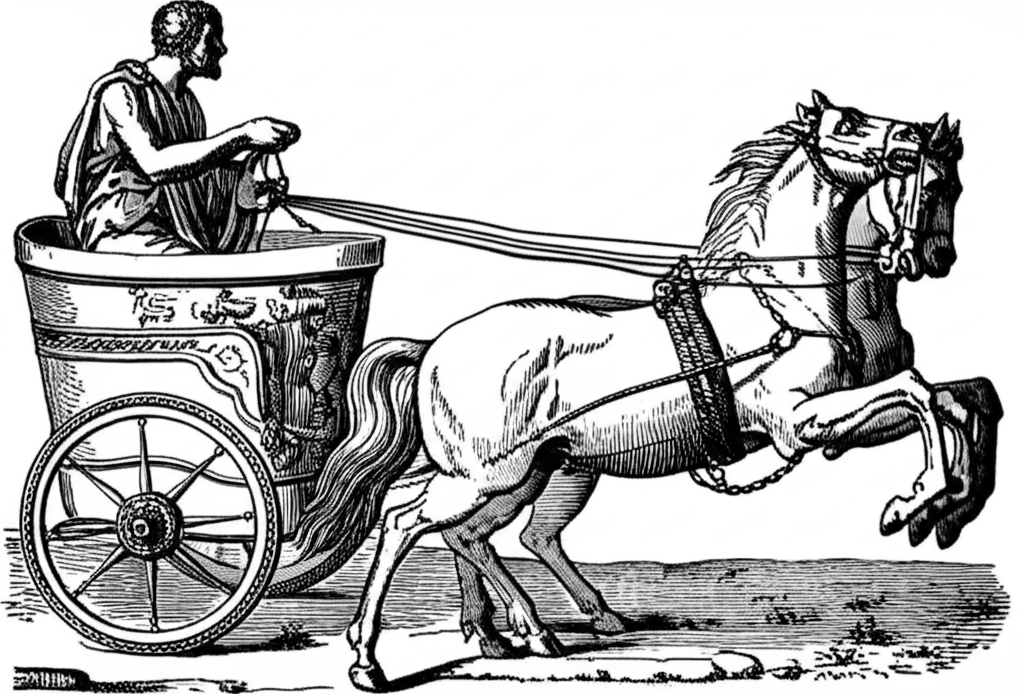 struggling to control two horses – one noble and white (representing Spirit/Thumos) and one unruly and dark (representing Appetite/Desire) – as they pull a chariot across a celestial landscape, symbolizing the soul's journey and its internal conflict.)
Conclusion: Emotion as the Fabric of Experience
The philosophical inquiry into the psychological basis of emotion demonstrates its enduring significance. It challenges us to look beyond simplistic definitions and to appreciate the intricate ways in which our feelings are woven into our perception, our morality, and our very being. Whether seen as a disturbance of the mind to be overcome, a natural phenomenon to be understood through the lens of physics, or the very wellspring of human motivation, emotion remains a cornerstone of what it means to be man, continually inviting deeper reflection and philosophical exploration.
📹 Related Video: PLATO ON: The Allegory of the Cave
Video by: The School of Life
💡 Want different videos? Search YouTube for: "Plato Chariot Allegory Explained"
📹 Related Video: ARISTOTLE ON: The Nicomachean Ethics
Video by: The School of Life
💡 Want different videos? Search YouTube for: "Spinoza Ethics Emotion"