

Navigating the Labyrinth of Existence: The Experience of Time and Space
The human encounter with reality is fundamentally shaped by two inescapable dimensions: time and space. Yet, our experience of these fundamental concepts is far from a simple, objective measurement. This article delves into how we sense, perceive, and ultimately construct our understanding of time and space, moving beyond their scientific definitions to explore their profound philosophical implications for our consciousness, memory, and very being. Drawing insights from the rich tapestry of thought found in the Great Books of the Western World, we will uncover the subjective, dynamic, and often paradoxical nature of our temporal and spatial existence.
The Subjectivity of Temporal Experience: A Flow Felt Within
While clocks meticulously tick away objective seconds, minutes, and hours, our experience of time often defies such rigid quantification. We all know the phenomenon: moments of intense joy or focus seem to vanish in an instant, while periods of boredom or anticipation stretch interminably. This discrepancy highlights that our sense of time is deeply personal and inextricably linked to our consciousness and emotional state.
Consider the profound reflections of St. Augustine in his Confessions (a cornerstone of the Great Books collection). He grappled with the very nature of time, famously asking, "What then is time? If no one asks me, I know; if I wish to explain it to one who asks, I know not." Augustine concluded that time exists primarily in the mind, as a "distension" – a stretching out of memory, attention, and expectation. The past is present in memory, the future in expectation, and the present is merely a fleeting transition.
Our Experience of Time is Influenced By:
- Emotional State: Joy accelerates it, sorrow decelerates it.
- Focus and Engagement: Deep concentration makes it fly; boredom makes it drag.
- Memory and Anticipation: Our past informs our present, and our future expectations shape our current sense of duration.
- Age: As we age, a year can feel shorter due to a larger proportion of our lived experience.
This inherent subjectivity reveals that time is not just a container for events, but an integral part of our inner landscape. Our experience of time is not merely in us, but is us, in a very real sense.
Spatial Perception and Embodiment: Grounding Our Being
Just as our experience of time is subjective, so too is our sense of space. While physics defines space as a three-dimensional continuum, our lived experience of it is always from a particular vantage point, intimately tied to our physical bodies and our capacity for movement. We don't just exist in space; we are of space, our bodies serving as the primary anchors for spatial orientation and interaction.
Immanuel Kant, another titan of the Great Books, argued in his Critique of Pure Reason that space (and time) are not properties of things-in-themselves, but rather a priori forms of intuition, inherent structures of the mind through which we experience the world. We cannot conceive of objects outside of space, nor can we imagine space without objects; it is the very framework that makes perception possible. Our sense of near and far, up and down, left and right, is always relative to our embodied self.
Table: Objective vs. Subjective Spatial Attributes
| Aspect | Objective (Scientific) | Subjective (Experienced) |
|---|---|---|
| Measurement | Standardized units (meters, kilometers) | Relative to body scale (arm's length, a day's journey) |
| Direction | Absolute coordinates (North, South, East, West) | Egocentric (my left, your right, ahead of me) |
| Distance | Fixed numerical value | Perceived effort to traverse, emotional significance of proximity |
| Shape/Form | Geometric properties (Euclidean) | How an object feels, its usability, its aesthetic appeal |
| Meaning | Neutral, quantifiable | Infused with personal history, memory, and emotion (e.g., "home") |
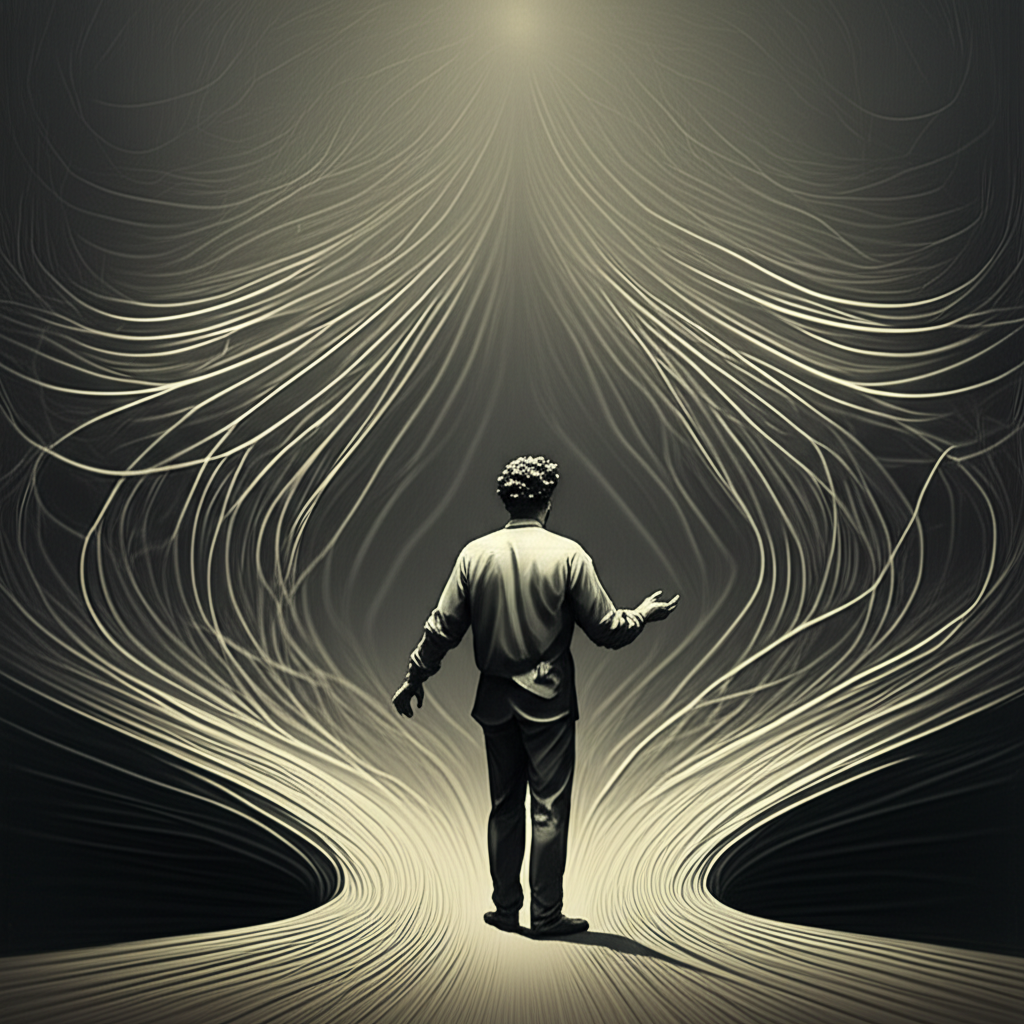
The Intertwined Dance: Time, Space, and Consciousness
The experience of time and space is not neatly compartmentalized; they are profoundly intertwined within our consciousness. Our memories, for instance, are not just recordings of past events but are often spatially located ("I remember that place where...") and temporally sequenced ("It happened before..."). Similarly, our navigation through space is guided by an implicit understanding of the time it will take to traverse it.
Aristotle, in his Physics, explored the relationship between motion, place, and time. He saw time as the "number of motion with respect to 'before' and 'after'," emphasizing its relational aspect. For Aristotle, space (place) was the inner boundary of the containing body, and motion was the actualization of potential. This classical perspective, foundational in the Great Books, highlights how philosophers have long understood that our sense of movement through space is inextricable from our experience of time passing.
Our consciousness acts as the orchestrator, weaving these dimensions into a coherent narrative of existence. We constantly project ourselves into future spaces (planning a trip) and mentally revisit past spaces (recalling a childhood home), all within the dynamic framework of our lived experience. The very act of sensing and interpreting the world around us is a continuous process of temporal and spatial synthesis.
Conclusion: The Profound Architecture of Our Reality
The philosophical inquiry into the experience of time and space reveals that these are not merely objective backdrops against which life unfolds. Instead, they are deeply subjective, fluid, and profoundly shaped by our consciousness, emotions, and embodiment. From Augustine's struggle with the nature of time to Kant's a priori intuitions of space, the Great Books of the Western World consistently remind us that our sense of reality is an active construction, not a passive reception. To truly understand our place in the cosmos, we must first understand the intricate, personal architecture of our own temporal and spatial experience.
📹 Related Video: What is Philosophy?
Video by: The School of Life
💡 Want different videos? Search YouTube for: ""Augustine on Time Philosophy Explained""
📹 Related Video: KANT ON: What is Enlightenment?
Video by: The School of Life
💡 Want different videos? Search YouTube for: ""Kant's Philosophy of Space and Time Summary""