

The Eternal Conundrum: Navigating the Ethical Labyrinth of Immortality
The human yearning for immortality is as old as our consciousness of death itself. From ancient myths of gods and heroes to modern scientific pursuits of life extension, the dream of an endless existence has captivated our imaginations. Yet, beneath the allure of escaping finitude lies a profound ethical dilemma. Immortality, often perceived as the ultimate good, presents a complex web of moral, social, and existential challenges that compel us to re-evaluate our very understanding of Life and Death, purpose, and the essence of the Soul. This article delves into these intricate questions, exploring why an eternal lifespan might be a burden rather than a blessing.
The Allure and Anxiety of Endless Life
For millennia, philosophers, theologians, and poets have grappled with the concept of living forever. Is it a divine reward, a scientific triumph, or a curse? The desire to transcend our mortal limits is deeply ingrained, fueled by fears of oblivion and the wish to preserve cherished experiences and relationships. However, the true implications of such a leap—moving beyond the natural cycle of Life and Death—are rarely fully considered in their staggering complexity. What happens to a society, to an individual, when the finality that gives shape and urgency to our choices is removed?
Redefining Existence: The Philosophical Dimensions of Immortality
When we speak of immortality, we must first clarify its nature. Are we imagining a physical body immune to decay, a consciousness uploaded to a digital realm, or the traditional spiritual concept of an undying Soul? Each form presents unique challenges, yet all fundamentally alter the human condition.
- Physical Immortality: A body that never ages, never sickens, never dies.
- Digital Immortality: Consciousness existing as data, perhaps in a simulated environment.
- Spiritual Immortality: The enduring nature of the Soul beyond the physical body, a concept deeply explored in works like Plato's Phaedo and Aquinas's Summa Theologica, where the soul's imperishability is tied to its non-material nature and its capacity for reason.
Regardless of its form, the cessation of Life and Death as we know it would necessitate a complete re-evaluation of our values, our laws, and our very definition of what it means to be human.
The Ethical Quandaries of an Endless Existence
The pursuit of immortality, while promising liberation from our greatest fear, opens a Pandora's Box of ethical dilemmas.
| Ethical Dilemma | Description |
|---|---|
| Resource Scarcity & Overpopulation | An ever-growing, non-dying population would place unimaginable strain on Earth's finite resources. Food, water, space—all would become critical points of conflict, leading to potentially draconian measures to control birth rates or access to immortality itself. The Malthusian trap, once a theoretical concern, would become an existential crisis. |
| Social & Economic Inequality | Who would gain access to immortality? It is highly probable that such a technology, if developed, would initially be prohibitively expensive, creating an unbridgeable chasm between the "deathless" elite and the mortal masses. This would exacerbate existing inequalities, leading to unprecedented social stratification and resentment, fundamentally challenging our notions of justice and human rights. |
| The Diminished Value of Life | Does life lose its preciousness without the shadow of death? The urgency to live fully, to love deeply, to strive for meaning often stems from the finite nature of our time. If every moment stretches into infinity, does boredom set in? Does the drive for self-improvement wane? The very concept of heroism or sacrifice might become meaningless if death is no longer a factor. |
| Psychological & Existential Burden | Imagine experiencing millennia. The sheer accumulation of memories, the potential for overwhelming boredom, the loss of purpose. Would an immortal being cease to grow, becoming stagnant, or perhaps even psychologically broken by the endless parade of events and the inevitable loss of countless mortal loved ones? Nietzsche, in his contemplation of eternal recurrence, touched upon the crushing weight of endless repetition. |
| Stagnation of Progress | Death, in a grim but vital way, clears the path for new ideas, new generations, and new perspectives. Without it, would societies become rigid, resistant to change, dominated by ancient viewpoints that refuse to yield? Innovation and societal evolution might grind to a halt. |
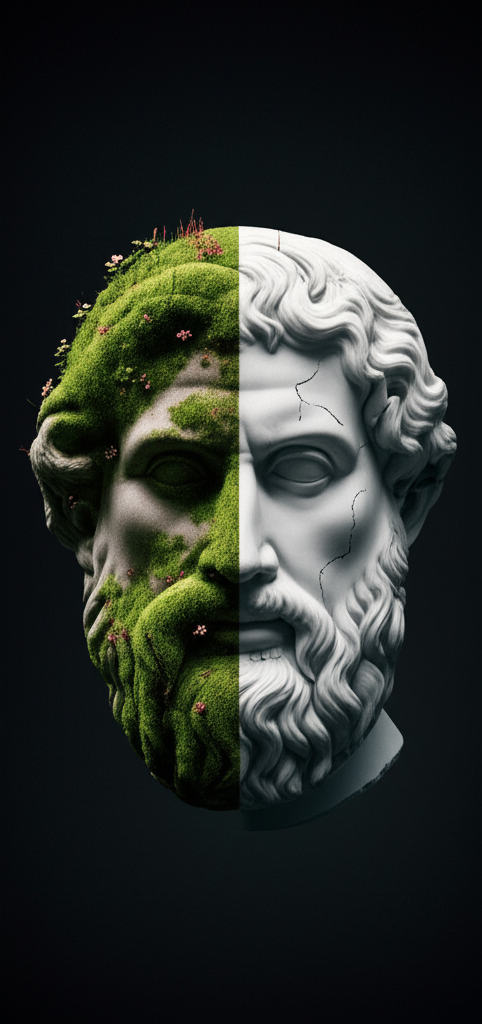
The Human Condition and the Immortal Soul
Many of the Great Books of the Western World explore the human condition through the lens of our mortality. Aristotle, in his Nicomachean Ethics, discusses the pursuit of eudaimonia (flourishing) within the context of a finite life, where virtues are cultivated through choices made under the pressure of time. Augustine, in Confessions, grapples with the brevity of earthly life in contrast to eternal spiritual life, but the latter is a state of grace, not a mere extension of physical existence.
If we remove the natural cycle of Life and Death, what happens to the Soul? Is it capable of infinite growth, or does it reach a point of saturation? Does the very concept of a "good life" or a "meaningful existence" depend on its finite boundaries? The courage to face mortality, the compassion born from shared vulnerability, the drive to leave a legacy – these profound aspects of human experience are inextricably linked to our awareness of an end. To eliminate death is to fundamentally alter the crucible in which our humanity is forged.
Conclusion: An Ethical Crossroads
The dream of immortality, while deeply seductive, demands rigorous ethical scrutiny. It forces us to confront not just the practicalities of an endless existence, but the very philosophical foundations of what it means to live, to suffer, to love, and to grow. Far from being a simple boon, true immortality would represent an unprecedented transformation of the human condition, one fraught with moral hazards and existential dilemmas that could shatter our societies and redefine the very essence of the Soul. As we stand on the precipice of potentially radical life extension technologies, it is imperative that we engage in a profound and ongoing dialogue about the ethical costs and benefits, lest we inadvertently condemn ourselves to an eternity we never truly understood.
📹 Related Video: ARISTOTLE ON: The Nicomachean Ethics
Video by: The School of Life
💡 Want different videos? Search YouTube for: ""Philosophical implications of immortality""
📹 Related Video: ARISTOTLE ON: The Nicomachean Ethics
Video by: The School of Life
💡 Want different videos? Search YouTube for: ""Ethics of life extension and transhumanism""