

The Essence of Courage in Battle: A Philosophical Inquiry
The battlefield, with its stark realities of life and death, has long served as a crucible for human character. Within this intense theater, the concept of courage emerges not as a simple absence of fear, but as a profound philosophical subject, a complex interplay of emotion, reason, and moral choice. Drawing upon the rich tapestry of the Great Books of the Western World, we delve into what truly constitutes courage in combat, distinguishing it from mere recklessness or instinct, and examining its enduring status as a cardinal virtue in the face of the ultimate human conflict: war and peace. This article explores the nuanced nature of battlefield valor, its psychological underpinnings, and its ethical dimensions, asserting that true courage is a deliberate act of will, guided by reason, even when confronted by overwhelming terror.
Defining Courage Beyond Mere Absence of Fear
To speak of courage in battle is to immediately confront its elusive definition. Is it the warrior who charges heedlessly into danger, or the one who trembles yet holds their ground? Philosophy, from antiquity, has sought to clarify this distinction.
Courage as a Deliberate Act
Aristotle, in his Nicomachean Ethics, provides a foundational understanding. For him, courage is not a universal fearlessness, but rather a mean between the excess of rashness and the deficiency of cowardice. The truly courageous person, the magnanimous soul, experiences fear, as is natural and rational, but acts appropriately despite it. They understand the danger but choose to face it for a noble cause. This is a crucial philosophical insight:
- Rationality: Courage involves a reasoned assessment of danger and a deliberate choice to act. It is not an impulsive, thoughtless charge.
- Purpose: The courageous act is undertaken for a worthy end – the defense of one's polis, comrades, or principles.
- Endurance: It signifies the capacity to endure terrifying things for the sake of what is noble.
Consider the heroes of Homer's Iliad – figures like Hector and Achilles. While their prowess is undeniable, their struggles with fear, honor, and duty illustrate the complex psychological landscape of courage. Hector, knowing his fate, chooses to face Achilles for the sake of Troy, embodying a profound, almost tragic, form of courage.
The Role of Emotion in Valor
The interplay between courage and emotion is central to its philosophical understanding. Fear is the primary emotion against which courage is measured. Plato, in his Republic, likens the soul to a charioteer (reason) guiding two horses: one noble (spirit/thumos) and one unruly (appetite). Courage, in this analogy, is the spirit's steadfastness in upholding the convictions of reason, even under threat.
This isn't to say that emotions like anger or hope play no part. A warrior's righteous anger can fuel their resolve, and hope for victory can sustain them. However, if these emotions override reason, leading to reckless behavior, they cease to be courage and descend into rashness. True courage demands mastery over these internal states, allowing reason to dictate action.
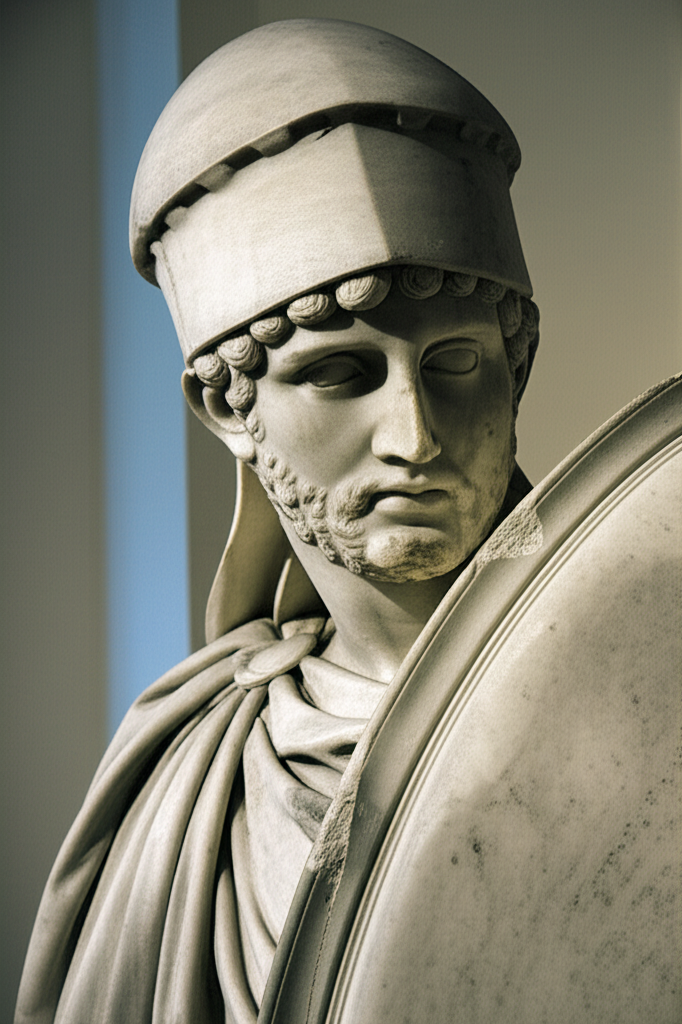
The Battlefield as a Crucible for Virtue
The extreme conditions of battle strip away superficialities, revealing the core of human character. It is here that courage is most acutely tested and, if present, forged into a profound virtue.
Courage as a Cardinal Virtue
Among the cardinal virtues identified by ancient Greek philosophers – wisdom, justice, temperance, and courage – courage holds a unique place, particularly in the context of civic life and defense. For Plato, a state exhibits courage when its guardian class preserves its convictions about what is to be feared and not feared. This extends beyond physical bravery to a steadfastness of moral conviction.
| Philosophical Perspective on Courage | Key Characteristics | Contrast with Vice |
|---|---|---|
| Plato (Republic) | Steadfastness of conviction; preservation of right beliefs about what is terrible and what is not. | Cowardice (failing to preserve conviction), Rashness (misjudging what is terrible). |
| Aristotle (Nicomachean Ethics) | A mean between rashness and cowardice; acting rightly despite fear for a noble cause. | Cowardice (excessive fear, flight), Rashness (insufficient fear, reckless action). |
| Stoicism (e.g., Seneca) | Endurance of hardship; internal fortitude; confronting fate with equanimity. | Passion (being overcome by fear or desire), Weakness of will. |
| Christian Thought (e.g., Augustine) | Moral fortitude; enduring suffering for faith or justice; spiritual bravery. | Despair, Moral laxity. |
The battlefield, therefore, becomes a proving ground for this virtue. It is where one's commitment to principles, to comrades, and to self-preservation is balanced against an overwhelming threat. The vice of cowardice, the failure to act when action is required, or the vice of rashness, acting without due consideration, are exposed in their starkest forms.
The Paradox of Fear and Action
The most profound aspect of courage in battle is its paradoxical relationship with fear. It is not the absence of fear, but the mastery of it. Thucydides, in his History of the Peloponnesian War, recounts countless instances where soldiers, though terrified, performed extraordinary feats. Their courage was not born of ignorance of danger, but of a conscious decision to overcome their natural instinct for self-preservation for a greater good.
This is the essence of battlefield courage: the deliberate choice to confront the most terrifying aspects of human existence – injury, death, the loss of loved ones – and to act decisively. It is a testament to the human spirit's capacity for agency even in the face of overwhelming odds.
Courage, War, and Peace: A Broader Perspective
While our focus has been on the battlefield, the philosophical insights into courage extend far beyond the immediate context of armed conflict, touching upon the broader themes of war and peace.
Beyond Physical Bravery
The lessons learned about courage in battle often inform our understanding of "civil courage" or "moral courage." The decision to speak truth to power, to uphold justice in the face of social pressure, or to endure personal hardship for a cause – these are all manifestations of courage, albeit without the immediate threat of physical harm. The discipline of mind and will required to face a charging enemy finds echoes in the steadfastness required to navigate the moral complexities of peace.
The Philosophical Weight of Sacrifice
The ultimate act of courage in battle is often self-sacrifice. Philosophers have long grappled with its meaning and value. Is it a rational act? Is it always noble? For thinkers like Augustine, while lamenting the necessity of war, recognized that brave acts, even unto death, could be virtuous if undertaken in a just cause, representing a profound commitment to one's community or faith. The willingness to lay down one's life speaks to a courage that transcends mere self-preservation, touching upon deeper questions of purpose, duty, and immortality. Tolstoy's War and Peace, though a novel, offers profound philosophical insights into the internal struggles of individuals caught in the machinery of war, highlighting how true courage often lies in quiet endurance and moral integrity amidst chaos.
Conclusion
The essence of courage in battle, as illuminated by the Great Books of the Western World, is far from a simple, brute force. It is a nuanced philosophical concept, deeply intertwined with emotion, reason, and moral conviction. It is the conscious, deliberate choice to act despite profound fear, to uphold a noble purpose, and to embody a profound virtue in the most challenging of human circumstances. From Aristotle's careful distinctions to Plato's psychological insights, and the historical accounts of human endurance during war and peace, courage emerges as a testament to the strength of the human will, a beacon of rational steadfastness against the tides of chaos and fear. It is, ultimately, a profound expression of what it means to be human, facing the abyss with unwavering resolve.
YouTube Video Suggestions:
-
📹 Related Video: ARISTOTLE ON: The Nicomachean Ethics
Video by: The School of Life
💡 Want different videos? Search YouTube for: "Aristotle Nicomachean Ethics Courage Explained"
2. ## 📹 Related Video: PLATO ON: The Allegory of the Cave
Video by: The School of Life
💡 Want different videos? Search YouTube for: "Plato Republic Courage Virtue Philosophy"