

The Primal Element: Water in Ancient Cosmology
In the annals of ancient philosophy, few concepts held as much foundational significance as the idea of a primary element from which all existence sprung. Among the earliest and most influential propositions was the assertion of water as this fundamental substance, a notion that profoundly shaped early understandings of the world, nature, and the very physics of reality. This article explores the pervasive role of water in ancient cosmology, from its status as the primordial arche to its symbolic resonance across diverse philosophical traditions.
Thales of Miletus: Water as the Universal Arche
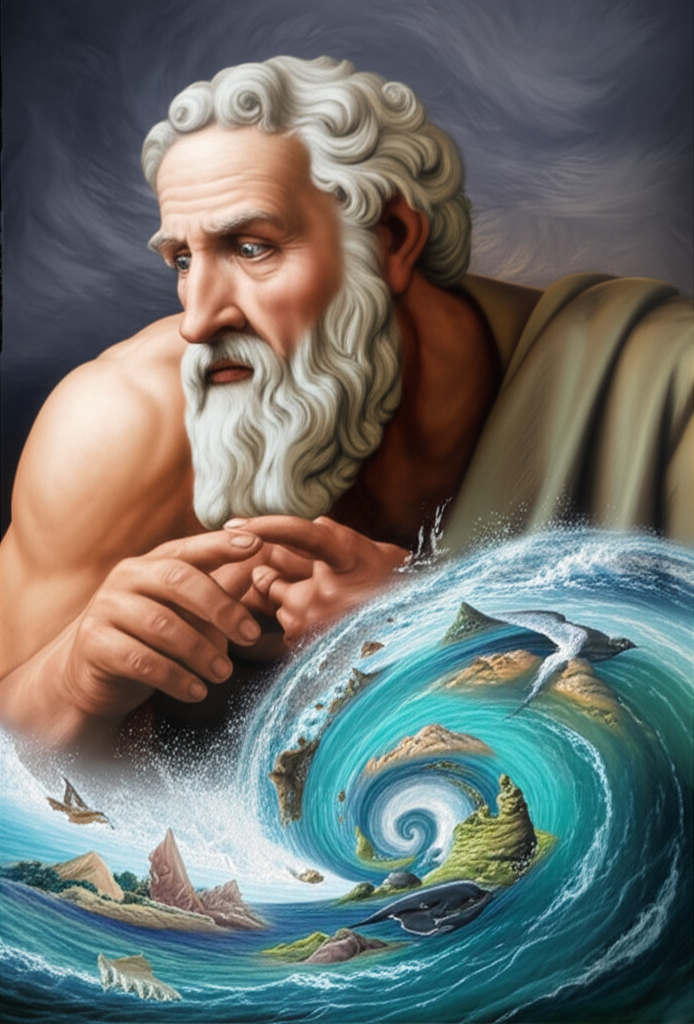
The earliest known philosopher of the Western tradition, Thales of Miletus (c. 624 – c. 546 BCE), famously declared water to be the fundamental element of all things. This bold assertion, chronicled by Aristotle in his Metaphysics, marked a pivotal shift from mythological explanations to a more rational, albeit still nascent, form of scientific inquiry.
Thales's Rationale for Water:
Thales observed the ubiquitous presence and vital importance of water in the world around him. His reasoning likely stemmed from several key observations:
- Nourishment and Life: All life, both plant and animal, requires water to survive and thrive. Seeds, the very essence of future life, are inherently moist.
- Ubiquity: Water is found everywhere – in the sea, in rain, within living organisms, and even in the earth itself (as moisture).
- States of Matter: Water exhibits the ability to transform into different states: liquid, solid (ice), and gas (vapor/mist). This fluidity and capacity for change might have suggested its potential to form all other substances.
- Earth Floats on Water: Thales is also said to have believed that the world itself floated on water, much like a ship, implying water as the ultimate substratum.
For Thales, water was not merely an ingredient but the arche – the origin, the underlying principle, and the constant substratum that persists through all change. It was the material cause of the world, the very essence of nature.
Beyond Thales: Water's Enduring Influence
While later pre-Socratic philosophers proposed other primary elements (Anaximenes with air, Heraclitus with fire, Anaximander with the apeiron), water retained a significant, often indispensable, role in their cosmologies.
- Heraclitus and Flux: Though fire was his primary element, Heraclitus’s famous doctrine of universal flux – "You cannot step into the same river twice" – implicitly highlights water's nature of constant change and flow, mirroring the ever-changing world. Water became a powerful metaphor for the ceaseless transformation inherent in nature.
- Empedocles and the Four Elements: Empedocles (c. 494 – c. 434 BCE) synthesized these earlier ideas by positing four fundamental elements: Earth, Air, Fire, and Water. These four, eternal and unchangeable, were mixed and separated by the cosmic forces of Love and Strife to create the diverse forms of the world. In this schema, water was an irreducible component, essential to the physics of all composite beings.
- Plato and the Timaeus: In Plato's Timaeus, water is assigned the geometric form of the icosahedron, one of the five Platonic solids, linking its physics to ideal mathematical structures. This further solidified its status as a fundamental building block of the cosmos.
- Aristotle's Four Causes: Aristotle, while critiquing the reductionism of earlier thinkers, still recognized water as one of the four terrestrial elements, characterized by the qualities of coldness and wetness. It played a crucial role in his understanding of generation and corruption in the sublunary world.
Water in Creation Myths and Metaphysics
Beyond its role as a physical element, water also held profound metaphysical and symbolic significance in ancient cosmologies, often predating philosophical inquiry.
- Primordial Waters: Many creation myths across diverse cultures describe a state of primordial waters or a cosmic ocean from which the world emerged. This "abyss" or "chaos" often represented the undifferentiated potential before creation, with water as its primary manifestation.
- Purity and Renewal: The life-giving and cleansing properties of water naturally lent themselves to rituals of purification and rebirth. Its association with fertility and regeneration underscored its vital role in the cycles of nature.
- Boundary and Passage: Water bodies like rivers and oceans often symbolized boundaries between different realms (e.g., the living and the dead) or passages to other worlds, as seen in myths like the river Styx.
📹 Related Video: PLATO ON: The Allegory of the Cave
Video by: The School of Life
💡 Want different videos? Search YouTube for: ""Thales of Miletus water fundamental element""
📹 Related Video: PLATO ON: The Allegory of the Cave
Video by: The School of Life
💡 Want different videos? Search YouTube for: ""Ancient Greek cosmology four elements""
The Enduring Legacy: Water and the Human World
The ancient philosophical engagement with water as a fundamental element was more than just an early attempt at physics; it was a profound contemplation of the origins and nature of the world itself. It reflected a deep observation of nature and an attempt to find order and unity in the bewildering diversity of phenomena.
The questions posed by Thales and his successors – What is the fundamental stuff of reality? How does change occur? What holds the cosmos together? – continue to resonate in contemporary philosophy and science. While modern physics has moved far beyond the concept of water as a primary element, the spirit of inquiry initiated by these ancient thinkers, their quest to understand the world through observation and reason, remains a cornerstone of intellectual endeavor. Water, in its fluidity and life-giving essence, continues to be a potent symbol of change, sustenance, and the enduring mysteries of nature.