

The Primordial Flow: Water as the Foundation of Ancient Cosmic Thought
Summary:
In the annals of ancient philosophy, water emerges not merely as a vital liquid but as a profound Element, often posited as the fundamental substance from which all existence springs. This article delves into how early thinkers, particularly those in the pre-Socratic era, grappled with water's unique Physics to construct their understanding of the World and the very Nature of reality, establishing it as a cornerstone of their cosmologies and metaphysical inquiries.
Introduction:
From the misty origins of philosophical inquiry, humanity has sought to understand the fundamental building blocks of the World. Before complex scientific instruments, observation of the natural World was the primary tool for discerning order from chaos. Among the earliest and most compelling candidates for a universal principle was water. Not simply a substance for quenching thirst or sustaining life, water, in the eyes of ancient cosmologists, held a deeper, more profound significance. It was seen as the arche, the primary Element from which everything else derived, shaping early ideas about the Physics of existence and the very Nature of the cosmos.
The Thalian Hypothesis: Water as the Arche
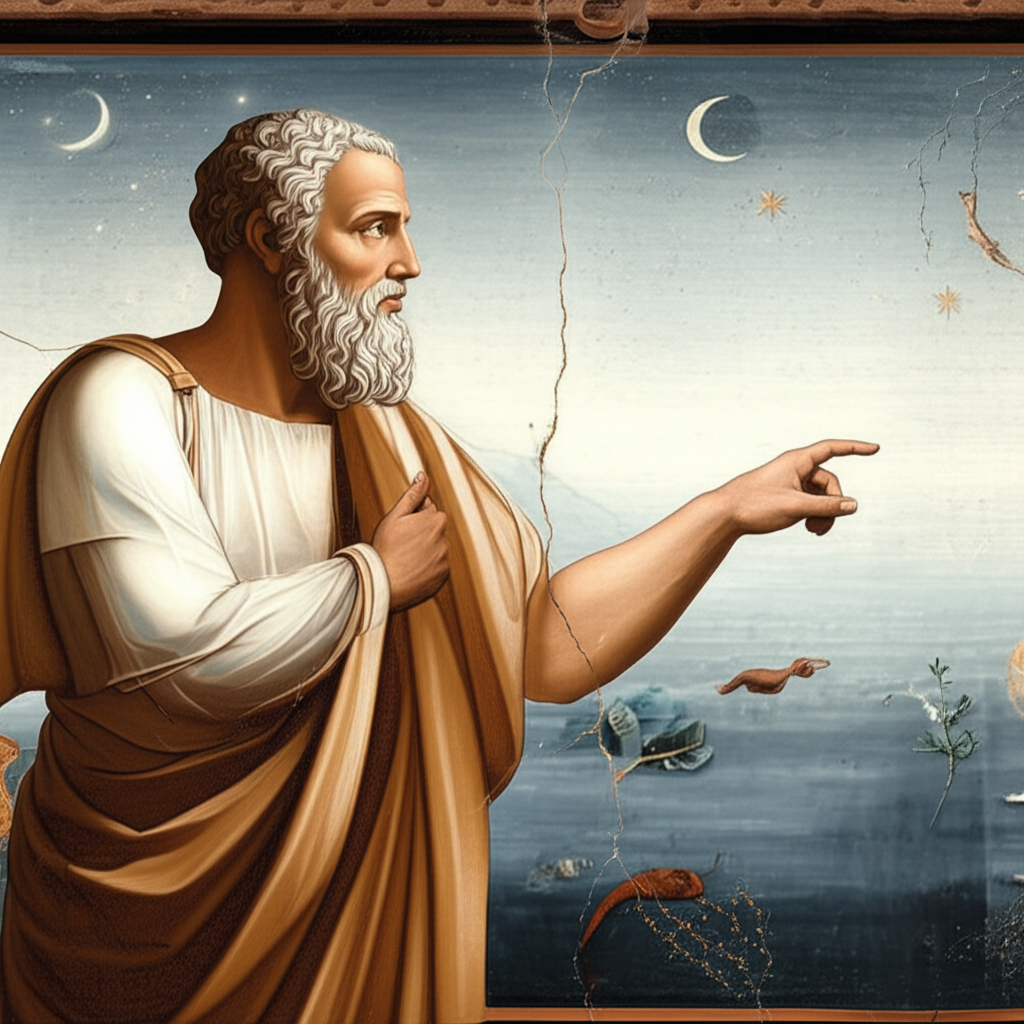
Perhaps the most famous proponent of water's elemental supremacy was Thales of Miletus, considered by many to be the first philosopher. As recounted in the "Great Books of the Western World" through the writings of Aristotle, Thales famously asserted that water is the arche, the originating principle of all things.
- Observation and Inference: Thales observed that moisture is essential for life, that heat itself seems to derive from moisture, and that the seeds of all things are moist. He saw the earth resting upon water, suggesting a foundational role.
- A Unified World: This bold assertion was a monumental leap in thought, moving beyond mythological explanations to seek a single, naturalistic explanation for the diversity of the World. It was an early attempt at Physics, seeking to understand the material Nature of reality.
Beyond Simple Substance: Water's Multifaceted Nature
While Thales laid the groundwork, other pre-Socratic philosophers elaborated on or challenged water's role, yet its importance remained undeniable.
- Anaximenes and the Cycle of Change: While Anaximenes proposed air as the primary Element, he acknowledged water's crucial place in the cosmic cycle. Air, through processes of rarefaction and condensation, could transform into fire, wind, clouds, water, earth, and stone. Here, water is not just a static substance but a dynamic stage in the transformation of matter, revealing its mutable Nature.
- Heraclitus and Perpetual Flux: For Heraclitus, famous for his doctrine of "everything flows," water served as a powerful metaphor for the constant change that defines existence. While fire was his primary Element of change, the very imagery of a river (you cannot step into the same river twice) is intrinsically linked to water's ceaseless motion and transformation, underscoring the dynamic Nature of reality.
- Empedocles' Four Roots: Later, Empedocles introduced the concept of four "roots" or Elements: earth, air, fire, and water. These four, driven by the cosmic forces of Love and Strife, mingled and separated to form all substances in the World. Here, water takes its place as one of the four irreducible components, crucial for the formation and dissolution of all things.
Cosmological Implications and the World's Structure:
The belief in water as a primary Element had profound implications for ancient cosmologies.
| Philosophical Concept | Role of Water |
|---|---|
| Origin of Life | Seen as the source of all living things, from which life first emerged. |
| Stability of the World | Earth was often thought to float on a boundless ocean, providing stability. |
| Cycles of Nature | Essential for atmospheric phenomena (rain, clouds) and seasonal changes. |
| Boundary and Sustenance | The oceans formed the outer boundaries of the known World and provided sustenance. |
Plato and Aristotle: Refining the Element Concept
Plato, in his Timaeus, assigned geometric forms to the four Elements, with water corresponding to the icosahedron, reflecting its fluidity and ease of movement. Aristotle, in his Physics and On Generation and Corruption, systematized the theory of the four Elements, describing them in terms of fundamental qualities: hot, cold, wet, and dry. Water was characterized as fundamentally cold and wet. This categorization provided a more sophisticated framework for understanding the interactions and transformations of matter, moving the discussion of Element from simple observation to a more rigorous philosophical Physics.
Conclusion: The Enduring Legacy of Water's Nature
From Thales' bold assertion to Aristotle's systematic categorization, water consistently held a place of paramount importance in ancient cosmology. It was not merely a physical substance but a philosophical Element, a key to unlocking the mysteries of the World's origin, its structure, and the very Nature of change and existence. The ancient fascination with water underscores a timeless human endeavor: to find order and meaning in the seemingly chaotic abundance of the World, beginning with the most observable and essential aspects of our shared reality. The study of water's role in ancient thought offers a clear window into the foundational Physics that shaped early philosophy and continues to resonate in our understanding of the Elements today.
📹 Related Video: What is Philosophy?
Video by: The School of Life
💡 Want different videos? Search YouTube for: ""Thales of Miletus water origin philosophy""
📹 Related Video: What is Philosophy?
Video by: The School of Life
💡 Want different videos? Search YouTube for: ""Ancient Greek elements philosophy cosmology""