

The Enduring Art of Questioning: Unpacking the Dialectic Method of Philosophical Inquiry
The dialectic method, a cornerstone of Western philosophy, is a rigorous process of reasoning through dialogue and critical exchange, aimed at uncovering truth and refining knowledge. From its Socratic origins to its Hegelian transformations, it challenges assumptions, exposes contradictions, and ultimately guides the inquirer towards a more comprehensive understanding of complex ideas. It is not merely a conversational technique but a profound journey of intellectual discovery, a systematic approach to peeling back the layers of appearance to grasp the essence of reality.
What is the Dialectic? Defining the Philosophical Conversation
At its heart, the dialectic (from the Greek dialektikē, meaning "the art of conversation") is a method of inquiry that proceeds through the exchange of arguments and counter-arguments. It is a collaborative, rather than adversarial, pursuit of truth, where opposing viewpoints are brought into conversation to test propositions, expose inconsistencies, and ultimately arrive at a more robust understanding. Unlike a simple debate focused on winning, the dialectic seeks to advance collective knowledge by critically examining every premise and conclusion.
This process typically involves:
- Presentation of a Thesis: An initial statement, belief, or proposed idea.
- Introduction of an Antithesis: A challenge to the thesis, presenting counter-arguments, objections, or logical inconsistencies.
- Movement Towards a Synthesis: A resolution or refinement that incorporates insights from both the thesis and antithesis, leading to a new, more nuanced understanding or a more robustly defended position. This synthesis then often becomes a new thesis, continuing the iterative process of inquiry.
From Athens to Enlightenment: A Brief History of Dialectic
The dialectic has a rich and varied history, evolving significantly across different philosophical epochs.
-
Socrates and the Elenchus: Often considered the progenitor of the dialectic, Socrates employed a method known as the elenchus—a systematic process of questioning designed to expose contradictions in an interlocutor's beliefs. Through this relentless cross-examination, Socrates aimed not to impart knowledge, but to help individuals realize the limits of their own understanding (aporia), thereby clearing the ground for genuine inquiry and the pursuit of virtue. His method, as recorded by Plato, is a prime example of dialectical reasoning in action.
-
Plato's Forms and Dialectic: For Plato, the dialectic was the highest form of philosophical inquiry, the very path to apprehending the eternal and unchanging Forms. In dialogues such as The Republic and Sophist, Plato illustrates how through rigorous intellectual exchange, one can ascend from the realm of mere opinion and sensory experience to the immutable truths of the intelligible world. The dialectic, for Plato, was the key to true knowledge.
-
Aristotle's Logic and Dialectic: While Aristotle distinguished formal logic (syllogism) as a path to demonstrative truth, he also recognized the value of dialectic. In his Topics, he describes dialectic as a method for examining arguments based on probable premises, useful for training, intellectual exercise, and for identifying the first principles of sciences. It was a means of critically assessing common opinions.
-
Kant and the Antinomies: Immanuel Kant, in his Critique of Pure Reason, introduced the concept of "transcendental dialectic." Here, he explored the inherent contradictions (antinomies) that arise when pure reasoning attempts to go beyond the limits of possible experience. Kant's dialectic was a critical examination of the illusions of reason itself, highlighting its natural tendency to overstep its bounds.
-
Hegel's Grand Synthesis: Perhaps the most famous, or infamous, evolution of the concept comes from G.W.F. Hegel. For Hegel, the dialectic was not just a method of argument but the very structure of reality and history. His famous "thesis-antithesis-synthesis" model describes how ideas, societies, and even the "Absolute Spirit" develop through a process of internal contradiction and resolution, constantly moving towards higher forms of knowledge and self-realization. This Hegelian dialectic is a dynamic, historical process that drives all change.
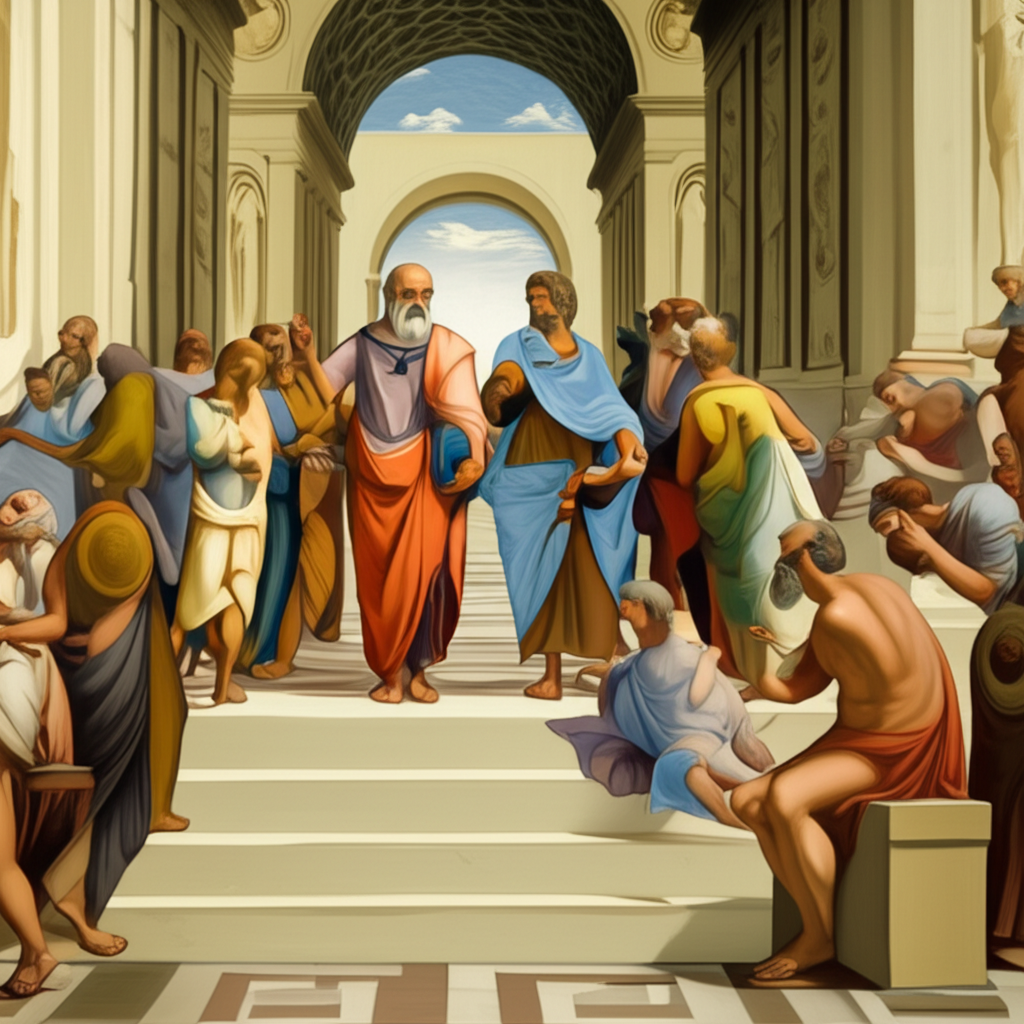
The Mechanics of Philosophical Inquiry: How Dialectic Works
Engaging in the dialectic requires more than just debating skills; it demands intellectual honesty, critical thinking, and a genuine desire to understand. The process can be outlined as follows:
- Identification of a Problem or Question: The starting point is often a contested concept, a paradox, or an unresolved philosophical question.
- Formulation of Initial Positions: Participants articulate their initial beliefs or hypotheses regarding the problem.
- Critical Examination and Questioning: Each position is subjected to rigorous questioning, exploring its assumptions, implications, and potential inconsistencies. This involves:
- Clarification: Ensuring terms are precisely defined.
- Logical Scrutiny: Identifying fallacies or gaps in reasoning.
- Counter-Examples: Proposing scenarios that challenge the universality of a claim.
- Exploring Consequences: Tracing the logical outcomes of a belief.
- Exposure of Contradictions: The aim is often to reveal where initial beliefs lead to untenable conclusions or conflict with other accepted truths.
- Revision and Refinement: Based on the insights gained, participants revise their initial positions, forming new, more sophisticated understandings that account for the previously identified contradictions. This iterative process continues until a more coherent and comprehensive knowledge is achieved, or until the limits of current understanding are acknowledged.
Why Dialectic Matters: Cultivating Deeper Knowledge
The enduring relevance of the dialectic method in philosophy stems from its profound benefits for intellectual development and the pursuit of truth:
- Uncovering Hidden Assumptions: It forces individuals to articulate and examine the often-unspoken premises underlying their beliefs, which are crucial for sound reasoning.
- Fostering Clarity of Thought: Through the necessity of precise definition and logical consistency, the dialectic sharpens conceptual understanding and intellectual articulation.
- Promoting Intellectual Humility: By exposing the limitations of one's own knowledge and the complexities of philosophical problems, it cultivates a healthy skepticism and an openness to alternative perspectives.
- Driving Intellectual Progress: The dialectic is not about arriving at a final, absolute answer in every instance, but about making progress—moving from a less adequate understanding to a more adequate one. It is the engine of ongoing philosophical inquiry.
- Enhancing Critical Thinking: Regularly engaging in dialectical reasoning hones one's ability to analyze arguments, identify flaws, and construct robust justifications for their own views.
📹 Related Video: SOCRATES ON: The Unexamined Life
Video by: The School of Life
💡 Want different videos? Search YouTube for: ""Socratic method explained animation""
📹 Related Video: ARISTOTLE ON: The Nicomachean Ethics
Video by: The School of Life
💡 Want different videos? Search YouTube for: ""Hegelian dialectic simplified""
The dialectic method remains an indispensable tool for anyone serious about philosophy and the pursuit of genuine knowledge. It is the very engine of intellectual progress, urging us to question, to challenge, and to construct more robust frameworks of understanding. By engaging in this venerable art of reasoning, we not only deepen our own insights but contribute to the ongoing, collective human endeavor to comprehend the world and our place within it.