

The Enduring Distinction Between Rhetoric and Dialectic
The ancient Greeks, in their profound exploration of language and truth, bequeathed to us a crucial conceptual framework for understanding how we communicate and reason: the distinction between rhetoric and dialectic. At its core, rhetoric is the art of persuasion, aiming to move an audience towards a particular belief or action, often in public forums. Dialectic, conversely, is the rigorous method of philosophical inquiry, seeking to discover truth through systematic questioning, logical argumentation, and the examination of opposing viewpoints. While both involve the skilled use of language, their fundamental purposes, methods, and outcomes diverge significantly, shaping our understanding of knowledge, persuasion, and the very nature of human discourse.
Unpacking the Ancient Roots: A Philosophical Legacy
The exploration of rhetoric and dialectic is deeply embedded in the philosophical tradition, particularly within the works of Plato and Aristotle, foundational texts within the Great Books of the Western World. These thinkers grappled with the power of speech and argument, recognizing their capacity to both illuminate and deceive.
Rhetoric: The Art of Persuasion
Rhetoric, as articulated by figures like the Sophists and later meticulously analyzed by Aristotle in his treatise Rhetoric, is primarily concerned with persuasion. It is the faculty of discovering the available means of persuasion in any given case.
- Purpose: To influence, convince, or move an audience to adopt a particular viewpoint or take a specific action. Its success is measured by its effectiveness in achieving this goal.
- Audience: Typically a large, often undifferentiated public, such as a jury, an assembly, or a ceremonial gathering. The orator adapts their message to appeal to the beliefs and emotions of this audience.
- Method: Often takes the form of a monologue, a continuous speech, or an oration. It employs various appeals:
- Logos (logical appeal): Arguments based on reason and evidence.
- Pathos (emotional appeal): Stirring the audience's feelings.
- Ethos (ethical appeal): Establishing the speaker's credibility and character.
- Nature of Language: Employs stylistic devices, figures of speech, and emotive language to captivate and sway. Clarity, elegance, and impact are paramount.
- Context: Courts of law, political assemblies, public ceremonies, and any situation requiring public address.
The Sophists were early masters of rhetoric, often criticized by Plato for their perceived willingness to prioritize winning an argument over discovering truth, teaching their students to "make the weaker argument appear stronger." Aristotle, however, viewed rhetoric as a valuable civic art, a necessary counterpart to dialectic, providing the tools for effective communication in public life.
Dialectic: The Pursuit of Truth
Dialectic, most famously championed by Socrates and Plato, particularly in dialogues like Gorgias and Phaedrus, is a method of philosophical inquiry aimed at discovering truth through systematic reasoning.
- Purpose: To uncover knowledge, achieve understanding, and arrive at truth through rigorous logical examination. Its success is measured by the soundness of its arguments and the clarity of its conclusions.
- Audience: Typically a small group of interlocutors, often individuals engaged in a shared pursuit of knowledge. The exchange is intimate and focused.
- Method: Characterized by a question-and-answer format, a dialogue where participants critically examine concepts, definitions, and arguments. It involves:
- Socratic Method: Relentless questioning to expose contradictions and refine understanding.
- Logical Inference: Moving from premises to conclusions.
- Refutation: Testing propositions by demonstrating their inconsistencies.
- Nature of Language: Prioritizes precision, clarity, and logical consistency. Ambiguity is sought out and eliminated.
- Context: Philosophical discussions, academic debates, and any setting where the goal is deep conceptual analysis and the pursuit of objective truth.
Plato saw dialectic as the highest form of intellectual activity, the only path to true knowledge, distinguishing it sharply from the persuasive but potentially deceptive nature of rhetoric.
The Crucial Distinction: A Comparative Look
The distinction between rhetoric and dialectic is not merely academic; it informs how we navigate information, evaluate arguments, and engage in meaningful discourse.
| Feature | Rhetoric | Dialectic |
|---|---|---|
| Primary Goal | Persuasion, belief, action, influence | Discovery of truth, knowledge, understanding |
| Audience | Large, often general public | Small, specialized interlocutors |
| Method | Monologue, continuous speech, oration | Dialogue, question-and-answer, logical exchange |
| Measure of Success | Effectiveness in swaying the audience | Soundness of arguments, logical consistency |
| Nature of Argument | Often relies on enthymemes (probable premises) | Relies on syllogisms (necessary conclusions) |
| Focus | Practical matters, public opinion, belief | Universal principles, abstract concepts, truth |
| Use of Language | Emotive, stylistic, ornamental, persuasive | Precise, logical, clear, analytical |
| Key Proponents | Sophists, Aristotle | Socrates, Plato |
Intersections and Complementarity
While distinct, rhetoric and dialectic are not always mutually exclusive. Aristotle, for instance, considered rhetoric to be the "antithesis" or counterpart of dialectic, suggesting that both are faculties for generating arguments, albeit for different purposes. He believed that rhetoric, when properly understood, could be a valuable tool for making truth effective in the public sphere.
Plato, in his Phaedrus, even suggests a "true rhetoric" – one that is informed and guided by dialectical understanding. This ideal rhetoric would only persuade an audience of what is truly good and just, because the speaker would first have arrived at that truth through rigorous dialectical inquiry. In this view, rhetoric becomes the vehicle for communicating dialectically derived truths to a broader audience.
Contemporary Relevance
Understanding this ancient distinction remains profoundly relevant today. In an age saturated with information, where political discourse often prioritizes soundbites over substantive debate, and social media amplifies persuasive narratives regardless of their veracity, the ability to discern rhetorical ploys from dialectical inquiry is paramount.
We encounter rhetoric in advertising, political campaigns, and popular media, all vying for our attention and allegiance. Simultaneously, genuine scientific discovery, philosophical debate, and critical thinking demand a dialectical approach, striving for evidence-based conclusions and rigorous logical consistency. Recognizing the tools and aims of each allows us to engage more critically with the language around us, whether we are analyzing a news report, a presidential speech, or a philosophical text.
Conclusion
The distinction between rhetoric and dialectic offers a powerful lens through which to examine the varied uses of language and argument. Rhetoric, with its focus on effective persuasion, shapes public opinion and action. Dialectic, with its unwavering commitment to truth-seeking through logical inquiry, illuminates the path to knowledge. Both are indispensable human endeavors, but their proper understanding demands an appreciation for their unique purposes and methodologies. As readers of the Great Books of the Western World know, navigating the complexities of human communication requires a discerning mind, capable of appreciating both the art of persuasion and the rigorous pursuit of truth.
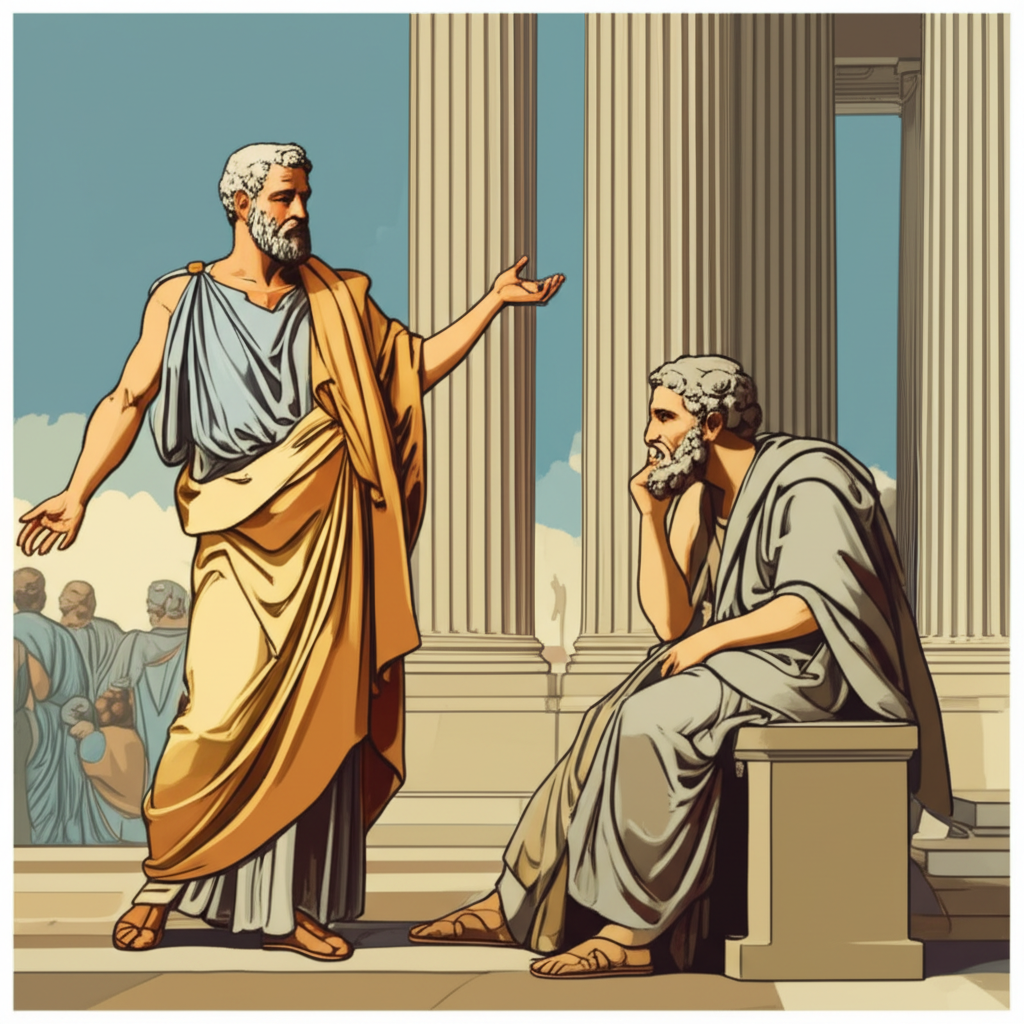 , and the other leaning in intently towards a single interlocutor, pointing to a scroll with intricate symbols (representing dialectic). The background subtly features both an agora with many people and a quiet, enclosed study.)
📹 Related Video: PLATO ON: The Allegory of the Cave
Video by: The School of Life
💡 Want different videos? Search YouTube for: "Plato Gorgias Rhetoric Dialectic, Aristotle Rhetoric Explained"