

The Enduring Divide: Unpacking the Distinction Between Rhetoric and Dialectic
The realms of language and argumentation are vast, often leading to confusion between seemingly similar concepts. Among the most fundamental, yet frequently misunderstood, are rhetoric and dialectic. While both engage with the art of persuasion and the exploration of ideas through language, their core objectives, methodologies, and ultimate aims diverge significantly. This article will delve into this crucial distinction, illuminating how one seeks to sway belief, while the other strives for truth.
A Clear Divide: Persuasion Versus Truth-Seeking
At its heart, the distinction between rhetoric and dialectic lies in their fundamental purpose. Rhetoric, as articulated by figures like Aristotle in his seminal work Rhetoric (a cornerstone of the Great Books of the Western World collection), is primarily concerned with persuasion. It is the art of discovering the available means of persuasion in a given case, aiming to influence an audience's beliefs or actions. Dialectic, on the other hand, as exemplified by Plato's Socratic dialogues, is a method of philosophical inquiry focused on discovering truth through rigorous logical argumentation and critical examination.
Understanding Rhetoric: The Art of Persuasion
Rhetoric is the strategic use of language to achieve a specific persuasive goal. Its effectiveness is measured by its ability to move an audience, whether to accept a claim, take an action, or adopt a particular viewpoint.
Key Characteristics of Rhetoric:
- Objective: To persuade, to move an audience to a particular belief or action.
- Audience: Typically a large, often passive, audience.
- Method: Employs various persuasive appeals (logos, pathos, ethos), narrative, emotional appeals, and stylistic devices. It often involves continuous discourse, like a speech or essay.
- Context: Highly context-dependent, tailored to specific occasions and audiences.
- Outcome: Belief, conviction, action.
Consider the orator delivering a powerful speech, designed to stir emotions and galvanize support for a cause. Their success is not necessarily in proving an absolute truth, but in convincing their listeners of the validity and importance of their perspective. The skillful rhetorician understands human psychology and the nuances of language to craft compelling arguments that resonate deeply.
Exploring Dialectic: The Pursuit of Truth
In contrast, dialectic is a more rigorous and collaborative method of inquiry aimed at uncovering underlying truths and refining understanding. It is often characterized by a question-and-answer format, epitomized by Socrates' method of probing assumptions and exposing contradictions.
Key Characteristics of Dialectic:
- Objective: To discover truth, to test hypotheses, to clarify concepts through logical reasoning.
- Audience: Typically a small, active, and engaged group of participants.
- Method: Involves sustained dialogue, critical questioning, logical analysis, and the identification of inconsistencies. It progresses through a series of propositions and counter-propositions.
- Context: Less dependent on external context, more focused on internal logical consistency.
- Outcome: Knowledge, understanding, refinement of concepts, approximation of truth.
Think of a philosophical debate, where participants challenge each other's premises, dissect arguments, and collectively work towards a more coherent understanding. The goal is not to "win" an argument in the rhetorical sense, but to arrive at a more robust and logically sound conclusion. This process, deeply embedded in the Great Books tradition, particularly in Plato's dialogues, reveals the power of reasoned discourse.
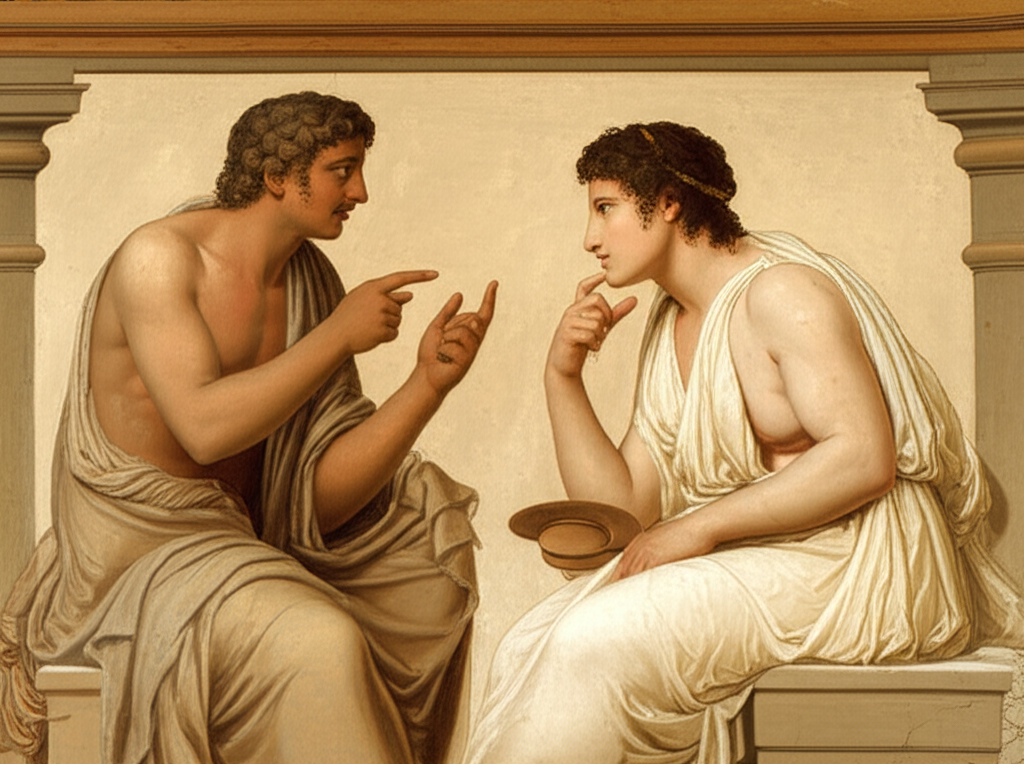
The Fundamental Contrast: A Comparative Overview
To further clarify the distinction, let's examine their differences across several key dimensions:
| Feature | Rhetoric | Dialectic |
|---|---|---|
| Primary Aim | Persuasion, belief, action | Truth-seeking, knowledge, understanding |
| Method | Monologue, speech, continuous discourse | Dialogue, question-and-answer, logical debate |
| Audience Role | Passive recipient | Active participant, co-inquirer |
| Focus | Practical action, probable truth | Universal truth, logical consistency |
| Appeals Used | Logos, Pathos, Ethos (emotional, ethical, logical) | Primarily Logos (logical reasoning) |
| Timeframe | Often time-limited (e.g., a debate, a trial) | Can be open-ended, iterative |
| Nature of Language | Emotive, ornamental, strategic | Precise, analytical, definitional |
The way language is employed serves as a critical differentiator. In rhetoric, language is a tool for impact, often leveraging emotional resonance and stylistic flair. In dialectic, language is a tool for precision, clarity, and logical articulation, stripping away ambiguity to reveal underlying concepts.
Interplay and Overlap: When Paths Converge
While distinct, rhetoric and dialectic are not entirely separate. A skillful philosopher might use rhetorical techniques to present their dialectically derived truths more effectively. Conversely, a rhetorician might employ dialectical reasoning to strengthen their arguments. However, the primary intention remains the defining factor. The Sophists, often contrasted with figures like Socrates, were masters of rhetoric who prioritized persuasive victory over the pursuit of truth, leading to ancient philosophical debates about the ethical implications of each approach.
Conclusion: Navigating Discourse with Clarity
Understanding the distinction between rhetoric and dialectic is crucial for anyone engaging with complex ideas and arguments. It allows us to critically assess the intentions behind various forms of communication: Is the speaker trying to persuade us to a particular viewpoint, or are they genuinely attempting to uncover a deeper truth? By recognizing these different modes of inquiry and influence, we become more discerning thinkers, better equipped to navigate the vast landscape of language and discourse.
📹 Related Video: PLATO ON: The Allegory of the Cave
Video by: The School of Life
💡 Want different videos? Search YouTube for: ""Plato's Dialectic vs. Aristotle's Rhetoric Explained""
📹 Related Video: SOCRATES ON: The Unexamined Life
Video by: The School of Life
💡 Want different videos? Search YouTube for: ""What is the Socratic Method? - Philosophy Basics""