

The Profound Divide: Unpacking Quality and Quantity
A Summary of the Essential Distinction
At the heart of understanding reality, whether through the lens of ancient philosophy or modern science, lies the fundamental distinction between quality and quantity. Simply put, Quality refers to the intrinsic nature, character, or inherent properties of a thing—what it is. It describes attributes like redness, sweetness, beauty, or justice. Quantity, on the other hand, describes the measurable aspects—how much or how many of a thing exists. It deals with properties like size, number, weight, or duration. While seemingly straightforward, the interplay and occasional reduction of one to the other have been central to philosophical discourse for millennia, profoundly shaping our understanding of the world, from the abstract realms of thought to the concrete operations of Physics.
The Ineffable Essence: What is Quality?
When we speak of Quality, we are delving into the very being of a thing. It’s what makes a rose a rose, beyond its petal count or stem length. A quality is often perceived directly through our senses or understood intuitively. It's the experience of warmth, the feeling of sadness, the characteristic of bravery. Philosophers from Aristotle, in his Categories, to Locke, with his distinction between primary and secondary qualities, have wrestled with how qualities exist and how we perceive them. Are they inherent in the object itself, or are they mind-dependent interpretations?
Consider the following examples of qualities:
- Color: The specific hue of blue in a clear sky.
- Taste: The sourness of a lemon.
- Sound: The melodic nature of a particular song.
- Texture: The smoothness of polished marble.
- Moral Virtue: The courage displayed in an act of heroism.
- Beauty: The aesthetic appeal of a painting.
These are not easily measured; they are experienced, described, and often carry subjective weight, even if their underlying physical causes might be quantifiable. The Definition of quality often circles back to its non-numerical, descriptive essence.
The Measurable World: What is Quantity?
In stark contrast, Quantity grounds us in the measurable, the enumerable, and the calculable. It provides the framework for comparison, for counting, and for scientific analysis. If quality asks "What kind of thing is it?", quantity asks "How much of it is there?" or "How many are there?". This aspect of reality is the domain of mathematics and forms the backbone of all empirical sciences.
Here are some typical examples of quantities:
- Number: Three apples, five fingers.
- Size: A table that is two meters long.
- Weight: A bag weighing ten kilograms.
- Volume: A liter of water.
- Time: An event lasting sixty seconds.
- Speed: A car traveling at 100 kilometers per hour.
These are objective and can be expressed numerically, allowing for universal agreement and precise communication. The Definition of quantity is inherently tied to its capacity for measurement and numerical representation.
From Ancient Greece to Modern Physics: A Historical Perspective
The philosophical journey through the distinction between quality and quantity is a rich one, deeply explored within the Great Books of the Western World. Ancient Greek thinkers, notably Aristotle, laid foundational groundwork by including both quality and quantity as two of his ten categories of being. For him, they were distinct ways in which things exist and can be predicated.
Centuries later, with the advent of the scientific revolution, the emphasis began to shift. Thinkers like Descartes and Galileo championed a mechanistic view of the universe, arguing that the true nature of reality lay in its quantifiable aspects—its extension, motion, and number. They suggested that what we perceive as Quality (like color or sound) were merely secondary qualities, arising from the primary, quantifiable qualities (like the size and motion of particles). This philosophical move profoundly influenced the development of modern Physics, which seeks to explain the universe by reducing phenomena to their fundamental measurable components.
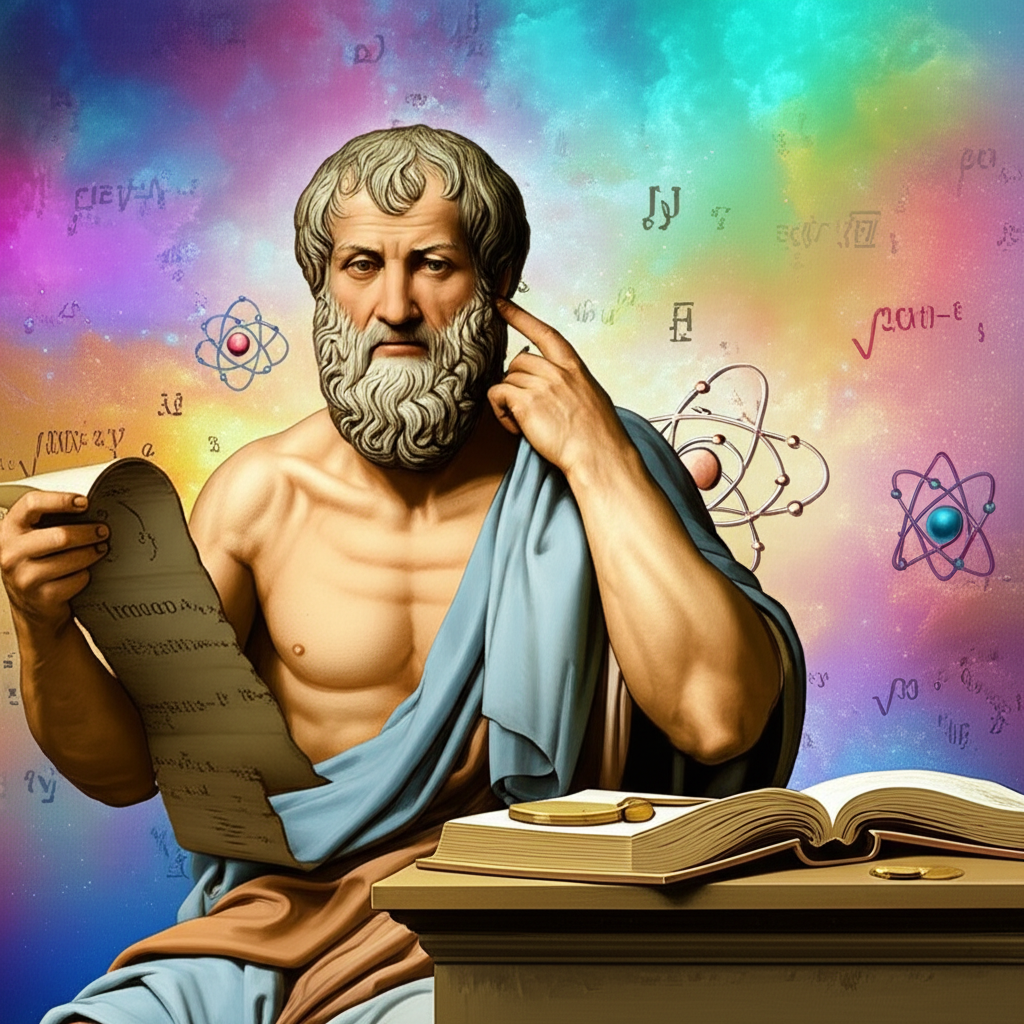
The Great Reduction: When Quality Becomes Quantity
Modern science, particularly Physics, often operates on the principle of reducing qualities to quantities. For instance:
| Phenomenon (Quality) | Scientific Explanation (Quantity) |
|---|---|
| Color (e.g., Red) | Specific wavelengths of light (e.g., ~620-750 nanometers) |
| Sound (e.g., High-pitched) | Frequency of sound waves (e.g., higher Hertz values) |
| Heat (e.g., Warmth) | Average kinetic energy of particles (e.g., higher Kelvin) |
| Taste (e.g., Sweetness) | Chemical compounds interacting with receptors, often involving molecular structures and concentrations |
| Beauty (e.g., Symmetrical) | Often linked to mathematical ratios (e.g., golden ratio), fractal dimensions, or neural activity patterns |
This reductionism has been incredibly successful in allowing us to understand and manipulate the physical world. However, it also raises profound philosophical questions: Does reducing a quality to a quantity fully capture its essence? Is the experience of redness truly just a wavelength, or is there something more? This is the core of the "hard problem of consciousness" and other debates concerning subjective experience.
Why This Distinction Matters: Implications for Understanding Reality
The ability to discern between quality and quantity is not merely an academic exercise; it's fundamental to how we interpret and interact with the world.
- Scientific Progress: The relentless pursuit of quantifying phenomena has led to breakthroughs in every scientific field. Without this distinction, the very language of scientific inquiry would be impossible.
- Philosophical Depth: It forces us to confront the nature of reality itself. Is reality fundamentally quantitative, with qualities being emergent properties or subjective interpretations? Or do qualities possess an independent existence?
- Human Experience: Our lived experience is rich with qualities—love, joy, pain, beauty. While we can attempt to quantify their biological or psychological correlates, the qualitative experience remains distinct and central to what it means to be human.
- Ethical Considerations: Ethical and moral Quality (e.g., justice, fairness) cannot be reduced to simple quantities. While we might count the number of people affected by an injustice, the quality of the injustice itself requires a different mode of understanding.
Navigating the Nuances
Ultimately, the distinction between quality and quantity reminds us that reality is multifaceted. While the quantitative lens offers precision and predictive power, the qualitative lens provides meaning, experience, and the richness of existence. Both are indispensable for a complete understanding, urging us to appreciate the measurable aspects of the cosmos while never losing sight of the intrinsic character and subjective dimensions that define so much of our world.
📹 Related Video: ARISTOTLE ON: The Nicomachean Ethics
Video by: The School of Life
💡 Want different videos? Search YouTube for: ""Aristotle Categories Quality Quantity Philosophy""
📹 Related Video: What is Philosophy?
Video by: The School of Life
💡 Want different videos? Search YouTube for: ""Primary and Secondary Qualities Locke Galileo Philosophy""