

The distinction between quality and quantity is not merely an academic exercise; it forms a bedrock upon which much of philosophy, science, and our everyday understanding of the world is built. At its core, this distinction helps us differentiate between what something is – its inherent nature or characteristic – and how much or how many of it there is. This article delves into these fundamental concepts, tracing their philosophical lineage and exploring their profound implications from ancient Greece to modern physics, ultimately revealing why this seemingly simple division remains vital for grappling with the complexities of existence.
Unpacking the Fundamental Divide: Quality vs. Quantity
For millennia, thinkers have wrestled with how to categorize and comprehend the myriad aspects of reality. The concepts of quality and quantity emerge as two primary lenses through which we attempt to make sense of the world. One speaks to the essence, the other to the measure.
Defining the Terms: What Are We Truly Talking About?
To embark on this philosophical journey, we must first establish clear definitions.
-
Quality (Latin: qualitas):
- Refers to the nature or kind of something; its inherent characteristic, attribute, or property that makes it what it is.
- It answers the question, "What sort of thing is it?" or "What is its nature?"
- Qualities are often subjective, perceived, or describe intrinsic features that are not easily measurable in numerical terms.
- Examples: The redness of an apple, the sweetness of sugar, the courage of a warrior, the smoothness of a stone, the beauty of a painting.
- In philosophy, qualities are often associated with the essence or form of a thing.
-
Quantity (Latin: quantitas):
- Refers to the amount, number, magnitude, or extent of something.
- It answers the question, "How much?" or "How many?"
- Quantities are inherently measurable, numerical, and objective, often expressed in units.
- Examples: The three apples, the ten grams of sugar, the six feet of height, the two hours of duration, the speed of a moving object.
- In philosophy, quantities are often associated with the material or physical aspects of a thing that can be counted or measured.
This preliminary definition lays the groundwork for understanding how these concepts have shaped philosophical inquiry through the ages.
A Historical Glimpse: Insights from the Great Books
The distinction between quality and quantity is not a modern invention but a cornerstone of Western thought, deeply explored by the giants whose works comprise the Great Books of the Western World.
Ancient Greece: Aristotle's Categories
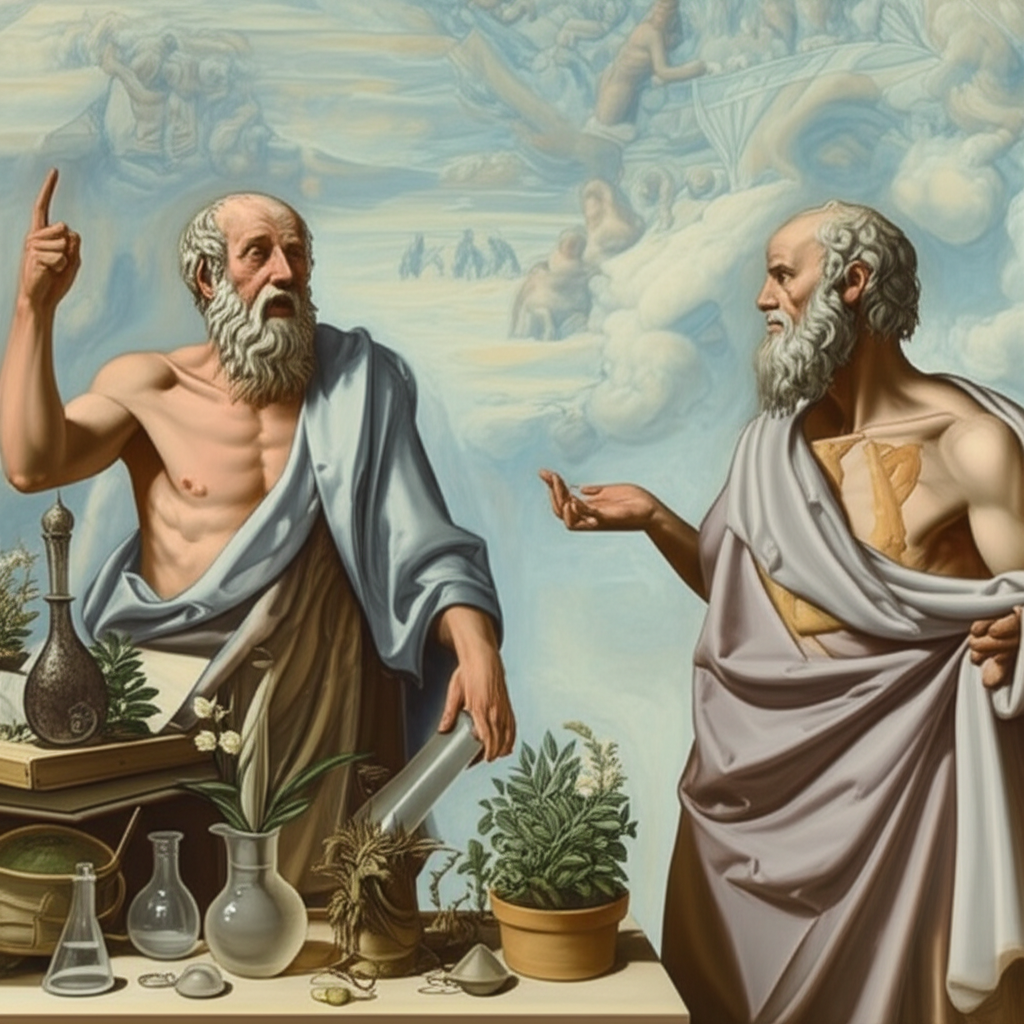
Perhaps the most foundational articulation of this distinction comes from Aristotle. In his Categories, he outlines ten fundamental ways in which something can be predicated of a subject, or ten ways in which a being can be said to exist. Quantity and Quality are two of these primary categories:
- Substance: (e.g., a man, a horse)
- Quantity: (e.g., two cubits long, three feet tall)
- Quality: (e.g., white, grammatical, hot, virtuous)
- Relation: (e.g., double, half, larger)
- Place: (e.g., in the Lyceum, in the market-place)
- Time: (e.g., yesterday, last year)
- Position: (e.g., lying, sitting)
- Having: (e.g., shod, armed)
- Doing: (e.g., cutting, burning)
- Being Affected: (e.g., being cut, being burned)
Aristotle clearly separates what sort of thing something is (Quality) from how much or how many of it there is (Quantity). For him, qualities are inherent attributes that define the character of a substance, while quantities describe its measurable extent.
The Scientific Revolution and Early Modern Philosophy
With the advent of the Scientific Revolution, the emphasis shifted dramatically towards the measurable, the quantifiable. Philosophers like René Descartes, John Locke, and George Berkeley grappled with the implications of this shift.
- René Descartes: In his Meditations, Descartes posited that the essential attribute of matter (or "extended substance") is extension – a purely quantitative property. All other properties, like color or taste, were seen as secondary and potentially subjective. The world, for Descartes, was fundamentally a machine describable by mathematical physics.
- John Locke: In his An Essay Concerning Human Understanding, Locke famously distinguished between primary and secondary qualities:
- Primary Qualities: These are qualities inherent in objects themselves, inseparable from them, and which objects retain in all their changes. They are objectively measurable and include solidity, extension, figure, motion/rest, and number – all fundamentally quantitative.
- Secondary Qualities: These are not in the objects themselves but are powers to produce sensations in us (e.g., colors, sounds, tastes, smells, warmth, coldness). They are subjective and perceived – fundamentally qualitative.
Locke argued that primary qualities resemble the objects, while secondary qualities do not. This distinction became crucial for understanding how our minds perceive the world.
- George Berkeley: Berkeley, an idealist, challenged Locke's distinction, arguing in A Treatise Concerning the Principles of Human Knowledge that all qualities, primary and secondary alike, are mind-dependent. For Berkeley, "to be is to be perceived" (esse est percipi), implying that even seemingly objective quantities like extension or motion are ultimately perceptions and thus, in a sense, qualitative experiences.
The Influence on Physics and Science
The trajectory of modern physics has largely been a triumph of quantity. From Galileo's measurements of falling objects to Newton's laws of motion and gravity, the scientific method has consistently sought to reduce qualitative observations to precise, mathematical relationships.
Consider the phenomenon of color. Qualitatively, it's an experience of redness or blueness. Quantitatively, physics describes it as a specific range of electromagnetic wavelengths. Similarly, heat is a qualitative sensation, but quantitatively, it's the average kinetic energy of molecules. This reductionist approach has been incredibly successful in predicting and controlling the physical world.
However, the question remains: Does the quantitative description fully capture the experience of the quality? Does knowing the wavelength of red light truly explain the sensation of seeing red? This philosophical challenge highlights the persistent tension between the objective, measurable world of quantity and the subjective, experienced world of quality.
The Interplay and Irreducibility: Why Both Matter
While distinct, quality and quantity are rarely found in isolation. A "high-quality" product often implies a certain measurable standard (e.g., durability, precision). A "large quantity" of something might also imply a different kind or quality of experience (e.g., a large crowd feels different from a small gathering).
The challenge arises when attempting to reduce one entirely to the other. Can the quality of a musical masterpiece be fully explained by the quantity of notes, their duration, and amplitude? Can the quality of human consciousness be fully accounted for by the quantity of neural firings? Most philosophers would argue no. There seems to be an irreducible aspect to quality that transcends mere measurement.
Modern Relevance and Enduring Questions
The distinction continues to be relevant in contemporary discussions:
- Artificial Intelligence: Can AI truly grasp quality (e.g., understanding humor, appreciating art, feeling empathy) or is it limited to processing and manipulating quantities of data?
- Ethics and Aesthetics: How do we quantify moral goodness or beauty? We often struggle to apply purely quantitative metrics to inherently qualitative domains.
- Economics: Beyond GDP (a quantitative measure), there's a growing recognition of the need for qualitative measures of well-being and societal health.
The enduring importance of distinguishing between quality and quantity lies in its capacity to remind us that not everything that counts can be counted, and not everything that can be counted truly counts.
📹 Related Video: ARISTOTLE ON: The Nicomachean Ethics
Video by: The School of Life
💡 Want different videos? Search YouTube for: ""Aristotle's Metaphysics: Substance, Quantity, and Quality""
📹 Related Video: PLATO ON: The Allegory of the Cave
Video by: The School of Life
💡 Want different videos? Search YouTube for: ""John Locke Primary and Secondary Qualities Explained""
Conclusion: A Primal Distinction for Deeper Understanding
The distinction between quality and quantity is more than a linguistic convenience; it is a fundamental philosophical tool for dissecting reality. From Aristotle's foundational categories to Locke's primary and secondary qualities, and into the heart of modern physics, this distinction has guided our attempts to understand the universe. While science often strives to quantify, the richness of human experience and the very nature of being frequently compel us to acknowledge the irreducible realm of quality. As we continue to explore the world, recognizing this primal divide remains essential for a truly comprehensive and nuanced understanding of all that is and how much of it there is.