

The Enduring Divide: Unpacking the Distinction Between Quality and Quantity
The world, as we perceive and analyze it, is a tapestry woven from countless attributes. Yet, beneath the surface of everyday observation lies a fundamental philosophical distinction that shapes how we understand reality itself: the difference between Quality and Quantity. This isn't merely an academic exercise; it's a bedrock concept that permeates everything from ancient metaphysics to modern physics, influencing our understanding of what things are and how much they are. At its core, this article seeks to illuminate this profound divide, exploring its definitions, historical interpretations, and persistent relevance in our quest for knowledge.
I. Defining Quality: The Essence of "What It Is"
Let us begin with Quality. This term, in a philosophical context, refers to the inherent characteristics, properties, or attributes that make something what it truly is. It's about its kind, its type, its fundamental nature – the "suchness" of a thing. When we speak of quality, we are addressing the intrinsic features that define an entity, distinguishing it from others.
1.1. The Intrinsic Nature of Things
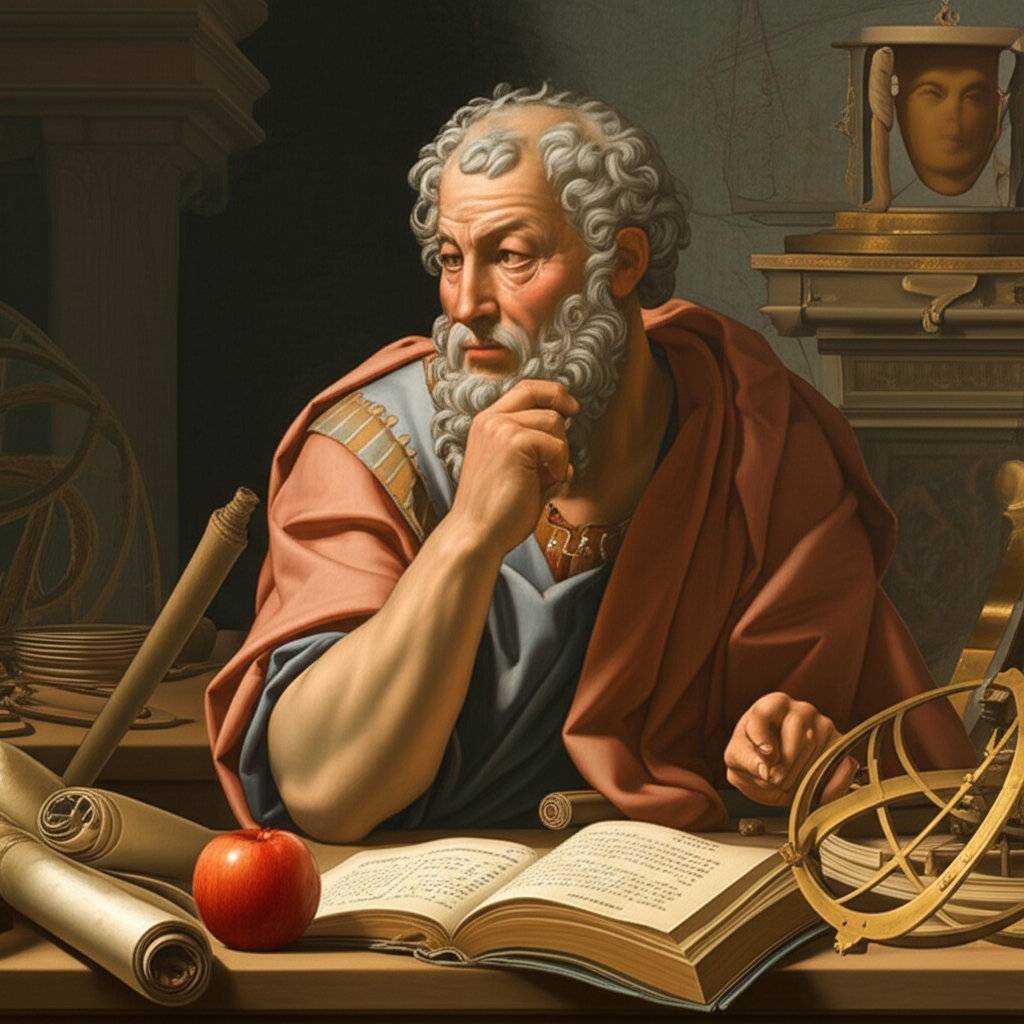
Imagine an apple. Its redness, its crispness, its sweetness – these are its qualities. They describe what kind of apple it is, how it tastes, how it feels. Similarly, the bitterness of coffee, the wisdom of a philosopher, the melancholy of a piece of music, or the beauty of a painting are all qualities. They are descriptive, often subjective in experience, yet fundamental to our understanding of the object or concept in question. A world without qualities would be a world devoid of color, taste, emotion, or intrinsic identity.
1.2. Philosophical Roots: From Plato to Aristotle
The concept of Quality has deep roots in the Great Books of the Western World. Plato, for instance, grappled with qualities through his theory of Forms, where ideal qualities like Beauty or Justice exist independently of their imperfect, physical manifestations. Aristotle, however, provided a more systematic framework in his Categories, listing "Quality" as one of the ten fundamental ways in which being can be predicated. For Aristotle, qualities are attributes that describe a substance – things like "being white" or "being grammatical." He meticulously laid the groundwork for understanding qualities as inherent characteristics, distinct from other aspects like size or relation.
II. Defining Quantity: The Measure of "How Much"
In stark contrast to quality, Quantity refers to the measurable aspects of something. It's about its amount, number, magnitude, or extent. When we engage with quantity, we are asking how much or how many. It's the realm of measurement, enumeration, and the cold, hard facts that can be expressed mathematically.
2.1. The Extrinsic Measure of Existence
Returning to our apple, its weight (e.g., 150 grams), its volume (e.g., 200 cubic centimeters), or the number of apples in a basket (e.g., 5 apples) are all quantities. They tell us nothing about the apple's inherent nature or taste, but rather its measurable presence. The volume of coffee (200 ml), the number of students in a class (30), or the dimensions of a canvas (24x36 inches) are further examples. Quantities are external, objective, and lend themselves readily to comparison and calculation.
2.2. The Mathematical Foundation of Reality
Quantity forms the very bedrock of mathematics and empirical science. It allows for precise description, prediction, and the formulation of universal laws. The abstract nature of numbers means that quantities can be manipulated and understood independently of the specific qualities they might be measuring. This universality is what makes quantity so powerful in our attempts to model and control the physical world.
III. The Interplay and Irreducibility: Where They Converge and Diverge
The distinction between quality and quantity is not always immediately obvious, as they often appear intertwined in our experience of reality. However, recognizing their fundamental differences is crucial.
3.1. The Fundamental Distinction: A Comparative View
Let's clarify this with a brief comparison:
| Aspect | Quality | Quantity |
|---|---|---|
| Focus | What it is (kind, nature, attribute) | How much or many (amount, measure) |
| Nature | Intrinsic, descriptive, often subjective | Extrinsic, measurable, objective |
| Question | "What kind?" / "What is it like?" | "How much?" / "How many?" / "How big?" |
| Example | The sweetness of sugar | The kilogram of sugar |
| Realm | Experience, description, identity | Measurement, calculation, comparison |
3.2. Can Quality Be Reduced to Quantity?
This is perhaps one of the most enduring and challenging questions arising from this distinction. Can the experience of the color red be fully explained by its wavelength (a quantity)? Can the feeling of pain be entirely reduced to neural firings (quantifiable electrical impulses)? This is the crux of philosophical reductionism. While science often seeks to explain qualities by breaking them down into their underlying quantitative components, many argue that something essential is lost in this process. New qualities, often termed emergent properties, seem to arise from complex arrangements of quantities, suggesting a richness that cannot be fully captured by mere measurement.
IV. Historical Perspectives from the Great Books of the Western World
The philosophical journey through the distinction between quality and quantity is a rich one, with pivotal thinkers from the Great Books tradition offering profound insights.
4.1. Ancient Foundations: Aristotle and Plato
As mentioned, Aristotle was instrumental in formalizing this distinction. In his Metaphysics and Categories, he meticulously categorized being, placing quantity and quality as distinct, fundamental ways in which things exist and can be described. For Aristotle, a substance (like a human) has both qualities (e.g., being rational) and quantities (e.g., being five feet tall). Plato, on the other hand, might argue that the qualitative "Form" of Beauty is primary and eternal, while any particular beautiful object merely participates in this Form, possessing quantitative attributes (size, shape) that are secondary to its inherent beauty.
4.2. Early Modern Thought: Descartes, Locke, and Hume
The Early Modern period saw a significant shift, particularly with the rise of empirical science. René Descartes introduced the distinction between primary and secondary qualities. Primary qualities (like extension, shape, motion, number) are objective, measurable, and inherent in objects – essentially, quantities. Secondary qualities (like color, taste, smell, sound) are subjective, mind-dependent, and arise from our interaction with primary qualities – essentially, qualities as we experience them. John Locke further developed this, arguing that primary qualities are inseparable from the body, while secondary qualities are merely powers in objects to produce sensations in us. David Hume, with his radical empiricism, pushed this skepticism further, questioning the very existence of inherent qualities apart from our sensory impressions.
V. The Distinction in Modern Science, Especially Physics
The scientific revolution, and particularly the development of modern physics, has profoundly shaped our understanding of this distinction, often by prioritizing quantity.
5.1. Physics and the Primacy of Quantity
Modern physics, in its relentless pursuit of objective truth, largely operates within the realm of quantity. The universe is conceptualized as a vast system of measurable forces, particles, and fields. Color is reduced to electromagnetic wavelengths, temperature to the kinetic energy of molecules, sound to pressure waves. Physics strives to quantify phenomena, reducing qualities to their underlying quantitative properties, allowing for precise mathematical models and predictive power. This approach has yielded immense success in understanding how the physical world operates.
5.2. The Philosophical Challenge to Physics: The Problem of Qualia
Despite the triumphs of quantitative physics, the philosophical challenge persists. The concept of qualia (singular: quale) refers to the individual instances of subjective, conscious experience – the felt quality of redness, the experience of pain, the taste of chocolate. These subjective qualities remain notoriously difficult, if not impossible, to quantify or reduce to purely physical, quantitative descriptions. This "Hard Problem of Consciousness," as articulated by philosophers like David Chalmers, highlights the potential irreducible gap between the objective, quantitative description of brain activity and the subjective, qualitative experience of consciousness. It's a stark reminder that while physics excels at describing how much, the question of what it's like remains a profound mystery.
VI. Conclusion: A Persistent and Productive Tension
The distinction between quality and quantity is not merely a linguistic or categorical exercise; it is a fundamental philosophical lens through which we attempt to grasp the nature of reality. From Aristotle's meticulous categorizations to Descartes' primary and secondary qualities, and on to the challenges posed by modern physics and the problem of qualia, this divide has consistently pushed the boundaries of human inquiry. While science has achieved unparalleled success by focusing on the measurable, quantitative aspects of the universe, the qualitative realm continues to challenge our comprehensive understanding. It reminds us that reality is perhaps richer and more complex than what can be merely weighed, counted, or measured, inviting us to ponder the profound interplay between what things are and how much they are.
Resources
📹 Related Video: ARISTOTLE ON: The Nicomachean Ethics
Video by: The School of Life
💡 Want different videos? Search YouTube for: ""Aristotle Categories Quality Quantity Philosophy""
📹 Related Video: What is Philosophy?
Video by: The School of Life
💡 Want different videos? Search YouTube for: ""Qualia and Consciousness Philosophy""