

The Nuance of Perception: Distinguishing Art from Beauty
The realms of aesthetics often find us grappling with terms that feel intimately connected, almost interchangeable. Among these, Art and Beauty stand out. Yet, to conflate them is to miss a crucial philosophical distinction. While often intertwined, Art and Beauty are fundamentally distinct concepts; beauty is a subjective or objective Quality that evokes pleasure or admiration, while Art is the intentional human creation or expression, whose Definition encompasses a vast range of forms, not all of which aim for or achieve conventional beauty. Understanding this separation enriches our appreciation for both the world of human endeavor and the intrinsic allure of existence itself.
Unpacking the Definitions: What We Mean
To truly appreciate the distinction, we must first establish a clearer Definition for each term. This isn't merely an academic exercise; it's about refining our lens through which we perceive the world.
Beauty: An Elusive Quality
Beauty refers to a Quality that gives pleasure to the senses or to the mind. Throughout the Great Books of the Western World, philosophers have wrestled with its nature:
- Plato, in dialogues like the Symposium, posited Beauty as an eternal, unchanging Form, an ideal existing independently of human perception. It's a transcendent truth, the ultimate object of love and aspiration.
- Aristotle, while less concerned with a transcendent Form, spoke of beauty in terms of order, symmetry, and definiteness in his Poetics. For him, a beautiful object possessed an intrinsic harmony and proportion.
- St. Thomas Aquinas, drawing from Neoplatonic and Aristotelian thought, identified three conditions for beauty: integritas (integrity or wholeness), consonantia (proportion or harmony), and claritas (radiance or clarity).
- Immanuel Kant, in his Critique of Judgment, shifted the focus significantly, arguing that judgments of beauty are subjective yet claim universal validity. Beauty, for Kant, is that which pleases without interest and without a concept. It evokes a feeling of disinterested pleasure.
Essentially, beauty is often characterized by:
- Pleasure: It evokes a positive emotional or sensory response.
- Harmony: It often involves balance, proportion, and order.
- Subjectivity/Objectivity: While its experience is personal, some argue for objective standards or universal appeal.
- Inherent Value: It is often valued for its own sake.
Art: The Act of Creation and Expression
Art, on the other hand, refers to the product or process of human creativity and skill. Its Definition is broader and more dynamic than beauty's.
- For Aristotle, art (techne) was primarily about skill, craft, and the imitation (mimesis) of nature. A potter making a functional vase was engaged in art.
- Later traditions emphasized art as a means of expression, communication, or exploration of ideas. From the Renaissance masters to modern conceptual artists, the scope of what constitutes art has expanded dramatically.
Key characteristics of Art include:
- Human Agency: It is always a product of human intention and effort.
- Skill/Craft: It often involves a mastery of specific techniques or materials.
- Expression/Communication: It conveys ideas, emotions, or experiences.
- Purpose/Intention: It is created with a goal, whether aesthetic, political, social, or purely exploratory.
- Definition's Fluidity: What is considered "art" has evolved significantly across cultures and historical periods.
The Overlap and the Great Divide
It's undeniable that much Art is created with the explicit intention of being beautiful, and indeed, achieves it. A classical sculpture, a masterful painting, a moving symphony – these are often celebrated for their beauty. Here, art and beauty converge, enhancing each other.
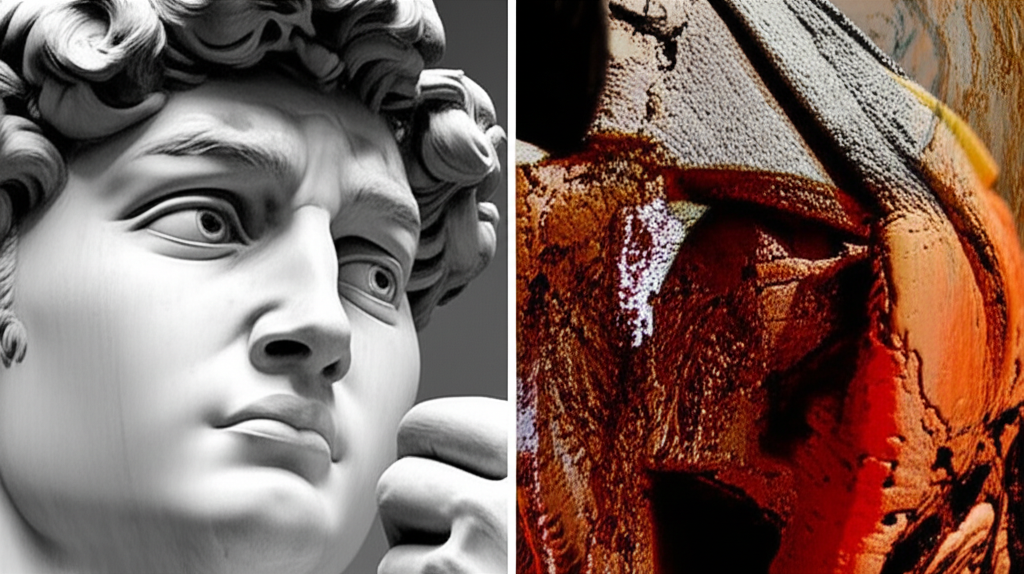
However, the crucial distinction emerges when we consider the scenarios where they diverge:
| Feature | Beauty | Art |
|---|---|---|
| Origin | Can be natural (sunset, flower) or man-made | Always a product of human creation/intention |
| Purpose | To please, to inspire awe, to be admired | To express, to communicate, to provoke, to challenge, to document |
| Experience | Primarily aesthetic pleasure | Intellectual engagement, emotional response, sensory experience |
| Necessity | Not necessary for art to exist | Not necessary for beauty to exist |
| Judgment Basis | Often subjective feeling or objective harmony | Skill, originality, impact, conceptual depth, historical context |
When Beauty Exists Without Art
Consider a breathtaking sunset over the ocean, the intricate pattern of a snowflake, or the symmetrical perfection of a rose. These are undeniably beautiful, yet they are not Art. They are phenomena of the natural world, occurring without human intervention or intention. Their Quality of beauty is inherent or perceived, but not created.
When Art Exists Without Beauty
This is where the distinction becomes most profound and often sparks debate. Much of modern and contemporary Art deliberately eschews traditional notions of beauty.
- Dadaist readymades like Marcel Duchamp's Fountain (a urinal) challenged the very Definition of art, aiming to provoke thought rather than aesthetic pleasure.
- Abstract Expressionism, with its raw emotion and often chaotic forms, prioritizes expression over conventional beauty.
- Performance art or installation art might focus on ephemeral experiences, social commentary, or intellectual concepts, where beauty is entirely secondary or absent.
- Guernica by Picasso, while a powerful work of art, depicts the horrors of war and is intentionally disturbing, not beautiful in the traditional sense. Its Quality lies in its impact and message.
Here, the Quality of the art is judged not by its pleasing appearance, but by its originality, its conceptual depth, its ability to provoke thought, its historical significance, or its technical mastery in conveying a particular message.
The Importance of the Distinction
Recognizing the distinction between Art and Beauty is vital for several reasons:
- Broader Appreciation: It allows us to appreciate a wider spectrum of human creativity. If beauty were a prerequisite for art, many significant works that challenge, provoke, or discomfort would be dismissed.
- Deeper Understanding: It helps us analyze both concepts more rigorously. We can ask: "Is this piece beautiful?" and "Is this piece effective art?" independently.
- Philosophical Clarity: It avoids the circular reasoning that often arises when these terms are conflated. It aids in understanding the diverse aims and impacts of human endeavor.
Ultimately, while Beauty can be a magnificent Quality within Art, it is not its sole purpose nor a defining characteristic. Art, in its expansive Definition, is a testament to human ingenuity, expression, and our unending quest to make sense of, and leave a mark on, the world around us.
YouTube Video Suggestions:
-
📹 Related Video: PLATO ON: The Allegory of the Cave
Video by: The School of Life
💡 Want different videos? Search YouTube for: "Plato Symposium Beauty Forms Explained"
-
📹 Related Video: KANT ON: What is Enlightenment?
Video by: The School of Life
💡 Want different videos? Search YouTube for: "Kant Critique of Judgment Aesthetics Summary"


