

The Fundamental Divide: Unpacking Quality and Relation in Philosophy
Welcome, fellow seekers of wisdom, to a journey into the bedrock of philosophical thought. Today, we're delving into two concepts so fundamental they often go unnoticed, yet without them, our understanding of existence would crumble: Quality and Relation. At first glance, they might seem straightforward, almost intuitive. But as we peel back the layers, we uncover a profound difference that shapes our logic, our metaphysics, and indeed, our very perception of reality.
This pillar page aims to illuminate the distinct nature of Quality – what a thing is in itself – and Relation – how a thing stands to something else. We'll explore their philosophical definitions, trace their historical significance through the Great Books of the Western World, and ultimately, understand why differentiating between them is not merely an academic exercise, but a crucial step in clarifying our thought.
Grasping the Essence of Quality: What a Thing Is
To speak of Quality is to speak of the intrinsic nature of a thing, its inherent characteristics that make it what it is. It's the "of what sort" something is, independent of anything else.
What is Quality? A Philosophical Definition
In the grand tradition of philosophy, especially as articulated by Aristotle in his Categories, Quality stands as one of the ten fundamental ways we can describe being. It's not what something is (substance), nor how much it is (quantity), but what kind of thing it is.
Consider a simple example: a red apple. The "redness" is a quality. It's an inherent attribute of the apple itself. It doesn't depend on another apple, or a table, or anything external for its redness to exist. Similarly, "sweetness" is a quality of the apple, "firmness" is a quality, and so on.
- Intrinsic Property: A quality belongs to a thing in itself.
- Monadic: It describes a single entity without reference to others.
- Examples: Color (red, blue), taste (sweet, bitter), shape (round, square), moral attributes (virtuous, wicked), physical properties (hot, cold, heavy, light).
Philosophers like John Locke further refined our understanding by distinguishing between Primary Qualities and Secondary Qualities. Primary qualities (like extension, motion, number) are those inherent to the object and mind-independent, existing whether we perceive them or not. Secondary qualities (like color, taste, sound) are powers in objects to produce sensations in us, dependent on our perception. This distinction, found in the Great Books, highlights the subtle complexities within the very definition of Quality.
Unraveling the Web of Relation: How Things Stand to Each Other
If Quality tells us what a thing is, Relation tells us how one thing connects, compares, or stands in regard to another. It's the "how it stands to something else" aspect of being.
Defining Relation: Connections and Contexts
Aristotle, again, provides a foundational definition of Relation as another category of being. Unlike Quality, which describes a single entity, Relation necessarily involves at least two entities. It's a bridge, a comparison, a dependency that binds distinct things together.
Take our red apple again. If we say "this apple is taller than that plum," "taller than" is a relation. It's not an intrinsic property of the apple alone, nor the plum alone, but a description of their comparative heights. Similarly, "parent of," "cause of," "simultaneous with," "similar to," or "opposite of" are all examples of relations.
- Extrinsic Property: A relation arises from the interaction or comparison of two or more things.
- Polyadic: It describes a connection between multiple entities.
- Examples: "Larger than," "father of," "to the left of," "cause and effect," "teacher of."
The concept of Relation is crucial for understanding causality, space, and time. David Hume, in his empirical philosophy, famously scrutinized the relation of cause and effect, arguing that we only observe constant conjunction, not a necessary connection. Immanuel Kant, in turn, posited Relation as one of his categories of understanding, essential for structuring our experience of the world.
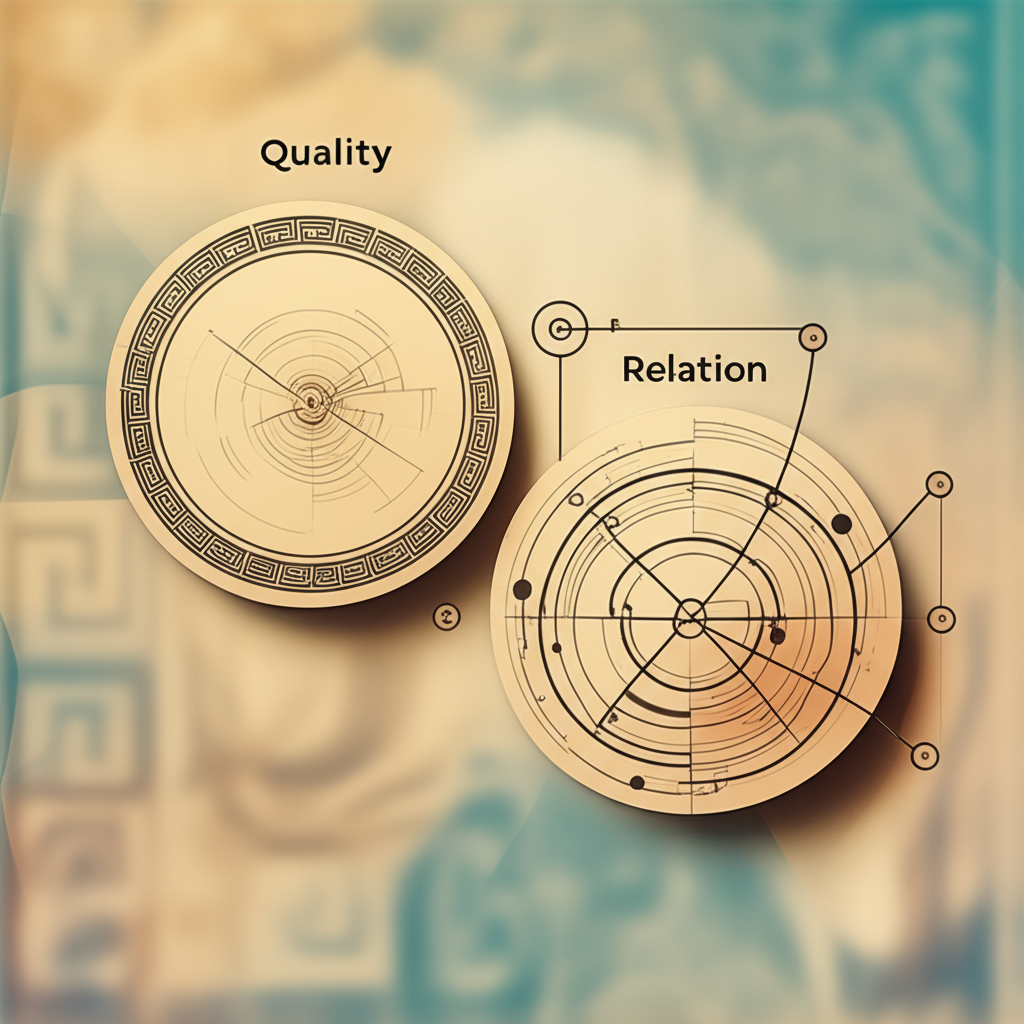
The Crucial Distinction: Why It Matters for Logic and Metaphysics
The difference between Quality and Relation is not a mere linguistic nuance; it's a profound conceptual divide that underpins much of our philosophical and scientific understanding. Misunderstanding this distinction can lead to significant logical errors and metaphysical confusion.
Quality vs. Relation: A Comparative Analysis
Let's consolidate the difference with a clear comparison:
| Feature | Quality | Relation |
|---|---|---|
| Nature | Intrinsic, inherent property | Extrinsic, comparative property |
| Focus | What a thing is in itself | How a thing stands to other things |
| Dependencies | Independent of other entities (for its being) | Dependent on at least two entities (for its being) |
| Mathematical Term | Monadic (describes one thing) | Polyadic (describes two or more things) |
| Question It Answers | "Of what sort?" / "What kind?" | "How does it stand to...?" / "How does it compare?" |
| Examples | Redness, sweetness, virtue, weight | Taller than, parent of, cause of, next to |
Implications for Understanding Reality
This distinction is vital for rigorous logic. If we confuse a quality with a relation, we might misattribute properties or misunderstand dependencies. For instance, if we say "beauty is in the eye of the beholder," we're not denying quality altogether, but positing that the relation between the object and the beholder is crucial for the experience of that quality.
In metaphysics, understanding this difference helps us categorize what exists. Is "love" a quality of a person (a loving disposition) or a relation between two people (the act of loving)? Often, it's both, but recognizing the distinct ways it functions conceptually allows for a more precise analysis. Plato, in his theory of Forms, grappled with how particulars relate to eternal qualities (Forms) like Beauty or Justice.
Historical Perspectives from the Great Books
The ongoing engagement with Quality and Relation demonstrates their enduring significance across centuries of philosophical inquiry.
Aristotle's Enduring Framework
As mentioned, Aristotle's Categories provides the earliest systematic treatment. For him, Quality and Relation are distinct ways of predication, fundamental modes of being. This framework has been foundational for Western logic and metaphysics, influencing thinkers for millennia.
Modern Philosophy's Engagement
- René Descartes distinguished between the qualities of mind (thought) and matter (extension), and explored the relation between them.
- John Locke's distinction between primary and secondary qualities profoundly impacted epistemology, examining how we know the qualities of objects.
- David Hume famously challenged the notion of necessary causal relations, arguing that we only perceive constant conjunctions of events, not an inherent bond. His skepticism forced philosophers to re-examine the very definition of relation in causality.
- Immanuel Kant integrated Quality (reality, negation, limitation) and Relation (substance and accident, cause and effect, community) into his table of categories of understanding. These categories are, for Kant, the necessary structures through which the mind organizes sensory experience, demonstrating their indispensable role in shaping our coherent world.
These thinkers, all represented in the Great Books of the Western World, show a continuous and evolving dialogue on how quality and relation define our understanding of substances, properties, and the very fabric of reality.
The Enduring Significance
The difference between Quality and Relation is more than a semantic quibble; it is a fundamental distinction that underpins our ability to describe, analyze, and comprehend the world. From the inherent attributes that define a thing to the intricate web of connections that bind everything together, these two concepts provide the essential building blocks for thought, logic, and metaphysical inquiry.
By rigorously differentiating between Quality and Relation, we gain clarity in our reasoning, avoid conceptual pitfalls, and deepen our appreciation for the nuanced complexity of existence. As you navigate the philosophical landscape, remember to always ask: Am I describing what this thing is in itself, or how it stands in connection to something else? The answer will often illuminate the path forward.
Further Exploration:
📹 Related Video: ARISTOTLE ON: The Nicomachean Ethics
Video by: The School of Life
💡 Want different videos? Search YouTube for: "Aristotle's Categories explained"
📹 Related Video: KANT ON: What is Enlightenment?
Video by: The School of Life
💡 Want different videos? Search YouTube for: "Locke Primary and Secondary Qualities"