

The Difference Between Monarchy and Tyranny: A Philosophical Inquiry
From the earliest philosophical inquiries into the nature of governance, the distinction between a ruler who serves the people and one who serves only themselves has been paramount. While both monarchy and tyranny often involve rule by a single individual, their fundamental purpose and method of governance diverge dramatically. In essence, a monarchy, as conceived by classical thinkers, is a form of government where a single, benevolent ruler governs for the common good, upholding justice and law. Tyranny, conversely, is a corrupted form of single-person rule, characterized by arbitrary power exercised for the ruler's self-interest, often through oppression and fear, with a blatant disregard for established law and the welfare of the populace. Understanding this ancient distinction is crucial for appreciating the foundations of political philosophy and the enduring quest for just governance.
Monarchy: Rule for the Common Good
The term "monarchy" derives from the Greek monos (one) and arkhein (to rule), literally meaning "rule by one." From a classical perspective, particularly as articulated by Aristotle in his Politics, monarchy was considered one of the good forms of government. It was envisioned as a state where a single, virtuous individual—a king or queen—exercised supreme authority, but always with the telos, or ultimate aim, of the well-being and prosperity of the entire community.
Key Characteristics of an Ideal Monarchy:
- Rule of Law: A true monarch governs within the framework of established laws and traditions, not above them. Their authority is bound by a higher moral or constitutional order.
- Justice and Virtue: The monarch is expected to embody justice, wisdom, and virtue, acting as a moral compass for the state. Plato's concept of the "philosopher-king" in The Republic is an extreme ideal of such a ruler, whose wisdom guides the polis towards the Good.
- Common Good: The primary motivation for monarchical rule is the welfare of the citizens. Decisions are made with the collective interest in mind, ensuring stability, security, and flourishing for all.
- Legitimacy: Historically, monarchical legitimacy often stemmed from hereditary succession, divine right, or a perceived natural superiority in leadership, granting the ruler a recognized, accepted authority.
In an ideal monarchy, the subjects willingly submit to the ruler's authority, trusting in their wisdom and commitment to the state. It's a relationship built on mutual duty and respect, rather than coercion.
Tyranny: Rule for Self-Interest
"Tyranny," originating from the Greek tyrannos, initially referred to an absolute ruler who seized power unconstitutionally. Over time, however, its definition evolved to emphasize the nature of the rule rather than merely its origin. Aristotle famously categorized tyranny as the perversion or degeneration of monarchy. Where a monarch rules for the common good, a tyrant rules purely for their own benefit, desires, and aggrandizement.
Key Characteristics of Tyrannical Rule:
- Arbitrary Power: A tyrant exercises power without constraint, ignoring laws, customs, or constitutional limits. Their will becomes the law.
- Self-Interest: The tyrant's decisions are motivated by personal gain, wealth, power, or pleasure, with no regard for the suffering or needs of the populace.
- Fear and Oppression: Tyrannical rule is maintained through intimidation, violence, censorship, and the suppression of dissent. Citizens live in constant fear, lacking fundamental freedoms.
- Illegitimacy (Moral): While a tyrant might hold de facto power, their rule lacks moral legitimacy because it fails to serve the community. John Locke, in his Two Treatises of Government, argued that tyranny is the exercise of power beyond right, and that such a ruler forfeits their authority.
- Instability: Despite appearances of strength, tyrannical regimes are inherently unstable, relying on constant vigilance and force, often leading to revolts or internal strife.
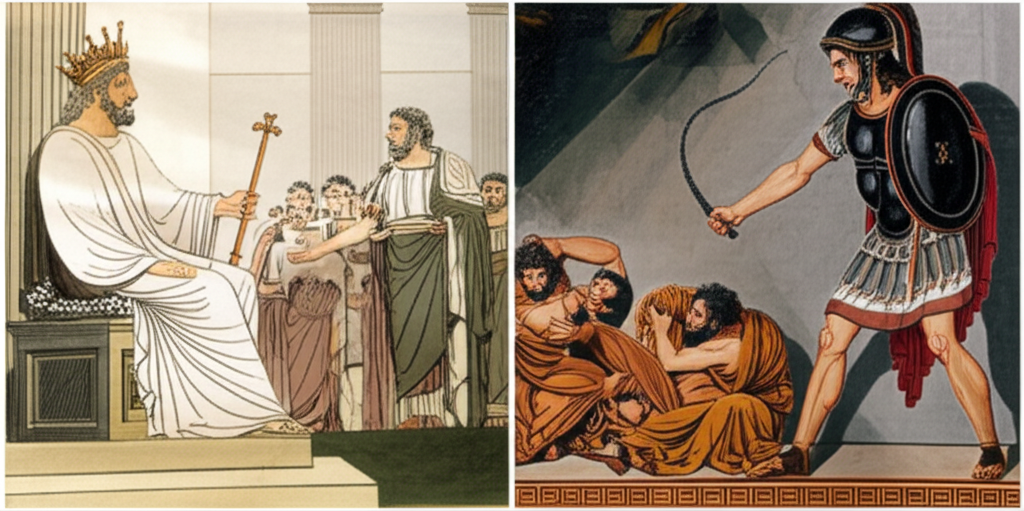
Distinguishing the Two: A Comparative View
The crucial differentiating factor between monarchy and tyranny lies in the intent and effect of the ruler's power. It's not merely about who rules, but how and why they rule.
| Feature | Monarchy (Ideal) | Tyranny (Corrupted) |
|---|---|---|
| Purpose | Common good, justice, welfare of the people | Self-interest, personal gain, power retention |
| Source of Law | Established laws, tradition, moral principles | Ruler's arbitrary will, personal decree |
| Method | Benevolent leadership, wisdom, consent of the governed | Fear, oppression, violence, suppression of dissent |
| Relationship with Subjects | Mutual duty, respect, trust | Coercion, subjugation, distrust |
| Legitimacy | Moral, traditional, often hereditary/divine | Power-based, often seized, morally illegitimate |
| Stability | Generally stable, based on acceptance | Inherently unstable, reliant on force |
Philosophical Perspectives on the Shift
The Great Books of the Western World are replete with discussions on this critical distinction. Aristotle's detailed analysis of political constitutions highlights how monarchy can degenerate into tyranny when the ruler abandons the common good for personal gain. He saw this as a natural corruption, much like an oligarchy (rule by the wealthy few for their own benefit) is a corruption of aristocracy (rule by the virtuous few for the common good).
Later thinkers, such as Niccolò Machiavelli in The Prince, while often interpreted as advocating for ruthless pragmatism, still implicitly recognize the ideal of a ruler who brings order and stability, even if the means are not always virtuous. However, Machiavelli's focus on maintaining power can sometimes blur the lines, suggesting that even a 'good' ruler might need to act tyrannically at times for the sake of the state. Yet, the core philosophical distinction remains: true governance aims at the flourishing of the governed, while tyranny exploits it.
The Enduring Relevance
In contemporary political discourse, where single-person rule is often viewed with suspicion, the classical distinction between monarchy and tyranny remains profoundly relevant. It reminds us that the form of government is less important than its function and ethical foundation. A government, whether it be a democracy, an aristocracy, or a monarchy, is only truly legitimate and just if it genuinely serves the interests of its people, adheres to a framework of law, and respects the dignity of its citizens. The concept of tyranny serves as a perpetual warning against the dangers of unchecked power and the corrosive effects of self-serving leadership on any political system.
The difference between monarchy and tyranny is not merely academic; it is a vital philosophical lens through which we can evaluate leadership, advocate for justice, and strive for governance that truly upholds the common good.
YouTube Video Suggestions:
-
📹 Related Video: ARISTOTLE ON: The Nicomachean Ethics
Video by: The School of Life
💡 Want different videos? Search YouTube for: "Aristotle Politics Monarchy Tyranny Explained"
2. ## 📹 Related Video: KANT ON: What is Enlightenment?
Video by: The School of Life
💡 Want different videos? Search YouTube for: "John Locke Two Treatises of Government Tyranny"