

The Labyrinth of Conscience: Exploring Sin and Moral Judgment
In the grand tapestry of human thought, few concepts are as deeply woven, as universally pondered, and as profoundly divisive as sin and moral judgment. From ancient myths to contemporary ethical debates, these ideas shape our understanding of right and wrong, culpability and redemption, and ultimately, what it means to be human. This pillar page delves into the multifaceted origins and evolutions of sin, the various frameworks through which we apply moral judgment, and the enduring philosophical questions these concepts provoke. We will traverse theological pronouncements, philosophical treatises, and modern critiques, drawing insights from the enduring wisdom contained within the Great Books of the Western World to illuminate this intricate landscape.
The Genesis of Sin: A Philosophical and Theological Inquiry
The notion of sin is not monolithic; it has undergone profound transformations across cultures and epochs, evolving from simple taboo to complex theological and existential dilemmas. At its core, sin represents a transgression – a crossing of a boundary, whether divinely ordained, socially constructed, or internally perceived.
Early Conceptions: From Taboo to Transgression
Long before formalized religions, early societies grappled with actions that brought misfortune or disrupted communal harmony. These were often understood as violations of sacred order or natural law, carrying immediate consequences.
- Ancient Greece: While the Greeks didn't have a direct equivalent to the Abrahamic concept of sin, they certainly understood transgression. Ate (blind folly or delusion) and hubris (excessive pride leading to downfall) were central to tragic narratives, as seen in Homer's epics and the plays of Sophocles. Plato, in works like The Republic, posited that injustice was a disharmony within the soul itself, a corruption more damaging to the perpetrator than the victim. The "sin" here is an internal disorder, a deviation from the rational and virtuous life.
- Pre-Axial Age Societies: Many cultures had elaborate systems of ritual purity and pollution, where certain acts or states rendered an individual 'unclean' and separated from the sacred. This separation, while not always carrying the same moral weight as later conceptions of sin, laid foundational groundwork for ideas of spiritual consequence.
The Abrahamic Perspective: Divine Law and Disobedience
The Abrahamic traditions (Judaism, Christianity, Islam) introduced a profound shift, centering sin as an act of disobedience against a benevolent, omnipotent God. This framework imbues sin with a unique moral and spiritual weight, emphasizing personal accountability and the need for atonement.
- Original Sin and Augustine's Legacy: Saint Augustine of Hippo, particularly in his Confessions and City of God, profoundly shaped Western Christian theology with his doctrine of Original Sin. For Augustine, sin is not merely individual acts but a fundamental flaw inherited from Adam's transgression, a turning away from God rooted in pride and self-love. This "fallen nature" predisposes humanity to evil.
- Aquinas and the Nature of Sin: Thomas Aquinas, in his Summa Theologica, meticulously categorized sin as a "deviation from right reason," a voluntary act or omission contrary to eternal law and natural law. He distinguished between venial and mortal sins, emphasizing the role of intellect and will in moral culpability. Here, sin is fundamentally a failure to act in accordance with God's rational order, which is also accessible through human reason.
Moral Judgment: Navigating the Ethical Compass
If sin defines transgression, then moral judgment is the process by which we evaluate actions, intentions, and character against a standard of Good and Evil. This judgment can be internal (conscience), external (societal norms, legal systems), or even divine.
The Foundations of Moral Authority: Internal and External
When we make a judgment about an action, on what basis do we do so? The authority for such judgments can stem from various sources:
- Conscience: Often considered an inner moral compass, conscience guides individual judgment. Philosophers like Joseph Butler argued for its innate authority, while others have seen it as a product of social conditioning.
- Divine Command Theory: For many religious traditions, moral laws are direct commands from God. An act is good because God commands it, and evil because God forbids it. This simplifies judgment but raises questions about arbitrary commands.
- Societal Norms and Law: Legal systems and cultural traditions codify what is acceptable or unacceptable, providing external standards for judgment. These often reflect a society's collective understanding of Good and Evil.
Rationality and Duty: Kant's Categorical Imperative
Immanuel Kant, a towering figure in Enlightenment philosophy, sought to ground moral judgment in pure reason, independent of religious dogma or personal inclination. His ethical system, detailed in works like Groundwork of the Metaphysics of Morals, centers on the Categorical Imperative.
- Duty and Good Will: For Kant, the moral worth of an action lies not in its consequences, but in the intention behind it – specifically, acting from duty. A "good will" is the only thing good without qualification.
- Universalizability: The Categorical Imperative states that one should "act only according to that maxim whereby you can at the same time will that it should become a universal law." This provides a rational test for moral actions, making judgment an exercise in universal application. An action is morally permissible if and only if it could be willed by everyone without contradiction.
Consequentialism vs. Deontology: Measuring Moral Outcomes
The debate between consequentialist and deontological ethics forms a fundamental divide in how we approach moral judgment.
| Ethical Framework | Primary Focus | Key Question for Judgment | Representative Thinkers |
|---|---|---|---|
| Deontology | Duty and Rules | Is the action inherently right? | Immanuel Kant, W.D. Ross |
| Consequentialism | Outcomes and Results | Does the action produce the best outcome? | Jeremy Bentham, John Stuart Mill |
| Virtue Ethics | Character and Virtue | What kind of person should I be? | Aristotle, Alasdair MacIntyre |
While not strictly consequentialist, Aristotle's virtue ethics (from Nicomachean Ethics) provides an alternative framework, focusing not on judgment of individual acts as much as the development of a virtuous character. A virtuous person, possessing practical wisdom, would naturally make good judgments.
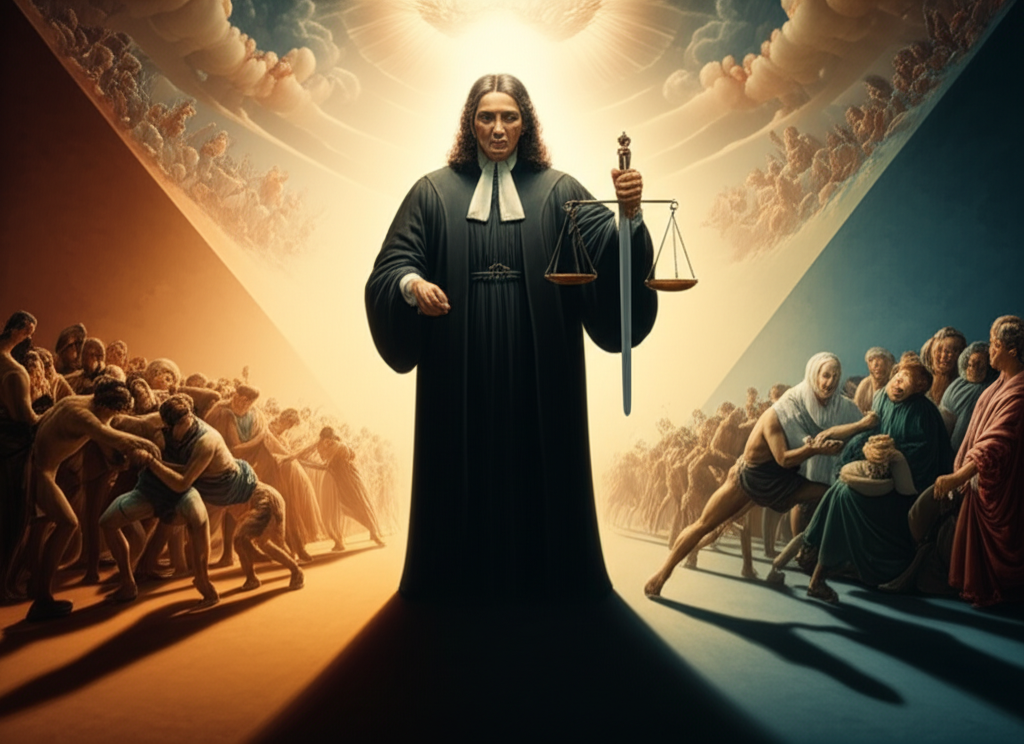
Beyond Good and Evil? Modern and Post-Modern Critiques
The Enlightenment's emphasis on reason paved the way for profound critiques of traditional notions of sin and moral judgment, challenging their very foundations.
Nietzsche's Revaluation of Values
Friedrich Nietzsche, in works like Beyond Good and Evil and On the Genealogy of Morality, launched a radical assault on conventional morality. He argued that concepts of Good and Evil were not universal truths but historical constructs, particularly the "slave morality" born from the resentment of the weak against the strong.
- Will to Power: Nietzsche proposed that all human action is driven by a "will to power," and that traditional morality stifles human flourishing.
- Transvaluation of Values: He called for a "transvaluation of all values," urging individuals to overcome traditional judgment and create their own morality, leading to the emergence of the Übermensch. For Nietzsche, the concept of sin was a tool of oppression.
Existentialism and Radical Freedom
Existentialist thinkers like Jean-Paul Sartre emphasized radical human freedom and responsibility. If "existence precedes essence," then there is no pre-ordained human nature or divine law to dictate Good and Evil.
- Condemned to be Free: Sartre argued that we are "condemned to be free," meaning we are solely responsible for our choices, and thus for the values we create. This perspective largely evacuates the traditional concept of sin, replacing it with an overwhelming sense of responsibility and the anguish of choice. Moral judgment becomes an intensely personal and self-imposed burden.
The Sociological Lens: Sin as Social Construct
More contemporary sociological and anthropological perspectives often view sin and moral judgment as products of specific social and cultural contexts.
- Foucault and Power Structures: Michel Foucault, for instance, explored how institutions (like prisons, asylums, and even confession in The History of Sexuality) construct categories of deviance and morality, serving to maintain power structures. From this viewpoint, sin is not an inherent moral failing but a label applied by dominant forces.
The Interplay of Sin, Judgment, and Human Experience
Regardless of one's philosophical or theological stance, the concepts of sin and judgment deeply impact individual psychology and societal structures.
Guilt, Shame, and Redemption
The internalization of moral judgment often manifests as guilt or shame. Guilt typically arises from the awareness of having violated a moral standard, while shame is often linked to a perceived failure of one's self or identity.
- Psychological Impact: These emotions can be profoundly debilitating or, conversely, act as powerful motivators for change and self-improvement.
- The Path to Redemption: Many traditions, both religious and secular, offer pathways to redemption, whether through atonement, forgiveness, or therapeutic processes, allowing individuals to reconcile with their past transgressions and societal judgment.
Forgiveness and Justice
On a societal level, the concept of judgment directly informs legal systems and ideas of justice. How do societies respond to acts deemed "sins" or moral transgressions?
- Retributive Justice: Focuses on punishment for past wrongs, often reflecting the severity of the sin or crime.
- Restorative Justice: Aims to repair harm caused by the offense, involving victims, offenders, and communities in finding solutions.
- The Act of Forgiveness: Whether interpersonal or societal, forgiveness offers a release from the cycle of judgment and retribution, though it remains one of the most challenging and complex human acts.
Conclusion: The Enduring Quest for Moral Understanding
The journey through the concepts of sin and moral judgment reveals a landscape of profound complexity, stretching from ancient taboos to modern existential anxieties. Whether viewed through the lens of divine command, rational duty, or socio-cultural construction, these ideas continue to shape our individual consciences and collective societies. The Great Books of the Western World stand as testament to humanity's relentless quest to define Good and Evil, to understand the nature of transgression, and to navigate the intricate process of judgment. As Daniel Fletcher, I contend that this ongoing philosophical inquiry is not merely academic; it is the very bedrock upon which we build our ethical lives, our communities, and our understanding of what it truly means to be human in a world perpetually grappling with its own moral compass.
📹 Related Video: PLATO ON: The Allegory of the Cave
Video by: The School of Life
💡 Want different videos? Search YouTube for: ""Plato's Republic: Justice and the Soul""
📹 Related Video: What is Philosophy?
Video by: The School of Life
💡 Want different videos? Search YouTube for: ""Nietzsche: Beyond Good and Evil - Crash Course Philosophy""