

The Enduring Nexus: Exploring the Citizen's Relationship to the State
The relationship between the citizen and the State is perhaps one of the most fundamental and enduring questions in political philosophy, shaping societies from ancient poleis to modern democracies. At its core, this intricate bond defines who we are as individuals within a collective, delineating our rights, responsibilities, and the very structure of our shared existence. This article delves into the historical philosophical underpinnings of this relationship, examining how thinkers from the Great Books of the Western World have grappled with concepts of law, duty, and the delicate balance between individual liberty and collective order.
A Fundamental Inquiry: Defining Our Place
The question of how the citizen relates to the State is not merely academic; it is deeply personal and profoundly political. It touches upon the source of authority, the limits of power, and the ethical obligations we hold towards one another and the governing structures we inhabit. From ancient Greece to the Enlightenment, philosophers have sought to articulate the terms of this engagement, often through the lens of the social contract, natural rights, or the pursuit of the common good. Understanding these perspectives is crucial for navigating our contemporary world, where the boundaries of State power and citizen agency are constantly being renegotiated.
Historical Foundations: Voices from the Great Books
The philosophical exploration of the citizen-State dynamic has a rich lineage, with each era contributing nuanced perspectives.
The Polis and the Good Life: Plato and Aristotle
For the ancient Greeks, particularly Plato and Aristotle, the State (the polis) was not merely an administrative entity but the essential framework for human flourishing.
- Plato's Republic: Envisioned an ideal State structured to achieve justice, where each citizen performed their duty according to their nature, ensuring the harmony of the whole. The individual's good was inextricably linked to the good of the polis.
- Aristotle's Politics: Argued that man is by nature a "political animal," meaning that full human potential could only be realized within the community of the State. The citizen's duty was to participate in the life of the polis, and the purpose of the State was to facilitate the good life for its members.
The Social Contract Theorists: Hobbes, Locke, and Rousseau
Centuries later, the Enlightenment brought forth the concept of the social contract, radically re-framing the relationship.
| Philosopher | Core Idea | Citizen's Role | State's Role | Key Work |
|---|---|---|---|---|
| Thomas Hobbes | Fear of a brutal "state of nature" leads citizens to surrender nearly all rights to an absolute sovereign for security. | Obedience to Law; no right to rebellion. | Absolute authority to maintain order and prevent chaos. | Leviathan |
| John Locke | Citizens possess inherent natural rights (life, liberty, property) which the State is formed to protect. Consent is key. | Limited duty to obey Law; right to resist tyranny if the State violates natural rights. | Protect natural rights; power derived from the consent of the governed. | Two Treatises of Government |
| Jean-Jacques Rousseau | Citizens surrender individual rights to the "general will" of the community, thereby gaining collective freedom. | Active participation in forming the "general will"; duty to obey laws made by the collective. | Enforce the "general will," ensuring collective freedom and equality. | The Social Contract |
These thinkers profoundly shifted the discourse, introducing ideas of consent, natural rights, and the legitimacy of government based on the will of the governed.
The Citizen: Rights, Responsibilities, and Identity
The concept of the citizen is dynamic, evolving from a participant in the Greek polis to a subject under a monarch, and eventually to an individual endowed with rights in a liberal democracy.
- Rights: Modern citizenship is often defined by a set of civil, political, and social rights – freedom of speech, the right to vote, access to education, etc. These rights establish a sphere of autonomy for the individual against the power of the State.
- Responsibilities (Duty): Alongside rights, there are inherent responsibilities. These include obeying the law, paying taxes, participating in civic life, and, in some contexts, military service. The balance between rights and duty is a constant negotiation.
- Identity: Being a citizen also confers a sense of belonging and identity within a political community, shaping one's relationship not only to the State but also to fellow citizens.
The State: Order, Justice, and Power
The State is the primary political organization that exercises authority over a defined territory and its population. Its functions are manifold:
- Maintaining Order: Through the establishment and enforcement of law, the State ensures peace and stability, preventing a return to a "state of nature."
- Administering Justice: Providing mechanisms for resolving disputes and punishing wrongdoing, ideally impartially and according to established law.
- Providing Public Goods: Offering services like infrastructure, education, healthcare, and defense that benefit all citizens and cannot be efficiently provided by individuals alone.
- Protecting Rights: In liberal democracies, a core duty of the State is to safeguard the rights and freedoms of its citizens.
However, the State also possesses immense power, which, if unchecked, can lead to oppression. The tension between the State's necessary authority and the citizen's desire for freedom is a perpetual challenge.
The Binding Force: Law and Duty
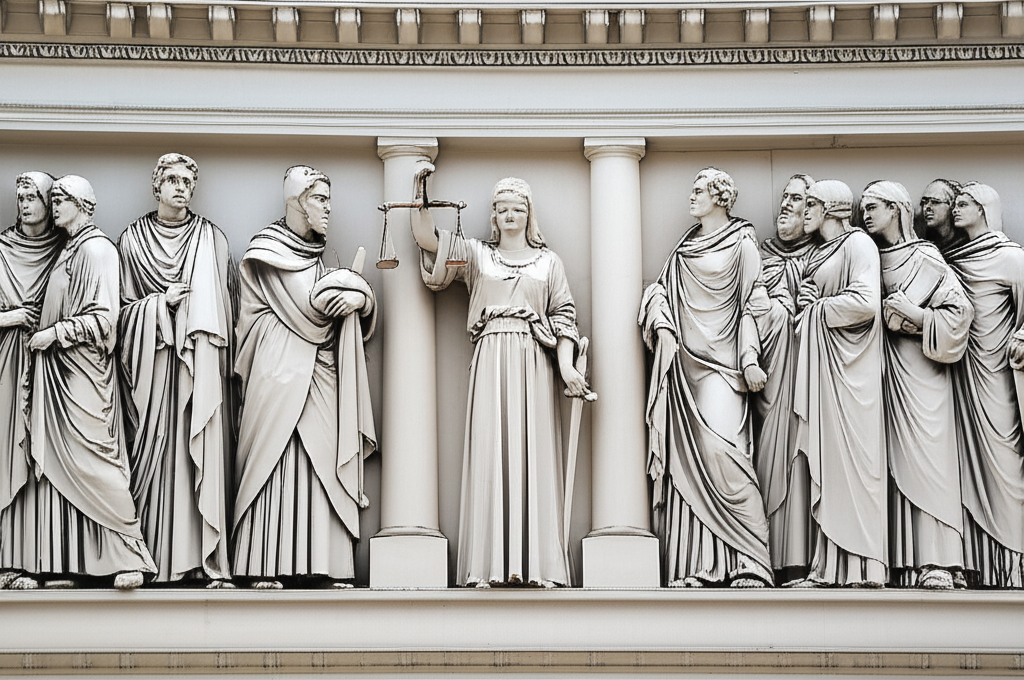
Law is the primary mechanism through which the State governs and the citizen understands their obligations. It is the formal expression of societal rules and norms, backed by the coercive power of the State.
- Source of Legitimacy: The legitimacy of law can derive from divine decree, natural reason, tradition, or the consent of the governed. For many philosophers, the law is legitimate only if it serves the common good or protects fundamental rights.
- Rule of Law: A cornerstone of stable societies is the principle that everyone, including those in power, is subject to the law. This prevents arbitrary rule and ensures predictability and fairness.
- Duty to Obey: A fundamental duty of the citizen is to obey the law. This duty is often seen as reciprocal to the State's duty to protect and provide.
When Duty Conflicts: Civil Disobedience
What happens when a citizen's conscience conflicts with the State's law? Philosophers like Henry David Thoreau and Martin Luther King Jr. have explored the concept of civil disobedience, arguing that an unjust law may not command moral obedience. This is not a rejection of the State itself, but a profound appeal to its moral principles, often undertaken with a willingness to accept the legal consequences. It highlights the dynamic and sometimes contentious nature of the citizen's duty to the State.
Conclusion: An Ongoing Dialogue
The relationship between the citizen and the State is a complex, evolving, and often contested domain. It is a perpetual dialogue, a negotiation of power, rights, and responsibilities that defines the very essence of political life. From the ancient Greek ideal of the polis as the arena for human flourishing, to the Enlightenment's emphasis on individual rights and consent, to contemporary debates about global citizenship and digital governance, this fundamental relationship continues to shape our societies. Understanding its philosophical underpinnings is not just an academic exercise; it is an essential part of being an engaged and informed citizen in the ongoing pursuit of a just and equitable State.
YouTube: "social contract theory explained"
YouTube: "Plato Aristotle politics citizenship"
📹 Related Video: What is Philosophy?
Video by: The School of Life
💡 Want different videos? Search YouTube for: "The Citizen's Relationship to the State philosophy"