

The Enduring Dance: Oppositional Forces in Nature
Summary: From the cosmic ballet of celestial bodies to the microscopic interactions within an atom, the universe is a symphony of oppositional forces. This article explores the profound principle that conflict and contrast are not merely incidental but fundamental to the very fabric of nature, driving all change and sustaining existence. Drawing from the wisdom embedded within the Great Books of the Western World, we shall uncover how this inherent tension is the wellspring of dynamism, form, and life itself.
The Inescapable Principle of Opposition
In the grand tapestry of existence, few truths resonate with such profound consistency as the presence of oppositional forces. It is a fundamental principle woven into the very structure of reality, an inescapable dynamism that defines and propels the world around us. Far from being a mere anomaly, this interplay of contraries is the engine of all change, the crucible in which new forms emerge and old ones transform.
From the earliest philosophical inquiries, thinkers have grappled with this pervasive duality. The ancient world, in particular, offered profound insights into how nature itself seems to thrive on a delicate balance of competing elements, a constant push and pull that prevents stagnation and ensures perpetual motion.
Ancient Echoes: Heraclitus and the Flux of Being
Perhaps no philosopher encapsulated this idea more succinctly than Heraclitus of Ephesus, whose fragments echo through the millennia. For Heraclitus, strife (polemos) was not a destructive force but the very "father of all things," the underlying principle that brings forth and maintains the cosmos.
Key Heraclitean Insights:
- "War is the father of all and king of all." This isn't a call for literal conflict, but an assertion that the tension between opposites is the source of all becoming.
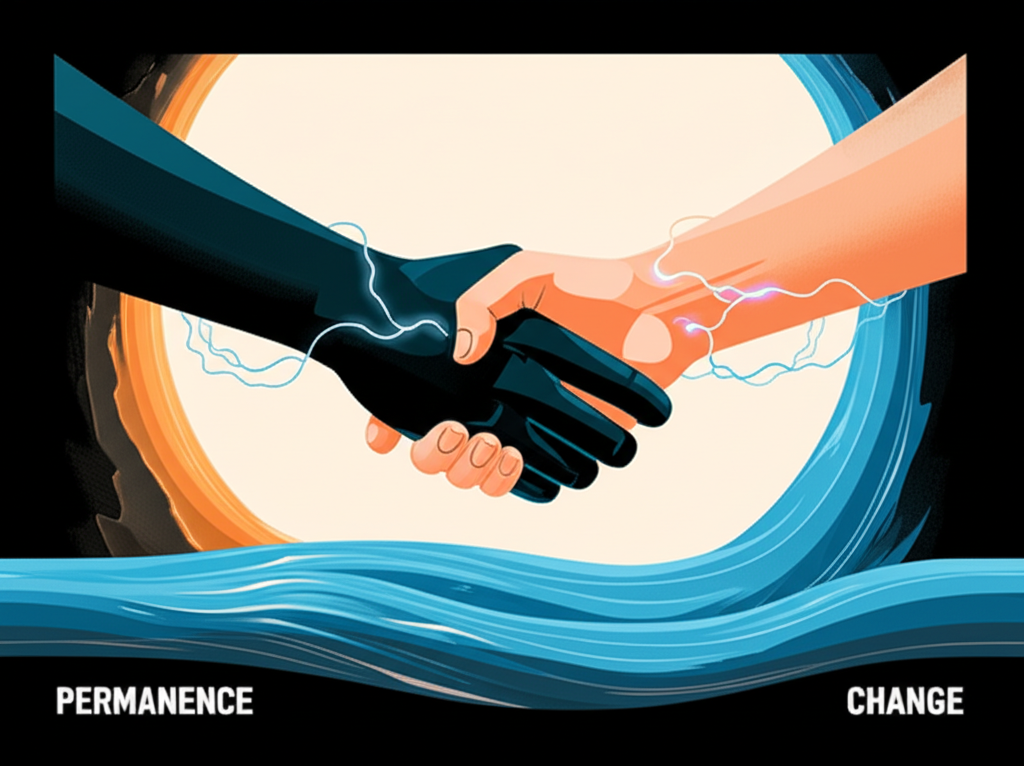
- The Unity of Opposites: Day and night, hot and cold, up and down – these are not separate entities but two sides of the same coin, defining each other through their contrast. "Good and ill are one."
- Perpetual Change: The famous dictum, "You cannot step into the same river twice," speaks to the constant flux, where change is the only constant, driven by these inherent oppositions.
Aristotle's Dialectic of Potency and Act
Moving forward in the lineage of Western thought, Aristotle, in his meticulous analysis of nature, also recognized the crucial role of opposition. His concepts of potency and act, for instance, describe a fundamental principle of development and realization. A seed (potency) strives to become a tree (act), overcoming the opposition of its current state through growth and change.
Aristotle's categories of contraries (e.g., hot/cold, wet/dry, large/small) are not merely descriptive but are seen as active forces that interact within substances, leading to qualitative transformations. The very process of generation and corruption, of coming into being and passing away, is predicated on the interaction and change brought about by these inherent oppositions in nature.
The Creative Tension: How Opposition Drives Change
The understanding gleaned from the Great Books reveals that opposition is not merely destructive but profoundly generative. It is the catalyst for evolution, adaptation, and the emergence of complexity.
Mechanisms of Change through Opposition:
| Oppositional Force Pair | Natural Manifestation | Philosophical Implication |
|---|---|---|
| Expansion vs. Contraction | Cosmic inflation, breathing, tides | The rhythm of creation and destruction |
| Attraction vs. Repulsion | Gravity, electromagnetism, chemical bonds | The formation and dissolution of structures |
| Growth vs. Decay | Life cycles, erosion, metabolism | The cyclical nature of existence, renewal |
| Order vs. Chaos | Ecosystems, weather patterns, societal structures | The constant striving for equilibrium and adaptation |
This principle extends beyond the purely physical. In intellectual discourse, the opposition of ideas (thesis and antithesis) is what drives philosophical inquiry and leads to new understanding (synthesis), a concept famously explored by Hegel in his dialectical method. Even in human experience, the contrast between joy and sorrow, struggle and triumph, gives depth and meaning to life.
Nature's Constant Negotiation
Consider the intricate balance of an ecosystem. Predator and prey exist in a dynamic opposition, yet this very tension ensures the health and evolution of both populations. Without predators, prey populations might overgraze, leading to resource depletion; without prey, predators would starve. This delicate, often brutal, opposition fosters resilience and change across generations.
Similarly, geological processes are driven by immense oppositional forces: the pressure of tectonic plates pushing against each other, leading to mountain formation; the erosive power of water and wind against the solidity of rock. These slow, relentless conflicts sculpt the landscape, demonstrating that change is the inevitable outcome of sustained opposition.
Embracing the Principle of Oppositional Change
The philosophical journey through the Great Books illuminates a crucial lesson: to understand nature is to understand the enduring principle of opposition. It is not a flaw in the design of the universe but its very essence, the dynamic tension that prevents stasis and ensures the perpetual unfolding of reality.
To resist change is to resist this fundamental principle. To ignore opposition is to misunderstand the very mechanisms that give rise to complexity, beauty, and life itself. By recognizing and even embracing these inherent forces, we gain a deeper appreciation for the continuous dance of existence, a dance where every step, every tension, every contrast, contributes to the grand, unfolding narrative of nature.
📹 Related Video: What is Philosophy?
Video by: The School of Life
💡 Want different videos? Search YouTube for: ""Heraclitus Philosophy of Change" for an exploration of ancient Greek ideas on flux and opposition."
📹 Related Video: PLATO ON: The Allegory of the Cave
Video by: The School of Life
💡 Want different videos? Search YouTube for: ""Hegel Dialectic Explained" for a modern philosophical perspective on thesis, antithesis, and synthesis."