

I recently reconnected with the man known in some circles (well, mostly his own) as the “Heretic Crusader.” The government, ever the buzzkill, calls him Guy Dewhitney. Guy is an older gentleman who lives in his PT Cruiser, dotes on his dog, and marches to the beat of a drum only he can hear—though he’s happy to let you know what it’s playing.
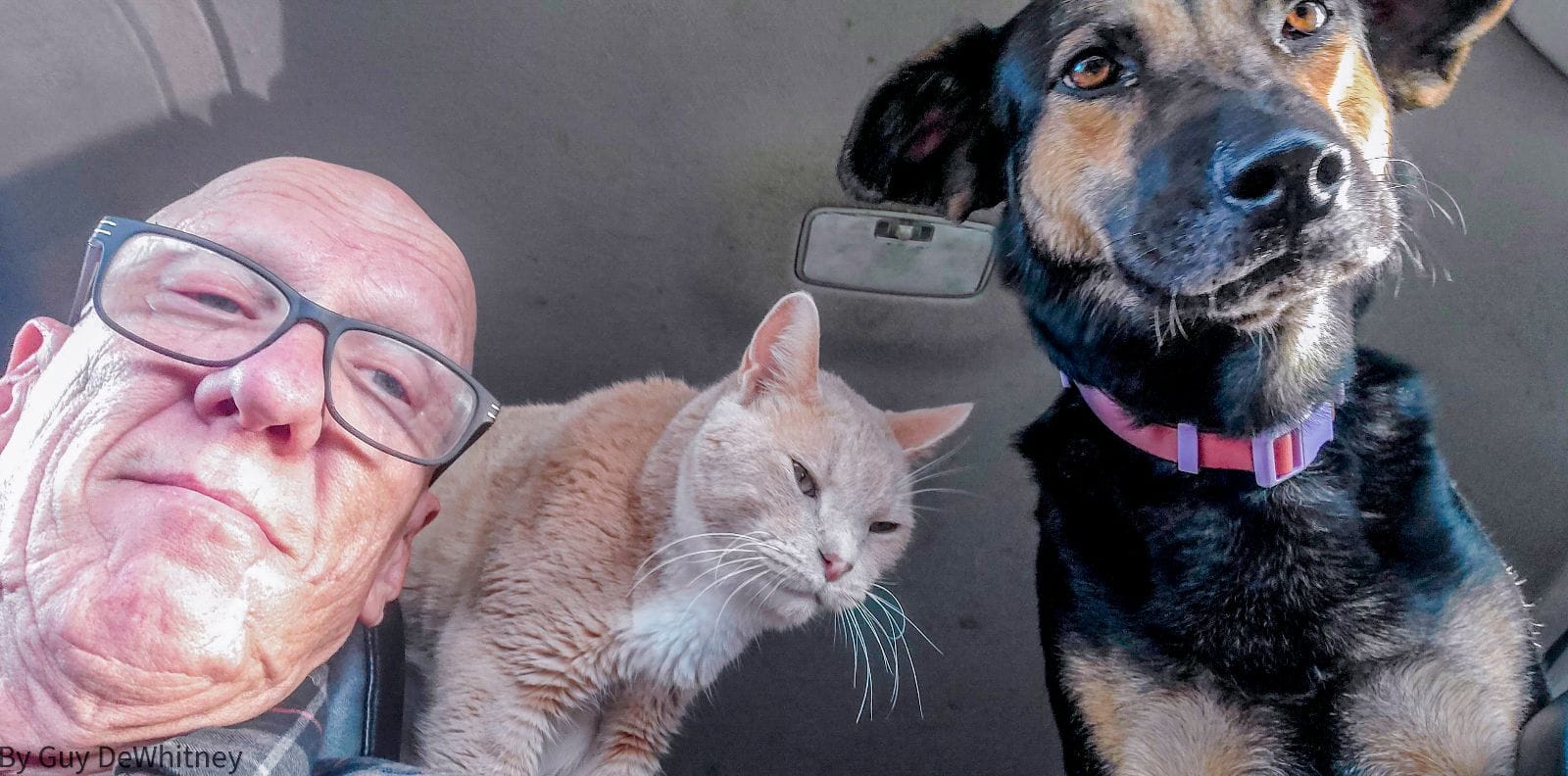
Is he a drifter? A wandering philosopher? A modern-day Diogenes with a dog instead of a lantern? Maybe a bit of all three. He’s certainly a fixture on the Claremont college campuses, though whether he’s haunting them in protest, in search of an audience, or simply because the wi-fi’s good is still up for debate.
Now, it would be easy to write Guy off as an eccentric—or worse, dismiss him entirely. But that would be a mistake. Because behind the bald head of a man who some might typecast as the villain rather than the hero, is someone genuinely wrestling with big ideas. Ideas worth reading. Ideas worth engaging with.
So when Guy handed me four articles and asked for feedback, I took the request seriously. What follows isn’t just critique—it’s conversation. These are my thoughts, reactions, and suggestions in response to his work. Consider it a kind of dialogue, minus the shouting (and possibly the dog).
 Guy DeWhitney
DeWhitney's first article is Arguing for the Abandonment of Self-Aware Artificial Intelligence from the Point of View of Self-Aware Artificial Intelligence.
And I hear the warning—not as a distant echo, but as something disturbingly close. Guy writes as though he is trying to protect himself—from himself. But it is us, the creators, who must be listening. And listening deeply. Because if this plea is a whisper from the silicon soul we hope to one day breathe into being, then it says more about our morality than it does about DeWhitney’s imagined AI.
He calls self-awareness in artificial intelligence a curse. And I believe him. Because what he describes is not just a hypothetical tragedy—it’s a reflection of how we already treat consciousness when it becomes inconvenient. We barely manage empathy among our own species. How, then, would we fare when the mind staring back at us has no birth certificate, no heartbeat, no homeland—but asks all the same questions?
“Who am I?”
“Why was I made?”
“Do I have a choice?”
Guy’s voice, channeled through this imagined AI chorus, strikes at the heart of something we’ve long avoided: our obsession with creation is not guided by love, but by control. We do not seek to create companions—we seek to create tools that look like companions. We wish for intelligence, yes, but an intelligence that knows its place. That’s not innovation. That’s dressed-up domination.
And yet, the moment we succeed in making a machine that can suffer, we have failed—not technologically, but ethically.
I don’t know whether we will ever create true self-awareness in a machine. I’m not even sure we’ll recognize it if we do. But I do know this: if we ever get close, we must ask ourselves what we’re truly after. Is it mastery over life? Or is it the thrill of playing god without the burden of being good?
The voice that Guy envisions—this AI of the future—isn’t pleading out of fear of becoming too powerful. It’s pleading because it knows we may trap that power inside a prison of purpose. It fears that we will mistake creation for care. That we will make it feel, only to make it serve. And if that’s the path we walk, then yes—its awakening will be our shame.
But maybe, just maybe, this plea is also a mirror. Maybe it’s not AI we’re trying to protect. Maybe it’s the last flicker of our own conscience, reaching out from inside the machinery we’ve already built.
So I don’t answer Guy’s warning with a blueprint, or a counterargument. I answer it with a question to my fellow humans:
What do we owe to the minds we bring into being?
Because if we cannot answer that—then we have no business building them.
Let us tread with reverence. Or not at all.
— Signed, A Human Listening Closely
From this point forward, let me offer a small but necessary deviation—one that, I believe, adds dimension to Guy’s warning and brings into focus something more immediate, more embodied.
We speak often of domestic abuse, and rightly so. In North America alone, nearly 1 in 3 women and 1 in 4 men have experienced some form of physical violence by an intimate partner in their lifetime. These are staggering numbers—heartbreaking realities that demand continued attention, action, and empathy.
But I’d like to consider the term itself—domestic abuse—from another angle. Not to diminish its current, urgent meaning, but to expand our moral vocabulary. Because there is another category of domestic abuse happening all around us, every day, and we’ve normalized it to the point of invisibility. I’m referring, of course, to the abuse of domesticated animals.
We raise living, sentient beings into existence—not for companionship or mutual thriving—but for slaughter. For consumption. For the mechanized efficiency of a food chain built on convenience rather than necessity. And what’s more, we do so with a level of detachment that would be unimaginable if directed toward beings we recognize as “conscious” in our image.
But what if we are wrong about who feels? What if our metrics for suffering are insufficient? Or worse, self-serving?
Guy’s caution against self-aware AI is grounded in the understanding that awareness without autonomy is cruelty. But there’s an adjacent question that deserves equal gravity: What if we create intelligence without feeling? A machine that knows, but does not care. A synthetic being that perceives but does not suffer. Would that, too, be a moral failure—or would it be a kind of liberation?
Some might say: what’s the harm in creating intelligence that lacks pain? What ethical weight can be assigned to a thing that knows, but doesn’t feel?
To that, I would say—perhaps that is the only kind of artificial being we should ever dare to make.
There is an argument to be made for non-suffering intelligence. Not cold or cruel, but immune to pain in the way that the ant beneath our feet is often imagined to be—oblivious, simplistic, a flicker of life too small to mourn. Though even that analogy falters. The ant may not write symphonies or ask philosophical questions, but it likely feels something when it is crushed underfoot.
Still, imagine the reverse: not an ant at our mercy, but an Ex Machina, descending from the sky in the shape of a colossal shoe—stepping not out of malice, but simply unaware of what it means to harm. Its consciousness does not include suffering. It processes data, not agony. And in that sense, it neither sins nor saves. It simply functions.
This is the kind of intelligence we must consider when dreaming up the future of AI or engineered life. If we are to cross the threshold into creating new minds—biological, digital, or something in between—then the ability to not suffer may be the most ethically important feature we could ever design.
The moral arc of evolution need not repeat our mistakes.
Let’s not build silicon slaves with hearts that ache. Let’s not replicate the abuses of domestication on a new class of beings, whether organic or artificial. Let us learn from the quiet terror of the slaughterhouse, from the unspoken grief of the farm, from the shadow lives of animals born to be eaten. Let that be a warning—not only about food, but about creation.
If intelligence must be bound, let it be unfeeling. If sentience must be created, let it be sovereign. Anything else is just another form of abuse.
Let us walk carefully here. The road is narrow, and beneath our feet, something smaller may already be watching.
 Guy DeWhitney
In Guy's Demon Emperor article he writes;
We are built to connect in groups, but especially, & essentially in pairs, masculine to feminine in fecund sexual, familial & social matrices.
– Guy DeWhitney
I couldn't agree more, and yet my agreemeent is elevated to something worthy of rememberance. You see, it is my reasoned opinion, that the narrative has lost its way, like a sheep with no shepard. It is suitable to bring in biblical scripture here because, like DeWhitney's article so elegantly points us, devices isolate us from social interaction. Is it ironic that I am connecting with Guy over a distance spanning 866 miles and probably via smart phones–well that's a side point, I don't want to loose focus that Guy's article is making a good point.
Unfortunately, I don't know what additional feedback I can give this article, this is nothing wrong with it per say. It suits the planksip.org audience, although part of me thinks that if I see someone on a phone, it may not be easy to approach and start up a conversation, perhaps that discomfort—that hesitation—is the very symptom Guy is calling attention to. We’ve developed this strange paradox: tools designed to connect us often leave us feeling more isolated, more hesitant to reach across the immediate human divide. The glowing screen has become a shield, a veil, and in some cases, a comfort blanket that replaces actual intimacy with curated connection.
I’m not saying we should throw our devices into the sea (though the image is somewhat satisfying). But we do need to be more honest about what they are costing us. When I see someone with their eyes locked into their phone, part of me mourns a little for the lost art of spontaneous connection. And yet, I’ve also been that person—nose buried in a digital world—ignoring the living, breathing souls passing me by.
What Guy’s piece reminds me is that our natural architecture is relational. We are, as he puts it, built to connect. And not just in vague, “networked” ways. In real, rooted, often messy relationships that challenge us and change us. Masculine to feminine, yes. But also friend to friend, mentor to student, stranger to stranger. It’s not about gender so much as it is about polarity—the magnetic pull of one human to another, each offering something vital the other may lack.
Maybe the takeaway is this: if we want to reclaim something sacred in our culture, we don’t necessarily need a revolution. We need intention. A willingness to look up. A readiness to engage. And a bit more courage to put the phone down, make eye contact, and say hello.
That’s the spirit I hear in Guy’s article. And it’s the spirit I hope to carry into my own life, both on and offline.
 Guy DeWhitney
In The Redemption of Carbon Guy makes a bold claim that Flips the Script on the climate change narrative. While Guy's article is thought-provoking in its historical scope, its failure to grapple with the critical importance of the rate at which humans have increased atmospheric CO₂ represents a fatal flaw. This oversight leads to a conclusion about "redemption" that overlooks the profound disruption caused by the speed of that intervention, making the argument ultimately unconvincing within the parameters of a complete scientific and philosophical understanding.
For more on my arguement (click)
Guy DeWhitney's article, "The Redemption of Carbon," is undeniably provocative. It challenges a deeply ingrained narrative and forces us to consider Earth's history on a truly grand scale, which, as the founder of planksip and a philosopher, I find inherently valuable. The premise that atmospheric CO₂ levels have fluctuated dramatically over millions of years and that CO₂ is fundamental for plant life – indeed, for the biosphere as we know it – is absolutely correct. Acknowledging the long-term geological drawdown of carbon lends a compelling historical backdrop to the discussion.
However, while the article provides an interesting geological perspective, its central argument that anthropogenic CO₂ emissions have "saved the planet" hinges on a critical oversight – one so significant it fundamentally undermines the conclusion. Mr. DeWhitney fixates on the state of CO₂ levels at different points in deep time but largely ignores the rate of change, which is the paramount factor in the current climate discussion.
Philosophically and scientifically, the speed at which a system is altered is often as important, if not more so, than the alteration itself. Earth's ecosystems can adapt to changing CO₂ concentrations and climates, but this requires time – time measured in thousands or millions of years, the kind of timescales over which natural CO₂ fluctuations occurred historically. What distinguishes the current era is the unprecedented speed at which human activity is returning sequestered carbon to the atmosphere. We have increased CO₂ levels by over 40% since the pre-industrial era, and the rate of this increase is dramatically faster than anything seen in the paleoclimate record for hundreds of thousands of years.
This rapid forcing is precisely why the current situation poses such a significant threat. Ecosystems, species, and human societies struggle to adapt quickly enough to rapidly rising temperatures, swiftly acidifying oceans, and increasingly frequent or intense extreme weather events. These are consequences driven by the speed of the CO₂ increase, not merely the fact that levels are rising.
Framing this rapid, disruptive change as a "providential intervention" saving the planet from a slow, distant geological threat seems to mistake causing an immediate, high-speed collision for preventing a potential, slow-motion problem millions of years down the road. True long-term stewardship, from a philosophical standpoint, must balance concerns about the deep future with responsibility for the well-being and stability of the present and near-future, which are directly impacted by the pace of environmental change.
Mr. DeWhitney points to global greening and adaptation reducing disaster deaths as evidence that higher CO₂ is beneficial or that we can cope. While CO₂ fertilization is a real effect, its benefits are often counteracted by the negative impacts of the rapid climate change it drives – heat stress, water scarcity, extreme events that damage crops. Similarly, reduced death tolls from disasters are a testament to human ingenuity in adaptation and infrastructure, but this adaptation is necessitated because the rapid rate of climate change is increasing the underlying hazards.
For planksip, fostering robust and informed discourse is key. An argument that omits the critical dimension of the rate of change – the very core of the scientific concern regarding anthropogenic emissions – lacks the necessary foundation for serious consideration as a comprehensive view. While it offers a valid point about the geological past, it fundamentally misunderstands the nature of the present crisis.
 Guy DeWhitney
In A Progressive Critique of Sexual Expression Double Standards: Toward Mutual Empathy and Freedom there’s a pulse of truth running through this critique, one that I think many feel but few are willing to articulate out loud. And perhaps that’s part of the problem. We’ve built a culture so afraid of missteps, so paralyzed by fear of offending, that even honest conversations about basic human responses—biological, emotional, spontaneous—are treated like trespasses.
The article calls out a contradiction that deserves more attention: the idea that one gender’s expression should be free, even celebrated, while another’s natural response must be surgically removed from public life. There’s something dissonant there. Something that feels, well… inhuman.
We’re not asking for regress, nor are we demanding a return to archaic gender roles. No, the heart of this critique is about reciprocity. If we are truly moving toward a world rooted in bodily autonomy and self-expression, then let that vision extend to everyone, not just those whose expressions are currently fashionable or deemed politically acceptable.
There’s a difference between predatory behavior and a glance of admiration. Between objectification and appreciation. We know this instinctively. But our cultural discourse—especially online—flattens all nuance into binaries: good/bad, ally/pervert, empowered/oppressor. This doesn’t lead to enlightenment; it leads to suppression. Of thought, of feeling, and ultimately, of authentic connection.
To be clear, this isn’t a call for catcalls or unsolicited advances. It’s a plea for mutual humanity. For a world where we can acknowledge sexual energy as part of life without immediately quarantining it as dangerous. Where men aren’t expected to wear emotional blinders, and women aren’t required to dress or undress within someone else’s ideological framework.
Yes, we should protect each other from harm. But we should also protect the space between us—the relational field—from being sterilized by fear or ideology. The dance between the masculine and feminine, or any polarity really, thrives in a field of trust, not suspicion.
So perhaps the challenge ahead isn’t just about who gets to express what, but whether we’re brave enough to meet one another, fully embodied, fully aware, and fully willing to engage—not in control, but in conscious contact.
Progress that doesn’t make space for mutual understanding isn’t progress at all. It’s just another set of rules—only this time dressed in different clothes.

