

The Rubik’s Cube looks like a rigid puzzle. Sharp corners. Flat edges. A perfect cube. But here’s the twist—literally:
It only rotates because its core is round.
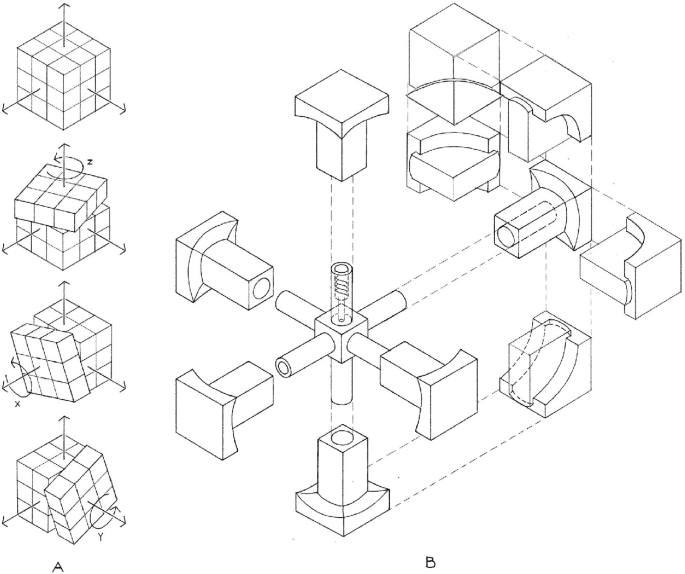
That’s right. The Rubik’s Cube works thanks to a central sphere inside the cube that allows the outer faces to turn smoothly. It’s an elegant engineering trick: the geometry of Pi hidden within a structure that appears entirely square.
So what does that mean, beyond toys and tinkering?
🧠 Function Hides Beneath Form
This is a great example of a deeper principle:
What looks rigid on the outside often depends on something flexible inside.
Systems that appear boxy—whether organizational, technological, or cultural—may only operate smoothly because of unseen curvature. Something adaptable. Something built on circular logic rather than linear constraints.
In the cube’s case, that circular logic is Pi.
✨ What About Phi?
There’s a second element at play: Phi, the golden ratio. While Pi governs rotation and structure, Phi governs alignment and aesthetics—the feeling of things “clicking into place.” In the Rubik’s Cube, we don’t just want it to move. We want it to resolve.
Pi gives us movement.
Phi gives us satisfaction.
Together, they create a puzzle that doesn’t just turn—it solves.