

Monarchy vs. Democracy: A Study of Governance
The choice of how a society is governed stands as one of humanity's most enduring and fundamental philosophical dilemmas. From the ancient city-states of Greece to the sprawling modern nations, the fundamental structures of Government have shaped civilizations, determined individual freedoms, and dictated the very nature of the State. This article delves into two primary forms of governance that have dominated much of this historical and philosophical discourse: Monarchy and Democracy. We will explore their core tenets, their historical evolution, and the profound philosophical arguments for and against each, drawing insights from the enduring wisdom contained within the Great Books of the Western World.
The Enduring Question of Rule
At its heart, the debate between Monarchy and Democracy is a debate about legitimacy, authority, and the optimal distribution of power. Is it best for power to reside in the hands of one, a monarch, often by birthright or divine decree? Or should it be distributed among the many, the citizens, as in a democracy? Each system presents a distinct vision for the organization of the State and the relationship between the ruler and the ruled.
Understanding Monarchy: The Rule of One
Monarchy, derived from the Greek monos (single) and arkhein (to rule), designates a form of Government where supreme authority is vested in a single individual, the monarch. This position is typically hereditary, passing down through a royal family, though historically, elective monarchies have also existed.
Philosophical Foundations and Historical Context
Historically, monarchies have been justified through various lenses. The concept of the divine right of kings posited that a monarch's authority came directly from God, making their rule unquestionable. Thinkers like Sir Robert Filmer, though later refuted by John Locke, argued for the patriarchal origins of monarchical power. The appeal of Monarchy often lies in its promise of stability, continuity, and a clear, decisive leadership. In times of crisis, a strong monarch could theoretically unite a State and act swiftly. Aristotle, in his Politics, classified Monarchy as one of the "good" forms of Government when exercised for the common good, contrasting it with tyranny, its corrupt deviation.
Advantages and Disadvantages of Monarchy
| Advantages | Disadvantages |
|---|---|
| Stability & Continuity: Clear succession, less prone to political upheaval. | Lack of Accountability: Monarch's power often unchecked. |
| Decisive Leadership: Swift decision-making in crises. | Risk of Tyranny: Potential for abuse of power. |
| Symbol of Unity: Monarch can embody national identity. | Competence by Birth: No guarantee of a good ruler. |
| Long-Term Vision: Not constrained by short electoral cycles. | Suppression of Dissent: Little room for public input. |
Understanding Democracy: The Rule of Many
Democracy, from the Greek demos (people) and kratos (power), is a system of Government where supreme power is vested in the people and exercised by them directly or indirectly through a system of representation, usually involving periodically held free elections.
Philosophical Foundations and Historical Context
The philosophical roots of Democracy are often traced back to ancient Athens, where direct citizen participation in Government was a reality for a segment of the population. However, modern democratic thought largely emerged from the Enlightenment. Philosophers like John Locke articulated ideas of natural rights, popular sovereignty, and the social contract, arguing that the legitimacy of the Government derived from the consent of the governed. Jean-Jacques Rousseau further developed the concept of the "general will," where collective decisions reflect the common good. The core principle is that the people, as a collective, are the ultimate source of authority for the State.
Advantages and Disadvantages of Democracy
| Advantages | Disadvantages |
|---|---|
| Citizen Participation: Empowerment of the people. | Inefficiency: Slow decision-making due to deliberation. |
| Accountability: Leaders are answerable to the electorate. | "Tyranny of the Majority": Potential to suppress minority rights. |
| Protection of Rights: Emphasis on individual freedoms. | Voter Ignorance/Apathy: Decisions by uninformed populace. |
| Adaptability: Ability to change policies and leaders peacefully. | Factionalism: Divisive party politics and instability. |
Key Philosophical Debates on Governance
The Great Books of the Western World are replete with profound discussions on these forms of Government.
-
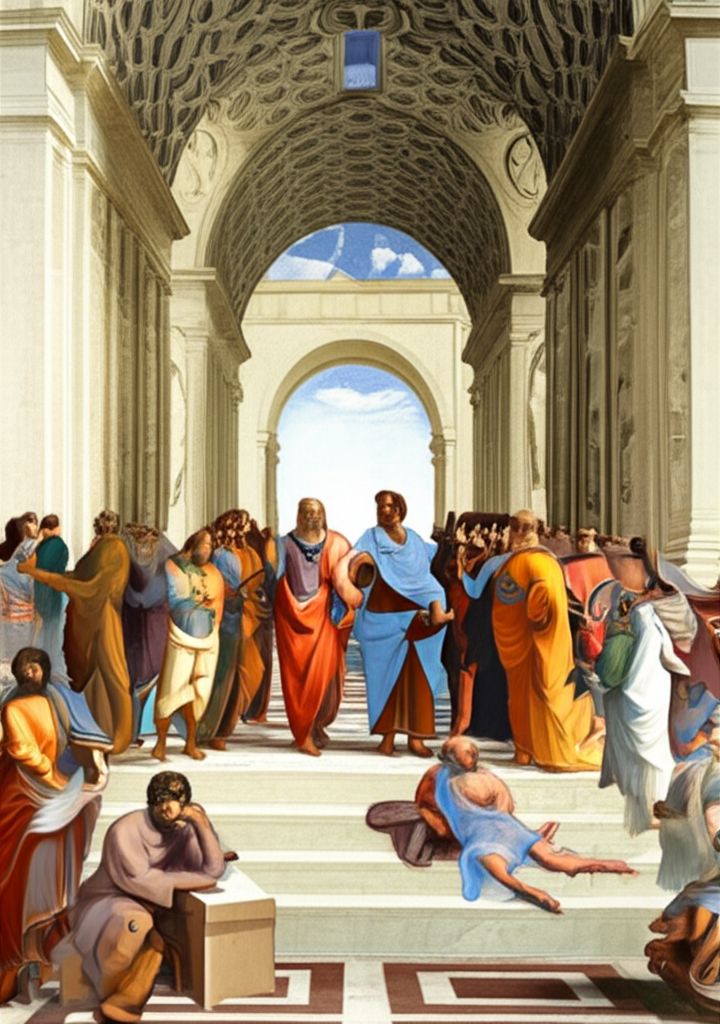
Plato's Critique: In his Republic, Plato famously critiqued Democracy, seeing it as a step towards tyranny. He argued that it prioritized freedom over order and wisdom, leading to a rule by the ignorant masses and eventually chaos. For Plato, the ideal State would be led by philosopher-kings, individuals trained in reason and wisdom, echoing a form of enlightened Monarchy or aristocracy.
-
Aristotle's Classification: Aristotle, in his Politics, provided a more systematic classification of Government forms, distinguishing between rule by one, few, or many, and further categorizing them as "good" (for the common good) or "perverted" (for the ruler's self-interest). He saw Monarchy (good) degenerating into tyranny (bad), aristocracy (good) into oligarchy (bad), and polity (good, a mixed form of Democracy) into Democracy (bad, rule by the poor for their own interest). His "polity" represented a mixed Government that blended elements of oligarchy and Democracy, aiming for stability and the middle class's rule.
-
Enlightenment and the Social Contract: The Enlightenment era brought forth vigorous debates on the nature of the State and the legitimate exercise of Government power. Thomas Hobbes, in Leviathan, argued for an absolute sovereign (a monarch) to prevent the "war of all against all" in the state of nature, suggesting that order and security required ceding individual liberties to a powerful Government. In contrast, John Locke's Two Treatises of Government championed limited Government and natural rights, laying the groundwork for modern democratic thought. Rousseau, in The Social Contract, explored how individuals could remain free while subject to the State, through their participation in the "general will."
These thinkers grappled with fundamental questions: What is the purpose of the State? How can justice be achieved? How can liberty be balanced with order? Their answers continue to inform our understanding of Monarchy and Democracy.
Modern Interpretations and Hybrid Models
Today, pure forms of Monarchy and Democracy are rare. Many modern monarchies are constitutional monarchies, where the monarch serves as a ceremonial head of State with real political power residing in an elected democratic Government. Similarly, most modern democracies are representative democracies (republics), where citizens elect representatives to make decisions on their behalf, rather than engaging in direct Government. These hybrid models reflect an ongoing attempt to combine the perceived strengths of both systems—the stability and symbolic unity of a monarch with the accountability and popular legitimacy of a democratic Government.
Conclusion: An Ongoing Philosophical Inquiry
The study of Monarchy versus Democracy is not merely an academic exercise; it is a vital inquiry into the very foundations of human society and the State. Each system, born from distinct historical circumstances and philosophical convictions, offers a different path to organizing power, ensuring justice, and fostering the common good. While the pendulum of history has largely swung towards democratic ideals in recent centuries, the philosophical questions raised by both forms of Government remain pertinent. The ongoing challenge for any State is to find a Government structure that maximizes human flourishing, balances individual liberty with collective order, and remains responsive to the evolving needs of its people.
📹 Related Video: PLATO ON: The Allegory of the Cave
Video by: The School of Life
💡 Want different videos? Search YouTube for: ""Plato Aristotle Political Philosophy Comparison""
📹 Related Video: KANT ON: What is Enlightenment?
Video by: The School of Life
💡 Want different videos? Search YouTube for: ""Social Contract Theory Hobbes Locke Rousseau Explained""