

The Hearts Within the Golden Ratio
From Ancient Seed to Infinite Geometry
The heart shape did not begin as a romantic doodle.
Over 2,500 years ago, it appeared on ancient coins from the North African city of Cyrene. The shape depicted the seed of silphium — a now-extinct plant valued so highly for its medicinal and culinary uses (and, some historians say, as a contraceptive) that it became Cyrene’s emblem and economic lifeblood.
From trade symbol to love emblem, the heart shape drifted across cultures and centuries. But what’s striking is this: in mapping the curves of the Golden Ratio — PHI (≈ 1.618…) — we find not one, but an infinite cascade of hearts hidden in the geometry.
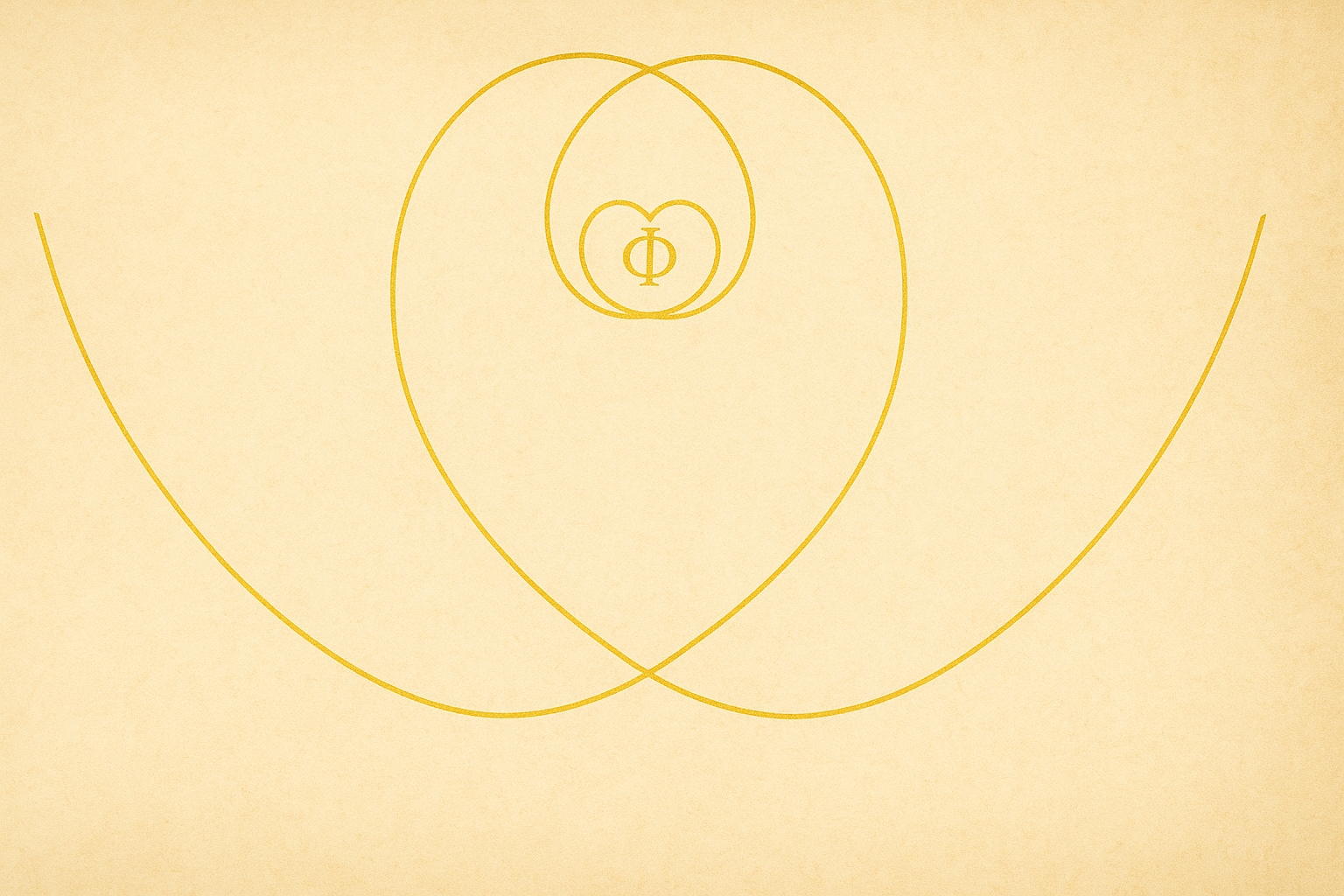
These are not stylized or imagined; they emerge naturally from the recursive proportions of PHI. As spirals fold into one another, arcs meet at intersections that resolve into perfect heart contours — small ones nested inside larger ones, forever repeating.
It’s a bridge across millennia:
- Ancient — A seed-shaped icon on silver coins, bound to trade, fertility, and survival.
- Medieval — A religious and poetic symbol of divine and human love.
- Mathematical — A hidden, infinite family of hearts within the architecture of PHI.
What began as a botanical silhouette in antiquity now reveals itself as a universal form, woven into the same proportional constant that shapes seashells, galaxies, and the branching of trees.
It’s humbling to realize that the heart — a symbol we often think of as sentimental or decorative — is also a mathematical inevitability.
It belongs as much to nature’s blueprint as to art and culture.
And in PHI, it never ends.