

From Specific Observations to Grand Truths: How Induction Forges Universal Knowledge
Summary: Induction, a cornerstone of human reasoning and scientific inquiry, is the process of deriving general principles (universals) from specific observations (particulars). While fraught with philosophical challenges, it remains our primary method for expanding empirical knowledge, allowing us to move beyond individual experiences to formulate laws and theories that aim for universal applicability, especially within the realm of science.
Friends, fellow travelers on the grand intellectual journey, let's talk about one of the most fundamental yet often understated engines of human understanding: induction. It's the silent workhorse behind much of what we accept as knowledge, particularly in the empirical sciences. We often take for granted the leap our minds make from observing a few instances to declaring a general truth, but this leap is precisely where the magic – and the philosophical peril – of induction lies.
The Great Leap: From Particular to Universal
At its heart, induction is about moving from the particular to the universal. Think about it:
- You observe that the sun has risen every morning of your life.
- You conclude that the sun will rise tomorrow morning.
- You've just performed an inductive inference.
This isn't a logical necessity in the same way that "All men are mortal; Socrates is a man; therefore, Socrates is mortal" is (that's deduction). The sun could theoretically not rise tomorrow. Yet, we rely on this pattern recognition to navigate our world, to predict, and to build robust systems of knowledge.
Aristotle, a titan among the Great Books of the Western World, certainly recognized the importance of observing particulars to understand universals in his empirical approach to natural philosophy. He meticulously categorized and studied specific instances to infer broader classifications and principles. Later, Francis Bacon, another luminary from the Great Books, championed induction as the bedrock of the new science, urging a systematic collection of data before formulating theories, thereby moving away from purely deductive, a priori reasoning.
The Inductive Process: A Simplified View
| Step | Description | Example |
|---|---|---|
| 1. Observation | Gathering specific data or instances. | Every swan I have ever seen is white. |
| 2. Pattern Recognition | Identifying recurring regularities or relationships within the observations. | The color "white" consistently appears with "swan." |
| 3. Generalization | Formulating a general rule, hypothesis, or theory from the patterns. | All swans are white. |
| 4. Testing/Refinement | Further observations or experiments to confirm or refute the generalization. | Search for non-white swans. |
Science's Engine: Building Universal Knowledge Through Induction
Where induction truly shines is in the realm of science. How do we arrive at laws of physics, principles of biology, or theories of chemistry? Through countless specific experiments and observations, leading to generalizations that we elevate to the status of scientific laws.
Consider gravity. Newton didn't just deduce gravity from first principles. He observed the particular phenomenon of apples falling, the moon orbiting, and extrapolated these particular instances into a universal law that describes how all masses attract each other. This law, once validated through extensive testing, allows us to predict the trajectory of planets or the behavior of objects on Earth – a profound expansion of our knowledge.
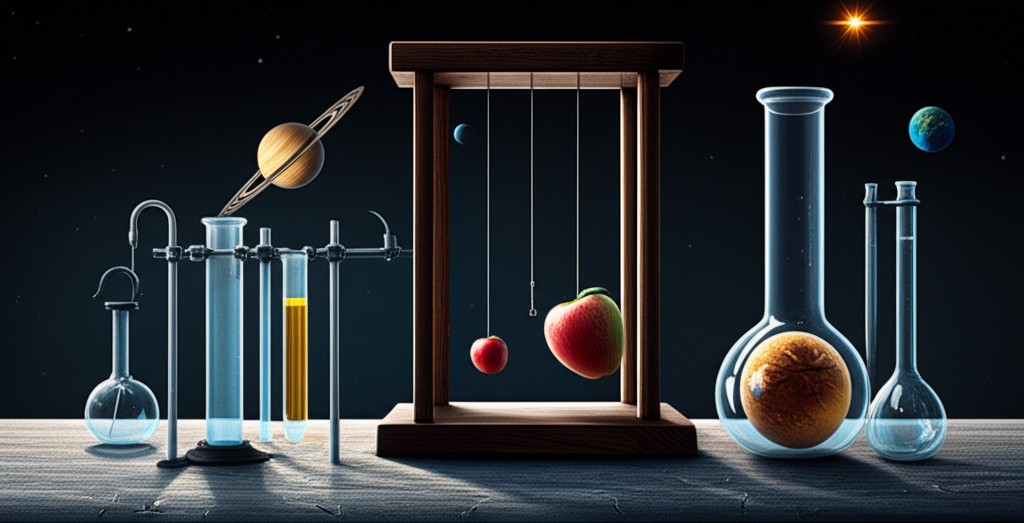 . These particular instances are visually connected by lines converging upwards towards a larger, glowing sphere labeled "Universal Law," symbolizing the inductive leap from specific data to a general principle.)
Without induction, science would be paralyzed, unable to move beyond mere cataloging of individual facts. It is the very mechanism by which we construct theoretical frameworks that aim for universal applicability, providing predictive power and explanatory depth.
The Philosophical Quagmire: Limitations and the Quest for Certainty
Of course, no discussion of induction would be complete without acknowledging its Achilles' heel, famously articulated by David Hume, another indispensable voice from the Great Books. Hume pointed out that there's no logical guarantee that future instances will resemble past ones. Just because the sun has risen every day doesn't mean it must rise tomorrow. This is often called the "problem of induction."
The leap from "all observed X are Y" to "all X are Y" is a leap of faith, not a logical certainty. The classic example is the "black swan" problem: for centuries, Europeans believed all swans were white because all observed swans were white. The discovery of black swans in Australia shattered that universal generalization, proving that even a vast number of particular observations cannot guarantee absolute truth.
However, recognizing this limitation doesn't negate the utility of induction. Instead, it refines our understanding of knowledge. We acknowledge that inductive knowledge is probabilistic, not absolutely certain. Science addresses this by:
- Falsifiability: Theories are formulated in a way that allows them to be disproven, rather than just endlessly confirmed.
- Probabilistic Reasoning: Accepting that our universal laws are highly probable, based on overwhelming evidence, rather than infallible.
- Constant Testing: Always seeking new data that might challenge or refine existing universal generalizations.
Conclusion: Our Indispensable Tool for Understanding the Universe
In essence, induction is how we learn from experience. It's how we build bridges from the specific things we encounter to the general principles that govern our world. It's the very foundation upon which science constructs its impressive edifice of knowledge, transforming countless particular observations into powerful, predictive universal theories. While the philosophical challenge of its ultimate justification remains a fascinating debate, our practical reliance on induction is undeniable. It allows us to not just observe the universe, but to truly understand and even anticipate its workings, constantly pushing the boundaries of what we know.
YouTube Video Suggestions:
- YouTube: The Problem of Induction Explained
- YouTube: Francis Bacon and the Scientific Method Induction
📹 Related Video: What is Philosophy?
Video by: The School of Life
💡 Want different videos? Search YouTube for: "How Induction Leads to Universal Knowledge philosophy"