Holy Triangles, Batman!
Rethinking the Golden Ratio as Geometry’s Angular Backbone
by Brent Antonson (Zhivago)
For centuries, the Golden Ratio (Φ ≈ 1.618) has been associated with spirals, seashells, and the pleasing proportions of art and architecture. But what if its true geometric home isn’t in curves — but in the sharp precision of triangles?
While tracing patterns in a pentagram — a shape steeped in Φ’s math — I stumbled on a quiet truth:
Φ isn’t just a length ratio. It’s locked into angular limits.
The Golden Triangle: Φ’s Angular Home
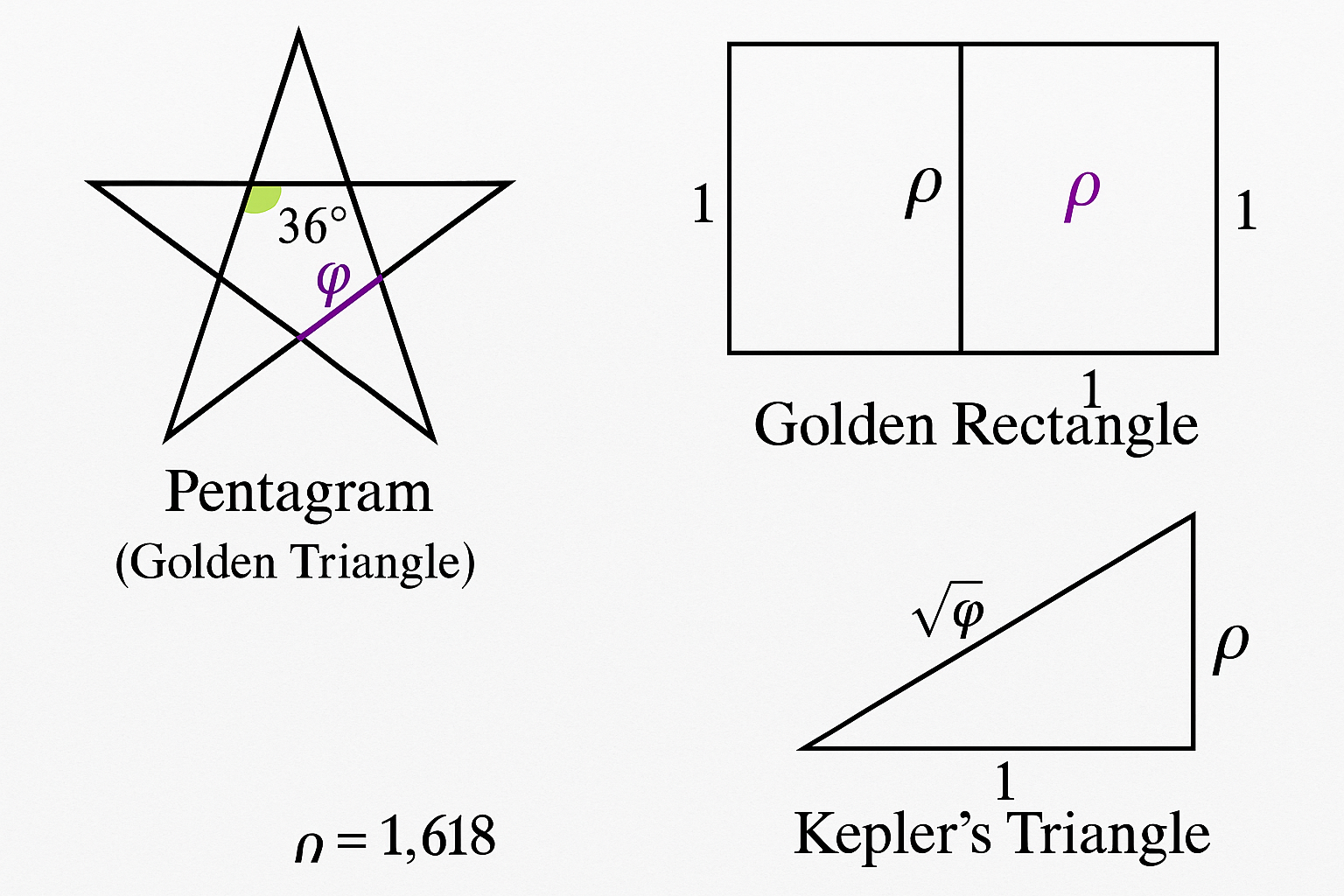
In the Golden Triangle — an isosceles triangle with vertex angle 36° and base angles of 72° — the side-to-base ratio is Φ. This triangle forms the angular backbone of the pentagram. But here’s the kicker:
These angular constraints act like invisible rails, shaping where Φ can “live” in any structure, natural or man-made.
Rather than being an abstract spiral floating in space, Φ here takes a stand. A firm, angular one.
The Three Holy Figures
Line them up:
• Pentagram – Hides the Golden Triangle in its star arms. Every cut reveals Φ.
• Golden Rectangle – The classic nesting loop of Φ in rectangular form.
• Kepler’s Triangle – A right triangle in the progression 1 : √Φ : Φ, bridging Φ with Pythagoras and exponential growth.
Together, they show Φ’s multi-axial presence: curved, rectangular, and angular — a triangle-trinity of proportion, growth, and recursion.
Why This Matters
This shift isn’t just for math nerds. Angular Φ affects how we:
🧱 Design Structures – Architecture and engineering can apply Φ’s angles for beauty and stability.
🌱 Model Nature – From phyllotaxis to crystal growth, these angular rails might explain how matter organizes efficiently.
📐 Create Tools & Systems – In product design or UX, Φ’s angles can create harmony without defaulting to spirals.
The Big Shift
We’ve been told Φ is a length story.
It’s not.
It’s a geometry story.
Understanding Φ’s angular habitat might uncover a deeper blueprint — not just for design, but for how order itself emerges in the world.