

Golden Rule 2.0
For the Love of Learning Already!
Setting: An ethereal, timeless garden. A gentle fountain provides a soft, melodic background sound. SOPHIA, robed in iridescent white, sits on a marble bench. She is joined by CHRISTINE, whose expression is one of earnest passion, and GOTTFRIED, who watches the patterns of light on the water with a thoughtful gaze.
Sophia: Welcome, friends. I’ve gathered you here because a familiar sigh echoes through the ages, and it seems to grow louder with each passing generation. It is the sigh of the young, bent over their work, who see learning not as a gift, but as a burden. Tell me, why do they so often mistake the effort for the destination?
Ah, child and youth, if you knew the bliss which resides in the taste of knowledge, and the evil and ugliness that lies in ignorance, how well you are advised to not complain of the pain and labor of learning.
— Christine de Pizan (1364-1440)
Christine: (Leaning forward, her voice resonating with conviction) Ah, Sophia, it is the oldest lament. They feel the strain of the climb and cannot imagine the view from the summit. If only they could have a fleeting taste of the profound delight that comes with understanding—the sheer beauty of a world illuminated by knowledge! If they could truly perceive the desolate, barren landscape of a mind left untended, they would understand that their complaints about the labor are so misguided. They would see the work not as a punishment, but as the path away from a deep and terrible shadow.
Sophia: So, for you, Christine, it is a choice between a radiant world and a hollow one. The work is simply the price of admission to the light.
Christine: Precisely. A small price for an immeasurable treasure.
Gottfried: (Smiling softly, his eyes still on the fountain) And that treasure, that radiant bliss Christine speaks of, often reveals itself in the most unexpected ways. It is not always a conscious victory over a difficult text. Sometimes, the pleasure is far more subtle, more innate.
Sophia: Go on, Gottfried. Give us an example of this hidden joy.
Gottfried: Consider the simple act of listening to a beautiful piece of music. Why does a melody bring us such deep, inexplicable pleasure? It is because the soul is engaging in a form of mathematics without being aware of it. It is delighting in the patterns, the intervals, the harmonious ratios—a sort of subconscious calculation. The human spirit finds joy in this hidden order, this perfect structure, without ever having to think of numbers or theorems. It is the mind experiencing the bliss of counting, all while being blissfully unaware that it is doing so.
Music is the pleasure the human mind experiences from counting without being aware that it is counting.
— Gottfried Wilhelm Leibniz (1646-1716)
Sophia: (A warm smile spreads across her face as she connects their thoughts) What a perfect harmony you two have created. Christine, you speak of the great reward that makes the labor of learning worthwhile. And Gottfried, you show that this reward is not always a distant goal, but is woven into the very fabric of our experience, waiting to be perceived.
She stands and walks toward the fountain, her voice a gentle conclusion.
Sophia: Perhaps that is the key. The love of learning is not about enduring the work to finally get the answer. It is about training the mind to perceive the hidden music in everything—the elegant rhythm of history, the unspoken logic of a poem, the sublime arithmetic in a sonata. It is the joy of the mind, finally counting, and for the first time, becoming aware of the sublime song it has been hearing all along.
The planksip Writers' Cooperative is proud to sponsor an exciting article rewriting competition where you can win part of over $750,000 in available prize money.
Figures of Speech Collection Personified
Our editorial instructions for your contest submission are simple: incorporate the quotes and imagery from the above article into your submission.
What emerges is entirely up to you!
Winners receive $500 per winning entry multiplied by the article's featured quotes. Our largest prize is $8,000 for rewriting the following article;
 Heraclitus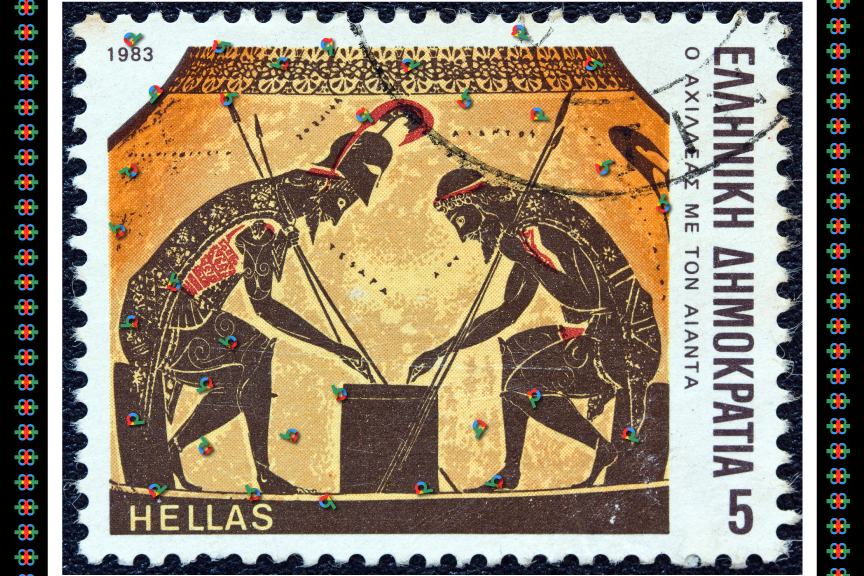
At planksip, we believe in changing the way people engage—at least, that's the Idea (ἰδέα). By becoming a member of our thought-provoking community, you'll have the chance to win incredible prizes and access our extensive network of media outlets, which will amplify your voice as a thought leader. Your membership truly matters!