

The Enduring Fabric: Custom and Convention in Family Life
The fabric of human society is woven from countless threads, some overtly visible, others subtly binding. Among the most fundamental of these threads are Custom and Convention, particularly as they manifest within the bedrock institution of the Family. This pillar page delves into the philosophical underpinnings of how these ingrained practices and agreed-upon norms shape the individual from infancy, defining their role as a Citizen, and ultimately influencing the very structure and stability of the State. From the ancient oikos described by Aristotle to modern debates on familial roles, we explore the profound and often invisible hand of custom and convention in our most intimate spheres.
Introduction: The Invisible Architects of Our Lives
At first glance, family life appears to be a realm of personal choice, affection, and individual idiosyncrasy. Yet, beneath this veneer lies a complex interplay of inherited practices and societal agreements that dictate everything from how we celebrate holidays to how we raise our children. These are the Customs and Conventions that, often without our conscious acknowledgement, sculpt our identities and dictate our interactions.
This exploration will embark on a journey through philosophical thought, drawing heavily from the "Great Books of the Western World," to illuminate how these forces within the Family serve as the primary school for the nascent Citizen, preparing them for the broader conventions of the State. We will examine how thinkers from antiquity to the Enlightenment grappled with the family's structure, its inherent power, and its indelible link to the larger political community.
Defining the Pillars: Custom and Convention
Before we delve into their impact on family life, it is crucial to distinguish between Custom and Convention, recognizing their unique characteristics and their often-intertwined presence.
Custom: The Unspoken Legacy
Custom refers to long-established practices, traditions, and habitual ways of acting that are deeply embedded within a community or Family. They are often unwritten, learned through observation and participation, and passed down through generations. Think of the specific rituals around mealtimes, the manner of addressing elders, or particular ways of celebrating milestones.
Philosophically, customs are akin to Aristotle's concept of habitus – repeated actions that, over time, shape character and moral disposition. In his Nicomachean Ethics, Aristotle emphasizes that virtue is not innate but acquired through habituation, much like the customs of a family instill particular virtues or vices in its members. These practices become second nature, forming the very grammar of family interaction.
Convention: The Agreed-Upon Framework
Convention, in contrast, denotes formal or informal agreements, explicit rules, or generally accepted standards that govern behavior. While customs evolve organically, conventions are often consciously adopted or understood, providing a framework for interaction. This could be a family agreement on screen time, a societal convention regarding marriage vows, or the legal conventions defining parental rights.
Philosophers like Jean-Jacques Rousseau, in his Social Contract, discuss the idea of convention as the basis of legitimate authority. While he applied it to the State, the principle resonates within the Family; certain behaviors are conventional because they are mutually understood or explicitly agreed upon, creating a miniature social order. John Locke, in his Second Treatise of Government, also touches upon conventional agreements, even within the context of parental power, which, while natural, is also subject to certain agreed-upon limits and responsibilities.
The Interplay: Where Tradition Meets Agreement
In reality, Custom and Convention rarely operate in isolation. Family life is a dynamic space where ancient customs are continually reinterpreted through modern conventions, and new conventions often solidify into future customs. A specific family custom for gift-giving might be a long-standing tradition (Custom), but the timing and method of gift exchange might be a recent, agreed-upon rule (Convention) to accommodate busy schedules. This constant negotiation and synthesis define the living, breathing nature of family life.
| Feature | Custom | Convention |
|---|---|---|
| Origin | Organic, historical, evolutionary | Deliberate, agreed-upon, often explicit |
| Form | Unwritten, implicit, habitual | Written or understood rules, standards |
| Enforcement | Social pressure, tradition, upbringing | Mutual agreement, legal frameworks, social norms |
| Example | Family recipes, holiday rituals | Curfew rules, marriage contracts, division of chores |
The Family as a Crucible of Custom and Convention
The Family is not merely a collection of individuals but a primary institution where Custom and Convention are first encountered, learned, and internalized. It is the initial school for the burgeoning Citizen.
Ancient Foundations: The Household in Classical Thought
Classical philosophers recognized the profound importance of the Family (the oikos in Greek) long before modern sociology.
-
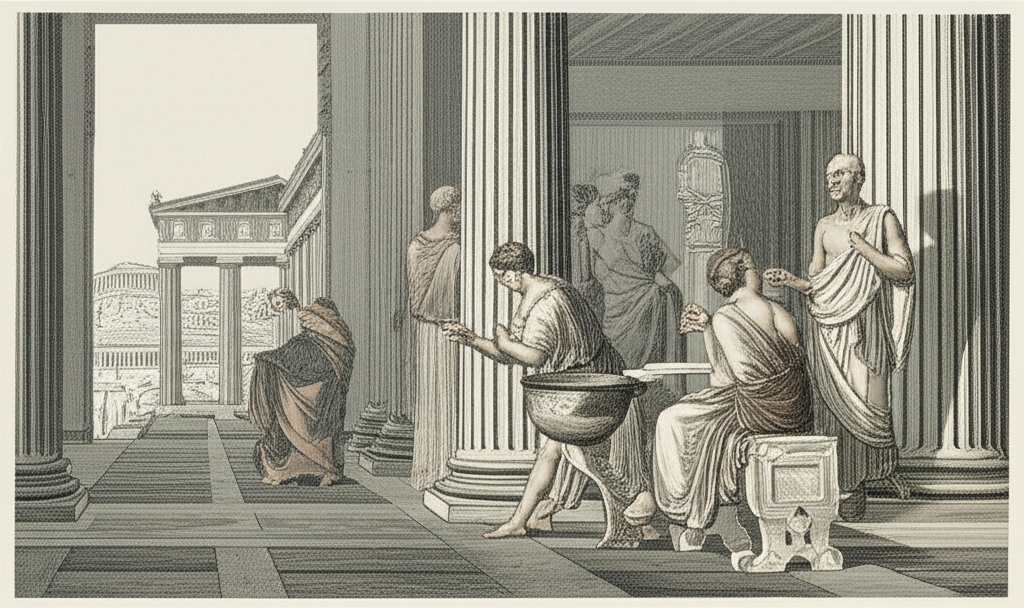
Aristotle's Oikos: In his Politics, Aristotle describes the household as the foundational unit of the city-state. It is where individuals learn to command and obey, where economic production occurs, and where children are raised. The customs governing the master-slave relationship, husband-wife dynamics, and parental authority were not arbitrary but seen as natural and essential for the well-being of the oikos and, by extension, the State. These customs dictated roles, responsibilities, and the very structure of daily life.
-
Plato's Republic: Plato, in a more radical vein, challenged traditional family structures in his ideal State. For the guardian class, he proposed the abolition of private families and common ownership of children. This was a direct attempt to replace the deep-seated customs and conventions of the private family with new, state-sanctioned conventions aimed at fostering ultimate loyalty to the State above all else. This highlights the tension between familial custom and the perceived needs of the larger political community.
Shaping the Individual: From Child to Citizen
The customs and conventions of the Family are the primary agents of socialization. They shape an individual's moral compass, their understanding of social roles, and their readiness to participate in the broader society as a Citizen.
- Moral Development: From a young age, children learn what is considered right or wrong, respectful or disrespectful, through the customs of their family. These early lessons in empathy, sharing, responsibility, and communication lay the groundwork for their ethical framework. The repeated practice of these customs internalizes values that will guide them as adults.
- Language and Culture: Beyond ethics, families transmit language, cultural heritage, and a sense of belonging. The conventions of communication, storytelling, and shared experiences forge a common identity that prepares the individual for their place in a larger cultural landscape.
- Preparation for the State: Locke, in his Second Treatise, discusses parental power as a temporary authority, guiding children until they reach the age of reason. This period of tutelage, governed by family conventions, is crucial for preparing future citizens to understand and consent to the laws and conventions of the State. The obedience learned within the family translates into respect for the law, and the understanding of shared duties within the household mirrors the responsibilities of a Citizen.
Custom, Convention, and the Evolution of the State
The relationship between the Family and the State is symbiotic. The structure and values cultivated within families profoundly influence the nature of governance, just as the State often seeks to regulate or define family life through its own conventions.
The Family as the First Society
Rousseau, in The Social Contract, posits that the Family is "the oldest of all societies, and the only one that is natural." While he quickly argues that this natural bond dissolves once children become independent, he acknowledges its significance as the original model for political societies. The idea of a head governing a family, he suggests, is a precursor to a chief governing a State. This highlights how the inherent customs and conventions of family life provide a template for understanding broader political organization.
Challenges and Transformations: Modernity's Impact
In the modern era, the interplay between Custom and Convention in the Family and the State has grown increasingly complex.
- Evolving Norms: Traditional customs surrounding marriage, gender roles, and family structure are constantly being challenged and redefined by evolving societal conventions. The State, through legislation, often formalizes these new conventions, such as recognizing same-sex marriage or establishing new parental rights.
- State Intervention: Modern states increasingly intervene in family life, setting conventions around child welfare, education, and domestic violence. This reflects a shift from viewing the family as a purely private sphere to recognizing its public implications and the State's role in ensuring the well-being of its Citizens.
- Pluralism: In diverse societies, multiple family customs and conventions coexist, leading to philosophical debates about which norms should prevail or how the State can accommodate a variety of familial forms while upholding universal rights and conventions.
Navigating the Philosophical Tensions
The relationship between Custom and Convention in Family life is not without its inherent philosophical tensions, particularly concerning individual freedom and the demands of the collective.
Freedom vs. Order: The Individual in the Family
When do family customs and conventions, intended to provide order and continuity, become oppressive to the individual? This question sits at the heart of many philosophical discussions on autonomy. While customs provide a sense of belonging and identity, they can also stifle individual expression or perpetuate harmful practices. The challenge lies in finding a balance between preserving valuable heritage and fostering the autonomy necessary for a flourishing individual and a dynamic Citizen.
The Citizen's Duty: Family Loyalties vs. Public Good
Plato's radical proposals in The Republic were driven by a concern that strong family loyalties could undermine a Citizen's devotion to the State. This tension remains relevant: When do the customs and conventions of one's family, or the obligations derived from them, conflict with the broader duties owed to the State or the demands of the public good? The challenge for the Citizen is often to reconcile these competing loyalties, guided by a philosophical understanding of justice and the common good.
Conclusion
The influence of Custom and Convention on Family life is profound, shaping not only our individual identities but also our roles as Citizens and the very nature of the State. From the ancient wisdom of Aristotle and Plato to the social contract theories of Locke and Rousseau, philosophers have consistently recognized the family as the primal school of human experience, a place where traditions are forged, agreements are made, and the groundwork for societal participation is laid.
These seemingly invisible forces dictate much of our personal world, preparing us for the larger, more explicit conventions of the political sphere. Understanding this intricate relationship allows us to appreciate the enduring power of our heritage while critically examining how customs and conventions can evolve to foster greater freedom, justice, and flourishing for all. The ongoing philosophical inquiry into the Family remains essential for comprehending the foundations of human society and the future of the Citizen within the State.
📹 Related Video: PLATO ON: The Allegory of the Cave
Video by: The School of Life
💡 Want different videos? Search YouTube for: ""Plato Family Republic Philosophy" or "Aristotle Politics Oikos""