

The Enduring Fabric: Custom and Convention in Family Life
Family life, in all its myriad forms, is the crucible in which individuals are forged, ultimately shaping the societies they inhabit. At its heart lies a fascinating, often invisible, interplay of custom and convention – the inherited practices and the deliberate agreements that define roles, responsibilities, and relationships. This exploration delves into how these foundational elements not only structure the private sphere of the family but also fundamentally influence the development of the citizen and the very nature of the state, drawing insights from the timeless wisdom preserved in the Great Books of the Western World.
The Foundational Pillars: Defining Custom and Convention
To truly grasp the essence of family life, we must first distinguish between its unspoken rules and its codified agreements.
- Custom: These are the unwritten, often unconscious, traditions and practices passed down through generations. They are the habits of the heart, the ways of doing things that feel "natural" or "just the way it's always been." Customs are deeply ingrained, learned through observation and participation, and carry the weight of ancestral authority. Think of specific rituals around meals, child-rearing practices, or expressions of respect within a household.
- Convention: In contrast, conventions are the explicit, agreed-upon rules, norms, or laws that govern interactions. They are deliberate choices, often formalized, and can be changed through collective will. Marriage contracts, inheritance laws, parental rights, and even explicit family rules are examples of conventions. They represent a conscious agreement, whether societal or familial, to structure relationships in a particular way.
While distinct, custom and convention are rarely isolated. They constantly interact, with customs often becoming formalized into conventions, and conventions, over time, sinking into the realm of custom. This dynamic tension is where the true character of family life – and by extension, society – emerges.
The Family: A Microcosm of Society
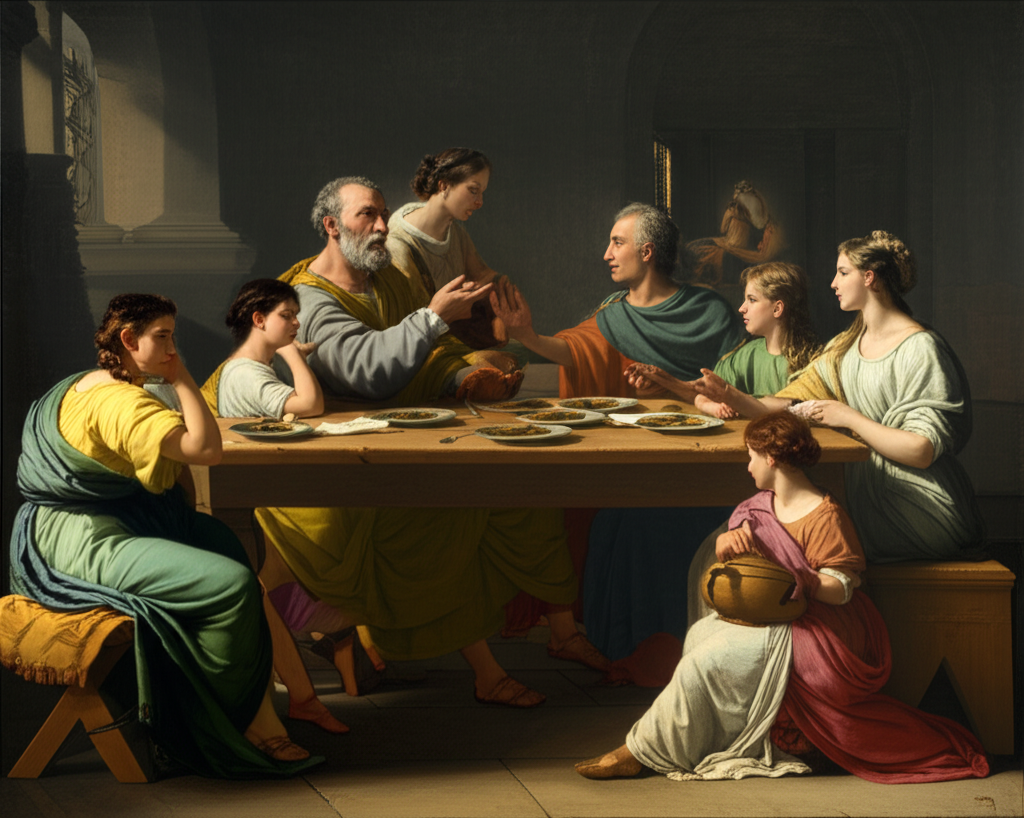
Long before the concept of the state took shape, the family existed as the primary unit of human organization. Philosophers from Aristotle to Locke recognized its fundamental importance, not merely as a biological necessity but as the first school of citizenship.
Aristotle, in his Politics, meticulously dissects the household (oikos) as the foundational community, arguing that the village springs from families, and the state from villages. Within this oikos, relationships of husband and wife, parent and child, master and slave (in his historical context) are governed by specific customs and conventions. These early lessons in hierarchy, cooperation, obedience, and responsibility directly prepare individuals for their roles as citizens in the larger polis.
The Role of Custom in Shaping Family Identity
Customs are the invisible threads that weave the fabric of family identity. They dictate:
- Roles and Responsibilities: Who does what, when, and how. These can range from gendered divisions of labor to specific tasks assigned to children as they grow.
- Values and Morals: The unstated principles that guide behavior. How conflicts are resolved, how compassion is shown, how success is celebrated, or how failure is met.
- Rituals and Celebrations: Annual traditions, holiday observances, rites of passage – these solidify a family's unique narrative and reinforce belonging.
- Communication Styles: The unspoken rules about how family members interact, express emotions, or resolve disagreements.
These customs, often inherited without question, instill a sense of belonging and provide a framework for navigating life. They are the bedrock of a child's earliest understanding of the world and their place within it.
Convention: Formalizing Bonds and Defining Rights
While custom provides the organic flow of family life, convention introduces structure, clarity, and legal recognition.
- Marriage: Perhaps the most significant convention in family life, marriage transforms a relationship into a legally and socially recognized institution. Whether a religious sacrament or a civil contract, it establishes rights, duties, and obligations between spouses, and often, towards their offspring. The conventions surrounding marriage – monogamy, polygamy, arranged, love-based – vary widely across cultures and epochs, reflecting different societal values.
- Parental Rights and Responsibilities: These are largely conventional, codified in law, defining the legal relationship between parents and children. They ensure children's protection, education, and welfare, and delineate parental authority.
- Inheritance Laws: Conventions dictate how property and assets are passed down, reflecting societal views on lineage, fairness, and economic stability.
These conventions are not static; they evolve with societal changes. The historical shifts in marriage laws, adoption rights, or the legal status of children born outside of wedlock demonstrate how society continually re-evaluates and re-defines family structures through convention.
The Citizen and the State: From Hearth to Polis
The interplay of custom and convention within the family has profound implications for the citizen and the state.
How Family Life Shapes the Citizen:
- Moral Education: The family is the primary site of moral formation. Through customs and conventions, children learn basic ethics: fairness, honesty, empathy, and respect. These are the virtues that, as Plato argued in The Republic, are essential for a just society.
- Socialization: Children learn social norms, how to interact with authority, how to share, and how to negotiate within the family unit. These skills are directly transferable to their roles as members of a larger community.
- Understanding Authority: The experience of parental authority, shaped by custom and convention, provides a child's first encounter with governance. This early understanding influences their perception of and interaction with the authority of the state.
- Sense of Belonging and Identity: A strong family identity, rooted in shared customs, fosters a sense of belonging that can extend to a broader national or civic identity.
The Family as a Mirror of the State:
Philosophers have often drawn parallels between the governance of a household and the governance of a state.
- Paternalism: Historically, many political theories, particularly monarchical ones, viewed the ruler as a father figure to his people, drawing on the customary authority of the patriarch within the family.
- Justice and Order: The pursuit of justice and order within the family – resolving disputes, enforcing rules – mirrors the state's efforts to maintain peace and order among its citizens.
- Economic Unit: The family's role as an economic unit, managing resources and contributing to the larger economy, is a foundational element that underpins the economic stability of the state.
The strength and character of families, shaped by their customs and conventions, are therefore directly linked to the health and stability of the state. A breakdown in familial customs or conventions can ripple outwards, impacting social cohesion and civic responsibility.
Evolution and Challenges: When Custom Meets Change
The dynamic relationship between custom and convention is not static. Throughout history, societal shifts, technological advancements, and philosophical debates have challenged and reshaped family life.
Consider the evolution of marriage: from a primarily economic or dynastic arrangement, driven by custom and necessity, to a convention increasingly based on individual choice and emotional connection. Or the changing roles within families, particularly regarding gender, which have seen a significant departure from long-held customs.
These changes are often contentious because they challenge deeply ingrained customs, forcing societies to re-evaluate and redefine their conventions. The "nuclear family" of the mid-20th century is giving way to a more diverse array of family structures, each navigating its own blend of inherited customs and newly forged conventions.
Key Aspects of Familial Evolution:
- Individual Rights vs. Family Duty: Modern conventions increasingly emphasize individual autonomy, sometimes clashing with traditional customs that prioritize family duty and collective good.
- Diversity of Family Forms: The recognition of same-sex marriage, single-parent families, and blended families necessitates new conventions and challenges old customs.
- Technological Impact: Communication technologies and reproductive advancements introduce new ethical dilemmas and reshape family interactions.
Understanding these shifts requires a deep appreciation for the philosophical underpinnings of custom and convention, and their ongoing impact on the family, the citizen, and the state.
Conclusion: The Enduring Legacy
The intricate dance of custom and convention within family life is far more than a private affair. It is a fundamental philosophical and practical concern that shapes individual identities, cultivates the virtues of the citizen, and ultimately determines the character and stability of the state. From the ancient wisdom of Aristotle's Politics to the social contract theories that define modern governance, the enduring lessons from the Great Books of the Western World remind us that our most intimate relationships are inextricably linked to our broadest societal structures. To understand the family is to begin to understand the very foundations of human civilization.
📹 Related Video: PLATO ON: The Allegory of the Cave
Video by: The School of Life
💡 Want different videos? Search YouTube for: ""Plato Aristotle Family State Philosophy""
📹 Related Video: ARISTOTLE ON: The Nicomachean Ethics
Video by: The School of Life
💡 Want different videos? Search YouTube for: ""Custom Convention Social Contract Theory""