

Navigating the Moral Labyrinth: The Enduring Concepts of Good and Evil
Summary
The concepts of Good and Evil form the bedrock of all moral systems, serving as the fundamental categories through which humanity judges actions, intentions, and character. From ancient philosophical inquiries into Virtue and Vice to theological discussions of Sin and modern ethical considerations of Duty, the quest to define and understand these opposing forces has shaped civilizations. This article explores the multifaceted interpretations of good and evil across various philosophical and religious traditions, drawing insights from the enduring wisdom compiled in the Great Books of the Western World, revealing a complex tapestry of thought that continues to challenge and guide our moral compass.
The Philosophical Quest for Good and Evil
Since the dawn of conscious thought, humanity has grappled with the distinction between what is right and what is wrong, what is beneficial and what is harmful, what is virtuous and what is vicious. This fundamental dichotomy — Good and Evil — isn't merely an academic exercise; it's woven into the very fabric of our daily lives, influencing our laws, our relationships, and our personal convictions. Yet, despite its omnipresence, a universal, uncontested definition remains elusive, prompting philosophers and theologians alike to continually revisit its depths.
From the Socratic dialogues seeking the essence of justice to Kant's rigorous formulation of moral law, the Great Books of the Western World offer an unparalleled chronicle of this intellectual journey. These texts reveal that understanding good and evil is not about finding simple answers, but about engaging with profound questions concerning human nature, free will, and the very purpose of existence.
Defining the Indefinable: Early Interpretations of Good and Evil
The earliest philosophical inquiries often sought to ground Good in an objective reality. Plato, in his Republic, posits the "Form of the Good" as the ultimate reality, illuminating all other forms and making them intelligible. For Plato, true goodness is not subjective opinion but an eternal, perfect ideal that wise rulers (philosopher-kings) strive to apprehend. Evil, then, could be seen as a deviation from this form, an ignorance or corruption of the soul.
Aristotle, while more grounded in the empirical, also sought an objective good. In his Nicomachean Ethics, he identifies eudaimonia (often translated as human flourishing or true happiness) as the ultimate good, achievable through living a life of Virtue. For Aristotle, ethical goodness is about developing a character that habitually chooses the "mean" between extremes, cultivating virtues like courage, temperance, and justice. Evil, conversely, arises from Vice – the excess or deficiency of these virtues.
Key Distinctions in Early Thought:
- Plato: Good as an ultimate, transcendent Form; Evil as imperfection or lack.
- Aristotle: Good as eudaimonia achieved through virtuous living; Evil as Vice or deviation from the mean.
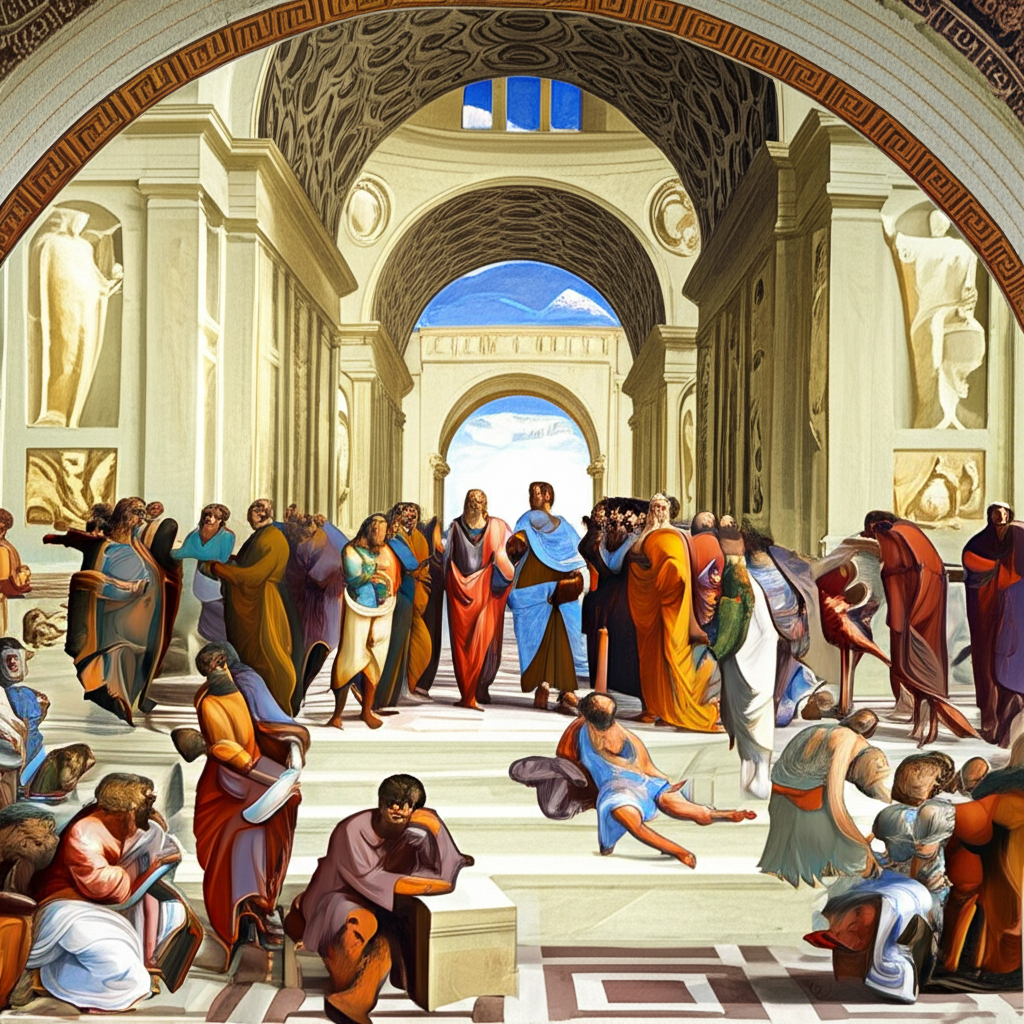
The Role of Virtue and Vice: Character as the Moral Compass
The concept of Virtue and Vice provides a powerful framework for understanding moral character. Virtues are those positive character traits that enable individuals to act in ways that are generally considered good or right, contributing to both their own well-being and the well-being of their community. Conversely, vices are negative character traits that lead to harmful or morally reprehensible actions.
Aristotle's Golden Mean:
Aristotle's ethical system is famously centered on the idea of the "golden mean," where virtue lies in a balance between two extremes of Vice.
| Virtue | Vice of Deficiency | Vice of Excess |
|---|---|---|
| Courage | Cowardice | Rashness |
| Temperance | Insensibility | Self-indulgence |
| Generosity | Stinginess | Extravagance |
| Truthfulness | Understatement | Boastfulness |
Cultivating these virtues, according to Aristotle, is not merely about following rules, but about developing a disposition that makes acting Good natural and fulfilling. A person of virtue wants to do good.
Duty and Obligation: The Categorical Imperative
While virtue ethics focuses on character, other moral systems prioritize actions themselves, often driven by a sense of Duty. Immanuel Kant, a central figure in the Great Books, radically shifted the ethical landscape with his deontological approach. For Kant, moral actions are not good because of their consequences or because they lead to happiness, but because they are performed out of respect for the moral law itself.
Kant's concept of the "Categorical Imperative" dictates that we should act only according to a maxim whereby we can, at the same time, will that it should become a universal law. This means that an action is morally good if it could be universally applied without contradiction, and if it treats humanity always as an end in itself, never merely as a means.
- Good Action (Kant): An action performed purely out of Duty, irrespective of inclination or outcome, that can be universalized.
- Evil Action (Kant): An action that violates the moral law, often by treating others as mere means, or by acting on maxims that cannot be universally applied.
For Kant, moral worth resides in the will behind the action, in the pure intention to do one's Duty.
The Concept of Sin: A Theological Dimension
Alongside philosophical ethics, religious traditions have profoundly shaped the understanding of Good and Evil, often introducing the concept of Sin. In Abrahamic religions, sin is typically understood as a transgression against divine law or a separation from God's will. It's not merely a moral error but a spiritual failing, often carrying implications of guilt, judgment, and the need for repentance or atonement.
St. Augustine of Hippo, another towering figure in the Great Books, explored the nature of evil extensively in works like Confessions and City of God. For Augustine, evil is not a substance in itself, but rather a privation of good (privatio boni). It is the absence or corruption of the good that God created. Sin, then, is a willful turning away from God, a misdirection of love towards lesser goods, leading to a state of moral and spiritual deficit.
Key Aspects of Sin:
- Transgression: Violation of divine commands or moral law.
- Separation: Alienation from God or a higher spiritual order.
- Consequence: Often entails guilt, punishment, and a need for redemption.
While philosophical discussions of Good and Evil can focus on human reason and societal harmony, Sin introduces a transcendent dimension, linking morality to a cosmic order and ultimate accountability.
Synthesizing Moral Frameworks: A Complex Tapestry
The journey through the Great Books reveals that the concepts of Good and Evil are not monolithic. They are interpreted through lenses of character (Virtue and Vice), action (Duty), and divine will (Sin). These frameworks often overlap and inform one another, yet they also present distinct approaches to understanding humanity's moral landscape.
- A virtuous person might naturally fulfill their Duty.
- A sinful act could be seen as a Vice that violates a Duty.
- The pursuit of Good can be understood as cultivating virtues, obeying duties, or aligning with divine will.
Ultimately, the ongoing philosophical and theological inquiry into Good and Evil underscores the profound complexity of human morality. There is no single, universally accepted answer, but rather a rich tradition of thought that compels us to critically examine our values, our actions, and our place in the world. This continuous engagement with moral questions is not just an academic exercise; it is essential for fostering ethical societies and nurturing individual integrity.
YouTube Video Suggestions:
-
📹 Related Video: PLATO ON: The Allegory of the Cave
Video by: The School of Life
💡 Want different videos? Search YouTube for: ""Plato's Ethics: The Form of the Good Explained""
-
📹 Related Video: KANT ON: What is Enlightenment?
Video by: The School of Life
💡 Want different videos? Search YouTube for: ""Kant's Categorical Imperative Explained | Deontology Philosophy""