

From the ancient heavens observed by our earliest philosophers to the expanding cosmic vistas revealed by modern telescopes, astronomy has been the primary architect of humanity's understanding of "the World." This article explores how our evolving astronomical insights have continually reshaped our perception of Space, Time, and our place within the grand, overarching structure we call the World, challenging established philosophical paradigms and inviting ever-deeper contemplation.
The Ancient Cosmos: A Finite, Human-Centric World
For millennia, the night sky was not merely a spectacle but a foundational text, dictating the very nature of our World. Early astronomical observations, meticulously recorded by civilizations across the globe, culminated in a profound, albeit ultimately mistaken, understanding of the cosmos that profoundly influenced philosophy, religion, and daily life.
The Geocentric Paradigm
Drawing heavily from the intellectual giants of ancient Greece, particularly Aristotle and later systematized by Ptolemy in his Almagest, the prevailing view was that of a geocentric World. Earth stood immovably at the center, a unique and privileged position. Surrounding it were crystalline spheres, each carrying a celestial body—the Moon, the Sun, the known planets, and finally, the sphere of the fixed stars. This was not merely a scientific model; it was a deeply philosophical construct.
Order and Purpose in a Spherical World
In this ancient World, Space was finite and hierarchical. The terrestrial realm was imperfect and mutable, while the celestial realm was eternal, perfect, and divine. This division imbued the cosmos with inherent order and purpose, reflecting a divine plan. The cycles of the stars and planets dictated seasons and time, providing a cosmic clock that underscored the regularity and predictability of existence. Our World was a complete, comprehensible entity, tailor-made for human experience and understanding. The concept of Time was often cyclical, tied to the observed rhythms of the heavens.
The Copernican Revolution: Expanding the World, Shifting the Center
The 16th and 17th centuries witnessed a seismic shift in astronomical thought, a revolution that not only reordered the planets but fundamentally reshaped the philosophical concept of the World.
Heliocentrism and the Challenge to Anthropocentrism
Nicolaus Copernicus, in his De revolutionibus orbium coelestium, dared to place the Sun, not the Earth, at the center of the planetary system. This heliocentric model, initially met with skepticism and resistance, was championed and empirically supported by figures like Galileo Galilei with his telescopic observations and mathematically formalized by Johannes Kepler's laws of planetary motion. The implications were staggering: humanity was dislodged from the physical center of the World. This wasn't just a change in astronomical coordinates; it was a profound blow to anthropocentric philosophy, forcing a reevaluation of humanity's unique status.
Infinite Space and the Disintegration of the Spheres
With the Earth now a mere planet orbiting the Sun, and observations revealing countless stars beyond the fixed sphere, the idea of a finite, bounded cosmos began to crumble. Thinkers like Giordano Bruno speculated about an infinite universe, teeming with other worlds. The crystalline spheres vanished, replaced by vast, empty Space. This expansion of the physical World into the immeasurable brought with it new philosophical anxieties and wonders. What did it mean to be human in such an immense and potentially indifferent cosmos?
Newton's Universe: A Clockwork World Governed by Law
The work of Isaac Newton in the late 17th century provided the ultimate synthesis for this new, expansive World, offering a coherent framework that dominated scientific and philosophical thought for centuries.
Absolute Space, Absolute Time, and Universal Gravitation
Newton's Principia Mathematica introduced the concept of universal gravitation, explaining the motions of both terrestrial and celestial bodies with a single set of laws. He posited the existence of absolute Space—an unchanging, infinite container—and absolute Time—a steady, universal flow independent of any observer or event. This was a World of predictable mechanics, where every particle exerted influence on every other, governed by precise, mathematical relationships.
The Mechanistic Worldview
This Newtonian World was akin to a grand, intricate clockwork mechanism, set in motion by a divine creator but then operating autonomously according to immutable laws. This mechanistic worldview profoundly influenced Enlightenment philosophy, fostering ideas of natural law, order, and the power of human reason to comprehend the universe. The World was no longer simply a place; it was a system, comprehensible and, in principle, predictable.
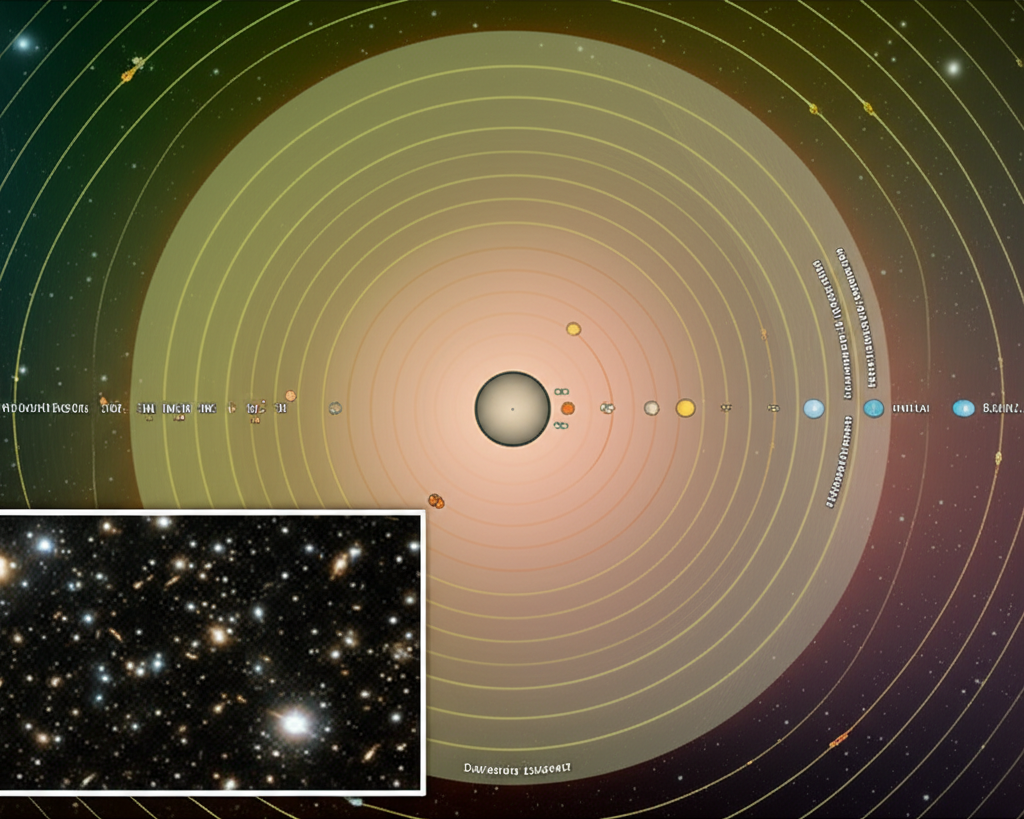
Modern Vistas: Relativity, Quantum, and the Ever-Expanding World
The 20th century brought further, even more radical, transformations to our understanding of the World through astronomy and physics, challenging the very foundations laid by Newton.
Curved Spacetime and the Relativity of Observation
Albert Einstein's theories of relativity shattered the Newtonian concepts of absolute Space and Time. Instead, he proposed a unified Spacetime continuum, a dynamic fabric that can be warped by mass and energy. The World was no longer a static stage but an active participant, its geometry influenced by its contents. Furthermore, the concept of simultaneity became relative, dependent on the observer's frame of reference, introducing a profound philosophical shift in how we perceive reality. The World became less about objective truth and more about observer-dependent perspectives.
The World as a Dynamic, Unfolding Mystery
Modern Astronomy has revealed a World far grander and stranger than ever imagined: an expanding universe born from a Big Bang, filled with dark matter and dark energy, black holes, and billions of galaxies stretching across unimaginable distances. Quantum mechanics, while operating at the subatomic level, further complicates our understanding, suggesting a World where determinism gives way to probability, and observation itself plays a role in defining reality. The World is no longer a clockwork mechanism but an unfolding, dynamic mystery, pushing the boundaries of human comprehension.
Philosophical Reverberations: Meaning in a Vast Cosmos
Each astronomical paradigm shift has forced humanity to reconsider its place, purpose, and the very meaning of existence within the World.
From Microcosm to Macrocosm: Redefining Our Place
The journey from a finite, human-centered cosmos to an infinite, expanding universe has been a humbling one. It has prompted philosophical inquiries into existentialism, the nature of consciousness, and the search for meaning in a seemingly indifferent cosmos. The World presented by modern Astronomy demands a re-evaluation of anthropocentrism, inviting us to consider ourselves as part of a much larger, interconnected whole, rather than its sole focus.
Here are some key shifts in the concept of the World driven by astronomical understanding:
- From Finite & Geocentric to Infinite & Heliocentric: A shift from a small, Earth-centered cosmos to a vast, Sun-centered (and eventually, acentric) universe.
- From Divinely Ordered to Mechanically Governed: The transition from a cosmos imbued with inherent purpose to one operating by universal, discoverable laws.
- From Absolute Space & Time to Relative Spacetime: A move from fixed, independent dimensions to a dynamic, interwoven continuum influenced by matter and energy.
- From Predictable Clockwork to Dynamic & Probabilistic: An evolution from a fully deterministic universe to one with inherent uncertainties and ongoing evolution.
The Enduring Quest for Understanding the World
Ultimately, Astronomy continues to be a powerful engine for philosophical thought. It challenges our assumptions about Space and Time, pushes the limits of our knowledge, and continually redefines the scope and nature of the World we inhabit. The questions posed by the cosmos—about origins, destiny, and our unique place within the grand tapestry of existence—remain as central to philosophy today as they were to the thinkers of ancient Greece. Our quest to understand the heavens is, fundamentally, our quest to understand ourselves and the World we are part of.
📹 Related Video: What is Philosophy?
Video by: The School of Life
💡 Want different videos? Search YouTube for: ""Great Books Western World Cosmology Philosophy""
📹 Related Video: KANT ON: What is Enlightenment?
Video by: The School of Life
💡 Want different videos? Search YouTube for: ""Kant Philosophy Astronomy Space Time""