

Astronomy and the Concept of Eternity: Glimpses of the Infinite
The human gaze, perpetually drawn skyward, has always sought to decipher the cosmic dance. From the predictable cycles of the moon and stars to the unfathomable depths revealed by modern telescopes, astronomy confronts us with scales of space and time that dwarf our earthly existence. This journey through the cosmos inevitably leads us to one of philosophy's most profound and elusive concepts: eternity. This article explores how our understanding of the universe, shaped by both ancient wisdom and contemporary science, compels us to grapple with the idea of endlessness, timelessness, and the enduring nature of reality itself, challenging our perceptions of the world and our place within it.
Staring into the Cosmic Abyss: Where Science Meets Metaphysics
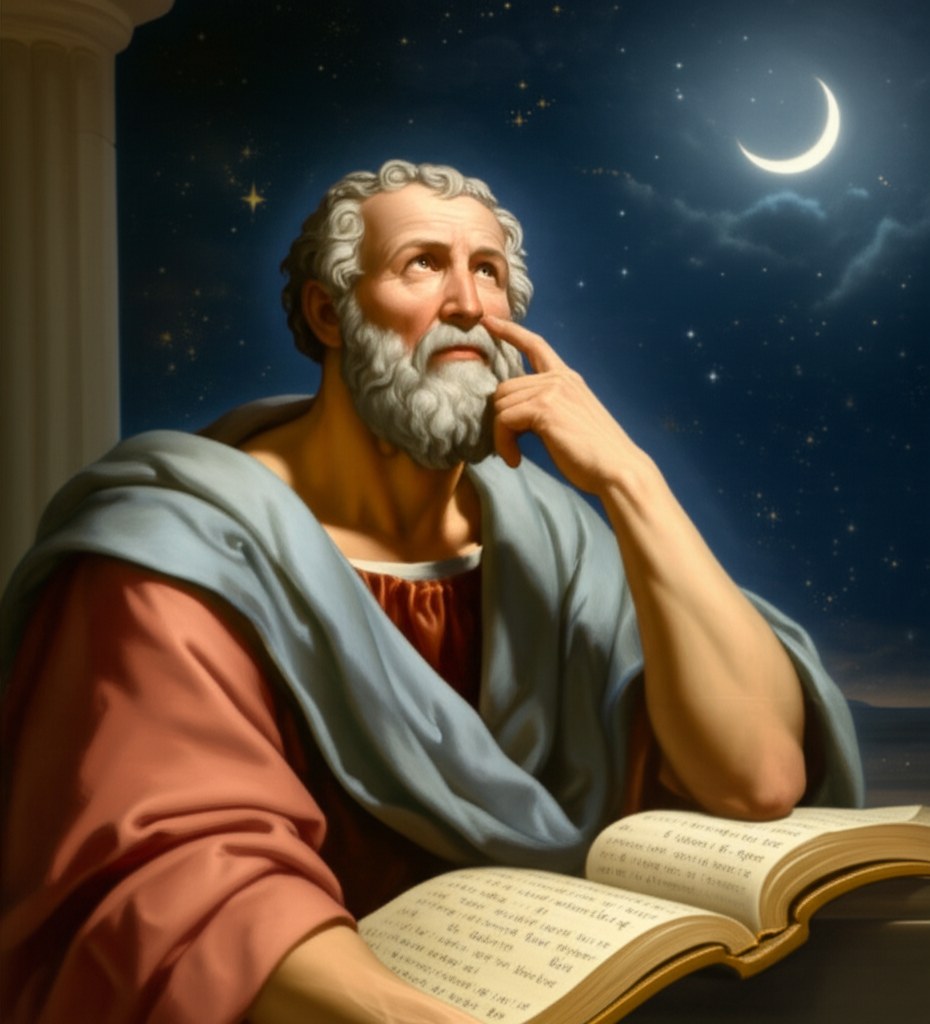
For millennia, the night sky has been humanity's grandest canvas for speculation. The seemingly immutable patterns of the stars, their vast distances, and the sheer scale of the cosmos have always hinted at something beyond the immediate, something that transcends the fleeting nature of human life. It is in this profound contemplation of the celestial that the concept of eternity finds some of its most compelling, if challenging, illustrations. We are not merely observing distant lights; we are observing echoes of deep time, prompting questions that resonate with the very foundations of philosophy.
The Unfolding Tapestry of Time and Cosmos
Our understanding of time and the universe has evolved dramatically, yet the underlying philosophical questions persist.
Ancient Gazes and Eternal Questions
From the earliest civilizations, the celestial sphere was understood as a realm of order, divinity, and often, eternity. For the ancient Greeks, as chronicled in the Great Books of the Western World, the cosmos was a divine artifact. Plato, in his Timaeus, describes the creation of the cosmos and time itself as an "image of eternity moving according to number." Aristotle, in his Metaphysics, posited an unmoved mover, an eternal, unchanging first cause responsible for the perpetual motion of the heavens. The cyclical nature of celestial events—the rising and setting sun, the phases of the moon, the return of constellations—imparted a sense of enduring order, a cosmic rhythm that seemed to echo an eternal principle. The world they observed was not static, but governed by principles that seemed to transcend mortal change.
Modern Telescopes, Ancient Ponderings
Today, astronomy has unveiled a universe far vaster and more dynamic than any ancient philosopher could have imagined. We speak of billions of light-years, billions of years, and galaxies numbering in the hundreds of billions. The Big Bang theory describes a universe with a finite beginning in time, yet its future—expansion into infinity, a cyclical collapse, or something else entirely—remains a subject of intense speculation. Each discovery, from exoplanets to black holes, pushes the boundaries of our comprehension, forcing us to confront the limitations of our temporal and spatial perception. Yet, even with these revelations, the core questions remain: What is the true nature of time? Is there an ultimate, unchanging reality that underpins this vast, evolving world?
Eternity: A Concept Beyond Human Grasp?
The concept of eternity itself is multifaceted and deeply challenging. It is not merely "a very long time," but often understood as existing outside of time altogether.
Philosophical Perspectives on Eternity
| Philosopher/Tradition | View of Eternity | Key Idea | Relevance to Astronomy |
|---|---|---|---|
| Plato | Timeless Forms | Eternal, unchanging Forms (e.g., Beauty, Justice) exist independently of the sensible world. | The cosmos as a perfect, mathematical reflection of eternal Forms. |
| Aristotle | Unmoved Mover | A pure actualizer, existing eternally and immutably, causing all motion without moving itself. | The celestial spheres' perpetual, perfect motion driven by an eternal cause. |
| Augustine of Hippo | God's Timelessness | God exists outside of time, creating time itself with the universe. | Challenges the idea of a universe existing for infinite time before creation; God's perspective is eternal present. |
| Immanuel Kant | Antinomy of Reason | Whether the world has a beginning in time and is limited in space, or is infinite in both, leads to equally valid but contradictory arguments. | Highlights the limits of human reason when contemplating cosmic time and space, suggesting eternity might be a concept beyond empirical proof. |
The Christian Perspective: A Timeless God
For thinkers like Augustine and Thomas Aquinas, drawing from the Great Books, eternity is intrinsically linked to the divine. God, in this view, does not experience time as we do, but rather exists in an eternal present, a simultaneous possession of endless life. This challenges the very notion of a beginning or end for God, making Him the ultimate ground of all existence, including time itself. The creation of the world is not an event within time for God, but the creation of time.
Kant's Antinomies: The Bounds of Reason
Immanuel Kant, grappling with the limits of human reason, identified "antinomies" concerning the world and time. He argued that reason could equally prove that the world had a beginning in time and was spatially limited, and that it was infinite in time and space. This profound insight suggests that perhaps eternity, in its cosmic sense, might lie beyond the grasp of pure empirical or rational demonstration, forcing us to confront the inherent limitations of our conceptual frameworks when faced with the truly boundless.
The Universe as a Manifestation of the Infinite
Our astronomical observations consistently push us towards a sense of the infinite.
The Expanding World and Its Implications
The discovery of the expanding universe implies a finite beginning, the Big Bang, roughly 13.8 billion years ago. This gives the universe a definite age in time. However, the future of this expansion remains open. Will it continue forever, leading to a cold, dark eternity? Or will it eventually reverse, culminating in a "Big Crunch," perhaps initiating a new cycle? Each scenario, in its own way, touches upon the idea of eternity, either as an endless continuation or as a cyclical recurrence without true beginning or end.
Cyclical Worlds vs. Linear Progress
Throughout history, philosophers and astronomers have debated whether the world and time are linear (with a definite beginning and end) or cyclical (repeating in an endless loop).
- Cyclical Views: Ancient cosmologies, including some Greek and Indian philosophies, often posited great cycles of creation and destruction, where the world is perpetually reborn. This offers a different kind of eternity—one of endless repetition, where all events, given infinite time, must recur.
- Linear Views: Monotheistic traditions generally uphold a linear view of time, with a creation, a progression, and a final culmination, often tied to a divine plan. Modern cosmology, with its Big Bang model, initially leans towards a linear progression, though some theories entertain cyclical models of the universe.
Reconciling the Finite and the Infinite
The human experience is inherently finite. We live, we die. Our world is but a speck in a vast cosmic ocean. Yet, our minds can conceive of the infinite, the eternal. Astronomy acts as a powerful catalyst for this philosophical leap. By revealing the immense scales of the universe, it stretches our imagination, forcing us to consider existence beyond our immediate grasp. The very act of observing a galaxy billions of light-years away is to peer into the past, touching a distant moment in cosmic time, bridging the gap between our fleeting present and the universe's enduring story.
Conclusion: Our Place in the Grand Narrative
Astronomy is more than just a science; it is a profound philosophical endeavor. It provides us with the raw data—the light, the distances, the patterns—that fuel our contemplation of eternity. Whether we envision eternity as a timeless realm outside of time, an endless progression, or an infinite cycle, the cosmos continually reminds us of the vastness of existence and the limits of our perception. As Daniel Sanderson, I find solace and wonder in this cosmic meditation. The universe, in its grandeur, compels us to look beyond the immediate, to ponder our place in the grand narrative of time and existence, and to continually seek meaning in the face of the ultimate mystery: eternity.
YouTube Video Suggestions:
-
📹 Related Video: What is Philosophy?
Video by: The School of Life
💡 Want different videos? Search YouTube for: ""The Nature of Time Philosophy Astronomy""
2. ## 📹 Related Video: What is Philosophy?
Video by: The School of Life
💡 Want different videos? Search YouTube for: ""What is Eternity Philosophy Cosmology""