

When Stillness Heals: Art, Witness, and the Impossible Balancing Act of Modern Resilience
Dear Friends,
Every week on “Created in the Image of God,” we dig into old questions in new forms.
But rarely has a conversation stirred in me quite the same sense of urgent irony—and subtle peril—as this Sunday’s dialogue with art therapist Tracey Saia.
We titled the episode: “When Words Fail, Art Speaks.” But this time, the silence was less meditative, more electric—a kind of static underlying the whole modern predicament.
Raised for speed, schooled by screens, all our secrets one click from viral, we live in what feels like a near-schizophrenic age. Privacy is almost quaint. A single offhand remark—or moment of vulnerability—can be magnified, dissected, and repurposed before we’ve even processed it ourselves.
And everywhere, the pressure builds: Move faster. Share more. React—now.
We ache to protect ourselves and, even more, the next generation. So we hover. We police every word, guard every feeling, “walk on eggshells,” desperate to shield against every microaggression and accidental slight. The result? A climate of vigilance bordering on pathology—where, in the frantic attempt to defend against “death by a thousand paper cuts,” we risk losing the thicker skins, internal fortitude, and quiet spaces that make real flourishing possible.
How, then, do we resist both hardening into cynicism and dissolving into defensiveness? How do we build souls equal to the times—without being shredded by their speed?
Living in the Blast Zone: The Sting of Ceaseless Exposure
From Tracey’s two decades of work with young people, the pattern is clear and deeply unsettling.
Today’s kids process a steady diet of anxiety, overwhelm, and subtle self-harm—sometimes easier to manage than the bruising unpredictability of online shaming, public failures, or emotional exposure.
Self-worth dangles on a tightrope: first the onslaught of too much information (trauma and drama streaming from every device), then the temptation to cushion every blow, shield every nerve, monitor every interaction lest some fresh wound appear.
It’s little wonder, as leading psychologists warn (see Lukianoff & Haidt, 2018), that we see an epidemic not just of “triggering” but of a kind of cultural allergic reaction—a defense system so hyperactive that it winds up undermining the very immune system we need to survive.
Our children are, in effect, being asked to live both in a bulletproof vest and in an emotional glass house—exposed, scrutinized, and subject to global opinion at the speed of TikTok. The pressure to endure “death by a thousand micro-cuts,” and the corresponding flight to total protection, have become two sides of the same coin.
Bearing Honest Witness: Stillness, Art, and the Escape from Panic
What, then, is the counterpoint? Tracey’s answer is the polar opposite of our hyperconnected, hyperreactive reality:
Stillness.
Slowing down.
Honoring presence and silence—not to escape, but to listen, to bear witness, to remember that not every pain needs a performance, not every urge needs a fix.
In the therapy room, art becomes the language of survival. When words are too risky—either weaponized or simply inadequate—color, line, and image offer an internal sanctuary. It is not about therapy as transaction or the therapist as fixer, but about making space for process—for allowing even the “unspeakable” to be seen, processed, witnessed… but not immediately solved or publicized.
Presence, as Tracey said, is everything.
Not the frenetic presence of the reactive crowd, but the humble, steady, trustworthy witness. “There is no greater human connection,” she reminded us, “than when someone lets you bear witness to their vulnerability.”
Quiet, not spectacle, is what heals.
This is not just therapeutic best practice—it’s ancient spiritual wisdom. Whether in the patience of Jesus with the suffering around Him, or the Baháʼí call to let “your heart burn with loving-kindness for all who may cross your path,” the true antidote to a world of eggshells is not more protection. It’s more presence.
Doors Without Doorknobs: How Not to Rush the Soul
Nowhere was this clearer than in Tracey’s account of the girl who—asked to draw her inner world—produced a door with no handle. A closed threshold. A symbol of timing and autonomy and the possibility that, sometimes, the path forward just isn’t open…yet.
Yet how many of us, in the speed of this culture, try to pry open every door for each other with advice, urgency, or moral panic? Parents, teachers, even friends rush to resolve, reconcile, or wrap in bubble wrap.
But true healing—real resilience—demands something far more difficult: the courage to let the timetable be sacred, to honor the in-between, to trust that nothing good comes from forcing another through a door until they are truly ready.
If modernity is a treadmill of endless reaction, the door-without-a-doorknob is its spiritual foil. It says: You may not be ready. You get to choose. And those who love you must have the wisdom to stand outside and wait.
In scriptural terms, this is neither passivity nor neglect. Revelation offers us God Himself, standing at the door and knocking—never breaking down the barrier, always inviting, never compelling (Revelation 3:20).
Real growth, like good art, happens at its own speed.
The Impossible Balance: Building Hearts That Can Endure—and Stay Open
So here is the crossroads we face.
How do we guard against “death by a thousand paper cuts”—the low-level barrage of slights, wounds, and exposures that seem uniquely modern—without armoring every nerve, policing every word, or vanishing from authentic community?
How do we teach our children (and ourselves) to build resilience when the digital town square both magnifies every mistake and tempts us to defend against even the smallest discomfort?
The answer, if there is one, lies here:
We must become a generation of sacred witnesses, not frantic shield-bearers.
We must relearn the lost art of holding space for pain, of inviting—not rushing—the slow self-discovery of art, silence, and reflection.
We must acknowledge that every heart has doors that can only open from within, and that even “protection” can wound if it becomes its own prison.
As research and soul wisdom alike affirm, resilience is not forged by shielding from every blow, nor by surrendering to every outrage. It comes from agency, presence, meaning—and above all, time (Seery, Holman & Silver, 2010).
A Communal Challenge—and Invitation
This week, I challenge you—and myself—to pause in the frantic swirl of news, noise, and notification.
Resist the compulsion to fix, post, or react. Bear silent, creative witness. Listen—not to respond, but to stay. Allow the art—the story, the silence, the unfinished question—to sit on the table a little longer.
If you steward the heart of a child, student, partner, or friend: Ask, “Where is their doorknob?”—and can I learn to wait for it?
If you tend your own battered soul: Dare to honor the door, the slow moment, the impulse for stillness, the need for real connection.
In the face of a society careening between panic and paralysis, let us be the embrace that steadies, the silence that anchors, the witness that abides.
For we are, all of us, created in the image of God—bearing, perhaps, the infinite patience that only the divine can teach. Let’s pass it on.
I welcome your comments, your art, your stories of learning to wait or witness, your struggles with this paradox. Like, share, restack—or support the series with a paid subscription if these conversations matter to your journey.
With hope for slower, more resilient days,
—Wade Fransson
References:
- Lukianoff, G., & Haidt, J. (2018). The Coddling of the American Mind. Penguin Press.
- Seery, M. D., Holman, E. A., & Silver, R. C. (2010). Whatever does not kill us: Cumulative lifetime adversity, vulnerability, and resilience. Journal of Personality and Social Psychology, 99(6), 1025-1041.
- Bahá’í Writings: Abdu’l-Bahá, Selections from the Writings of Abdu’l-Bahá.
- Psalm 139; Revelation 3:20 (NIV).
My Legacy (in the making)
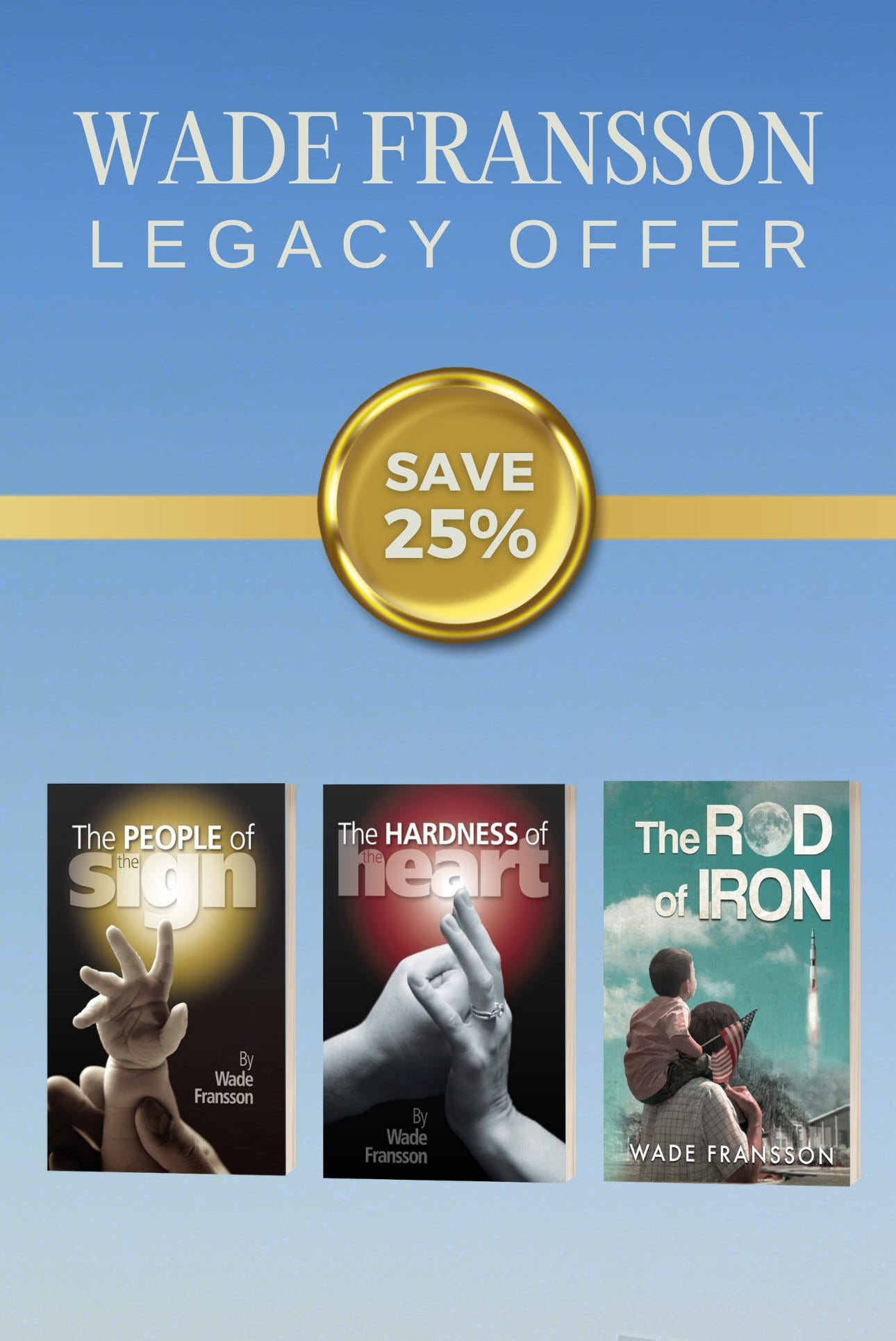
For a limited time, I’m offering signed copies of my complete trilogy set — The People of the Sign, The Hardness of the Heart, and The Rod of Iron — all original editions, for just $29.95 (US addresses only, due to shipping costs).
These are the stories and struggles, chronicled honestly, that shaped me — and perhaps they might serve as companions and signposts on your own pilgrimage.
By upgrading to a paid subscription in my Substack, you can receive the signed trilogy set for just $9.99 (to cover shipping and handling — again, US-only) and gain exclusive access to the making of my next book.


