

The Unequal Scales: Navigating Wealth Distribution and Economic Justice
This article delves into the enduring philosophical debate surrounding wealth distribution and economic justice. We will explore how thinkers from the Great Books of the Western World have grappled with questions concerning the equitable division of resources, the role of labor in generating value, and the legitimate authority of the state in mediating economic outcomes. From ancient Greek ideals of the polis to modern critiques of capitalism, understanding these foundational discussions is crucial for comprehending contemporary challenges of inequality and fairness in our economic systems.
Unpacking the Concepts: Wealth, Justice, and Society
At the heart of any discussion about economic fairness lies the need to define our terms. What exactly do we mean by wealth, and what does justice demand regarding its distribution? These are not simple questions with straightforward answers, and their complexity has captivated philosophers for millennia.
Defining Wealth: More Than Just Riches
When we speak of wealth, we are not merely referring to an individual's accumulated money. Philosophically, wealth encompasses a broader spectrum:
- Material Possessions: Land, property, goods, capital.
- Productive Capacity: The ability to generate future goods and services (e.g., factories, technology, education, skills).
- Social Capital: Access to networks, opportunities, and influence.
From Aristotle's discussions in Politics regarding household management (oikonomia) and the natural limits of acquisition, to Adam Smith's exploration of the Wealth of Nations as the collective output of a society's labor, the concept has evolved. Yet, the core question remains: who is entitled to what, and why?
The Demand for Justice: A Philosophical Imperative
Justice, particularly distributive justice, concerns the fair allocation of resources, opportunities, and burdens within a society. Different philosophical traditions offer distinct frameworks:
- Egalitarianism: Emphasizes equality in outcomes or opportunities.
- Meritocracy: Advocates for distribution based on individual effort, talent, or contribution.
- Utilitarianism: Seeks to maximize overall societal well-being, even if it results in some disparities.
- Libertarianism: Prioritizes individual liberty and property rights, with minimal state intervention in distribution.
Plato, in his Republic, envisioned a highly stratified society where wealth was largely communal among the guardian class, believing that private property could corrupt. His focus was on the arete (excellence) of the state, where each class performed its function justly. Aristotle, while acknowledging the need for private property for individual flourishing, also discussed the principles of distributive justice in Nicomachean Ethics, suggesting that goods should be distributed according to merit or contribution, but also acknowledging the role of corrective justice to rectify imbalances.
The Engine of Value: Labor and its Just Rewards
Central to understanding how wealth is generated and how it should be distributed is the concept of labor. Philosophers have long debated the relationship between effort, creation, and ownership.
Locke's Labor Theory of Property
John Locke, in his Second Treatise of Government, famously argued that labor is the origin of property. When an individual "mixes his labour" with unowned resources, they become his property. This foundational idea posits that:
- Self-Ownership: Each individual owns their own person and their labor.
- Value Creation: Labor adds value to natural resources, transforming them into something useful.
- Natural Right: Property acquired through labor is a natural right, predating the state.
However, Locke also introduced provisos: one should leave "enough, and as good" for others, and not allow anything to spoil. These provisos become critical when considering the accumulation of vast wealth and its impact on those who are left with little.
Marx's Critique of Labor and Capital
Karl Marx, building upon classical economists, radically reinterpreted the relationship between labor and wealth in works like Das Kapital. For Marx:
- Labor Theory of Value: The value of a commodity is determined by the socially necessary labor time required to produce it.
- Exploitation: Under capitalism, workers (proletariat) do not receive the full value of their labor; a portion, surplus value, is appropriated by the capitalist (bourgeoisie) as profit.
- Alienation: Workers become alienated from their labor, the product of their labor, and ultimately from themselves, leading to a profound sense of injustice.
Marx saw the unequal distribution of wealth not as a natural outcome but as a direct consequence of a system built on the exploitation of labor, leading to class struggle and inherent injustice.
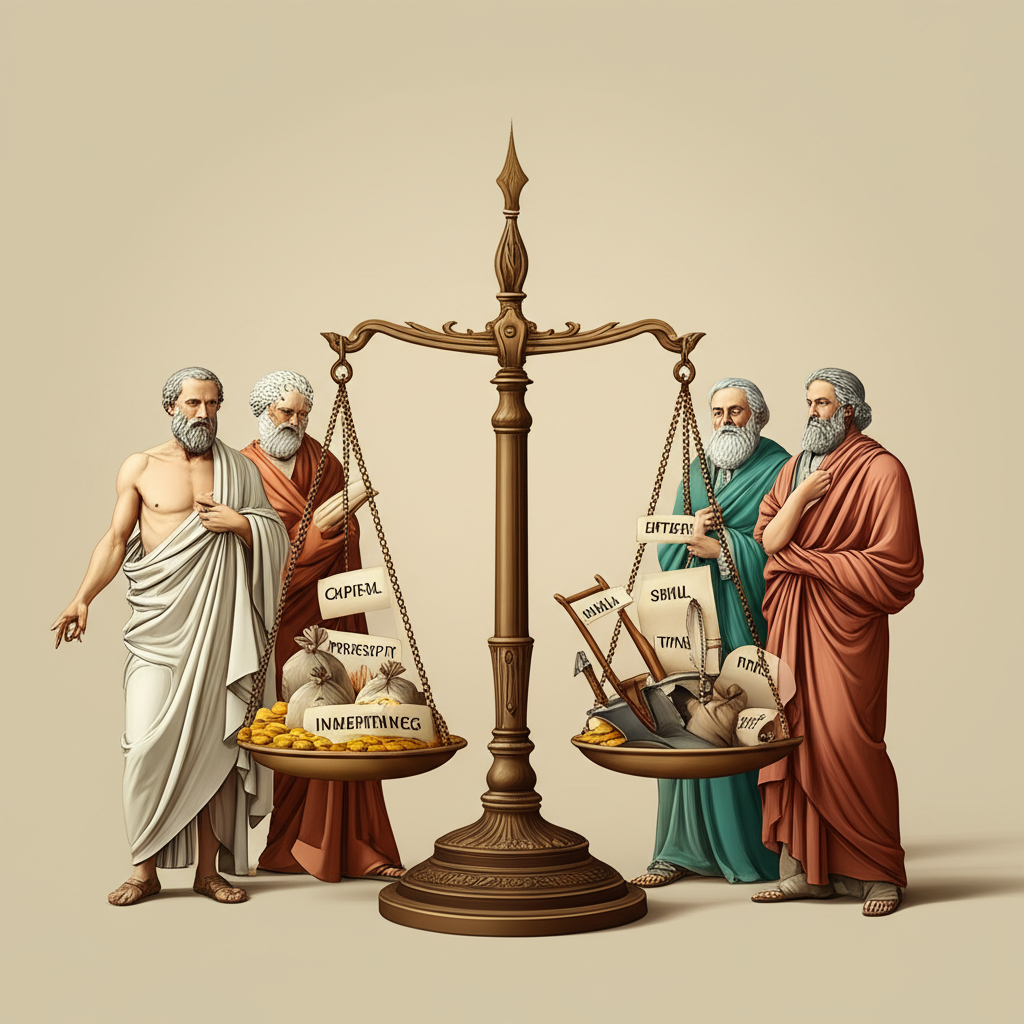
The State's Hand: Intervention and Regulation
Given the inherent complexities and potential for extreme disparities, the role of the state in regulating wealth distribution and ensuring economic justice becomes paramount. Is the state a neutral arbiter, a protector of property, or an active agent for redistribution?
Ancient Perspectives on State and Property
- Plato's Republic: Advocated for a highly controlled economic system, particularly for the guardian class, where private property was minimized to prevent corruption and ensure focus on the common good. The state was the primary instrument for achieving ideal justice.
- Aristotle's Politics: While supporting private property, Aristotle recognized the state's role in fostering a virtuous citizenry and preventing extremes of wealth and poverty, which he believed led to social instability. He discussed the importance of a strong middle class.
Modern Debates on State Intervention
The Enlightenment and subsequent eras brought forth diverse views on the state's legitimate economic functions:
- Classical Liberalism (e.g., Locke, early Smith): Advocated for a limited state whose primary role was to protect individual rights, including property rights, and enforce contracts. Market forces, guided by an "invisible hand," were thought to lead to optimal outcomes for wealth creation. Intervention in distribution was generally seen as illegitimate.
- Social Contract Theory (e.g., Rousseau): Jean-Jacques Rousseau, in Discourse on the Origin and Basis of Inequality Among Men, argued that private property, while perhaps a necessary evil, led to profound inequalities and the corruption of human nature. The state, through the "general will" articulated in The Social Contract, could legitimately intervene to mitigate these inequalities, ensuring a degree of economic equality to preserve true liberty.
- Utilitarianism (e.g., John Stuart Mill): While a proponent of individual liberty, John Stuart Mill, in Utilitarianism, recognized the state's potential role in improving overall societal well-being. If redistribution of wealth could lead to a greater good for the greatest number, it could be justified, provided it didn't unduly infringe upon individual rights or incentives.
- Marxist Theory: Envisions the ultimate dissolution of the capitalist state and its replacement by a classless society where the means of production are collectively owned, thereby eliminating private wealth accumulation and achieving true economic justice.
The spectrum of state intervention ranges from minimal regulation to extensive social welfare programs and wealth taxes, all justified by differing philosophical conceptions of justice and the common good.
Enduring Questions in Economic Justice
The philosophical journey through wealth distribution reveals that there are no easy answers. The tension between individual liberty and collective well-being, the recognition of labor's value versus the accumulation of capital, and the appropriate scope of state power remain central to contemporary debates.
The Great Books of the Western World offer not prescriptions, but rather a robust framework for critical inquiry. They challenge us to consider:
- What constitutes a just economic system?
- How should wealth be generated and shared?
- What are the ethical responsibilities of individuals and the state in addressing inequality?
These questions are more urgent than ever as societies grapple with unprecedented levels of wealth concentration, technological disruption, and global economic interdependence. The philosophical tools provided by our intellectual heritage are indispensable for navigating these complex ethical landscapes and striving towards a more just world.
YouTube Video Suggestions:
-
📹 Related Video: PLATO ON: The Allegory of the Cave
Video by: The School of Life
💡 Want different videos? Search YouTube for: ""Plato Aristotle Justice Wealth Distribution Crash Course Philosophy""
2. ## 📹 Related Video: ARISTOTLE ON: The Nicomachean Ethics
Video by: The School of Life
💡 Want different videos? Search YouTube for: ""John Locke Labor Theory Property Explained Karl Marx Capitalism""