

The Uneasy Balance: Navigating Wealth Distribution and Economic Justice
The question of how wealth should be distributed within a society is not merely an economic puzzle; it is, at its core, a profound philosophical challenge. For centuries, thinkers have grappled with what constitutes a just economic order, examining the origins of wealth, the value of labor, the role of the State, and the very definition of justice. This article delves into the rich philosophical tapestry surrounding wealth distribution and economic justice, exploring diverse perspectives from the Great Books of the Western World to contemporary debates, aiming to illuminate the complex interplay between individual liberty, collective well-being, and the pursuit of a fair society.
The Philosophical Foundations: What Do We Mean by Wealth and Justice?
Before we can discuss distribution, we must first define our terms.
- Wealth: Far more than mere monetary accumulation, philosophical discussions of wealth encompass all valuable resources—material goods, land, capital, natural resources, and even opportunities and capabilities. It's about what a society possesses and what its members can access.
- Justice: This concept, explored since antiquity, asks what is due to individuals and groups. Is it equality? Equity? Merit? Need? Justice serves as the moral compass guiding our judgments about fairness and rightness in social arrangements.
- Economic Justice: This specific branch applies principles of justice to the production, distribution, and consumption of economic goods and services. It questions whether the current allocation of wealth and opportunities is fair, and if not, what systemic changes are required.
The very pursuit of economic justice often pits competing values against one another: individual freedom to accumulate wealth versus the collective good, efficiency versus equity, and historical entitlements versus present needs.
Ancient Voices on Property and the Polis
The foundations of our debate can be traced back to the ancient Greeks, whose inquiries into the ideal polis inherently involved questions of property and distribution.
- Plato (c. 428–348 BCE): In his monumental work, The Republic, Plato famously proposed a radical solution for his guardian class: the abolition of private property and families. His aim was to prevent personal interest from corrupting public duty, ensuring that the rulers of the ideal State would act solely for the common good. For ordinary citizens, while private property was allowed, it was heavily regulated to prevent excessive wealth disparities, which he believed led to factionalism and instability.
- Aristotle (384–322 BCE): A student of Plato, Aristotle offered a more pragmatic view in his Politics and Nicomachean Ethics. He distinguished between different forms of justice, particularly distributive justice and corrective justice. Distributive justice, for Aristotle, meant that goods and honors should be distributed proportionately according to merit, not equally. He also defended private property as beneficial for fostering responsibility and generosity, but cautioned against avarice and recommended a moderate amount of property for citizens to participate fully in the polis. He saw the State as crucial in maintaining balance and preventing extreme inequality.
The Enlightenment and the Dawn of Modern Economic Thought
The Enlightenment era brought forth new theories on natural rights, individual liberty, and the origins of property, fundamentally reshaping discussions on wealth and justice.
- John Locke (1632–1704): In his Second Treatise of Government, Locke posited that property rights are natural rights, derived from an individual's labor. When a person mixes their labor with unowned resources, those resources become their property. However, Locke also included provisos: one must leave "enough and as good" for others, and one should only appropriate what one can use before it spoils. The invention of money, he argued, allowed for greater accumulation of wealth beyond immediate need, complicating these natural limits and necessitating the State to protect property.
- Jean-Jacques Rousseau (1712–1778): A powerful critic of existing inequalities, Rousseau, in his Discourse on the Origin and Basis of Inequality Among Men, famously declared, "The first man who, having enclosed a piece of ground, bethought himself of saying This is mine, and found people simple enough to believe him, was the real founder of civil society." Rousseau saw private property, particularly its unequal distribution, as the root of societal corruption and the loss of natural freedom. He argued that the State, formed through a social contract, should aim to protect liberty and equality, even if it meant limiting extreme wealth disparities.
- Adam Smith (1723–1790): While often seen as the father of capitalism, Smith's The Wealth of Nations also grappled with the implications of wealth creation. He argued that the division of labor and free markets, guided by an "invisible hand," could lead to general prosperity. However, his earlier work, The Theory of Moral Sentiments, revealed a philosopher concerned with empathy and the moral limits of self-interest. Smith believed that a thriving society required not only economic growth but also a degree of social cohesion and a State that provided essential public goods and regulated markets to prevent monopolies.
Labor, Value, and Revolutionary Critiques
The Industrial Revolution brought unprecedented changes, leading to new philosophical critiques of wealth and its distribution, particularly focusing on the role of labor.
- Karl Marx (1818–1883): Marx's Das Kapital presents a scathing critique of capitalism. For Marx, all wealth is derived from labor. He argued that capitalism inherently exploits the worker by paying them less than the value their labor creates (surplus value), which is then appropriated by the capitalist. This exploitation leads to class struggle and alienation. Marx envisioned a communist society where the means of production are collectively owned, thereby abolishing private property and the exploitation of labor, leading to a truly just and egalitarian distribution of wealth. The State, in his view, was an instrument of the ruling class and would eventually wither away in a classless society.
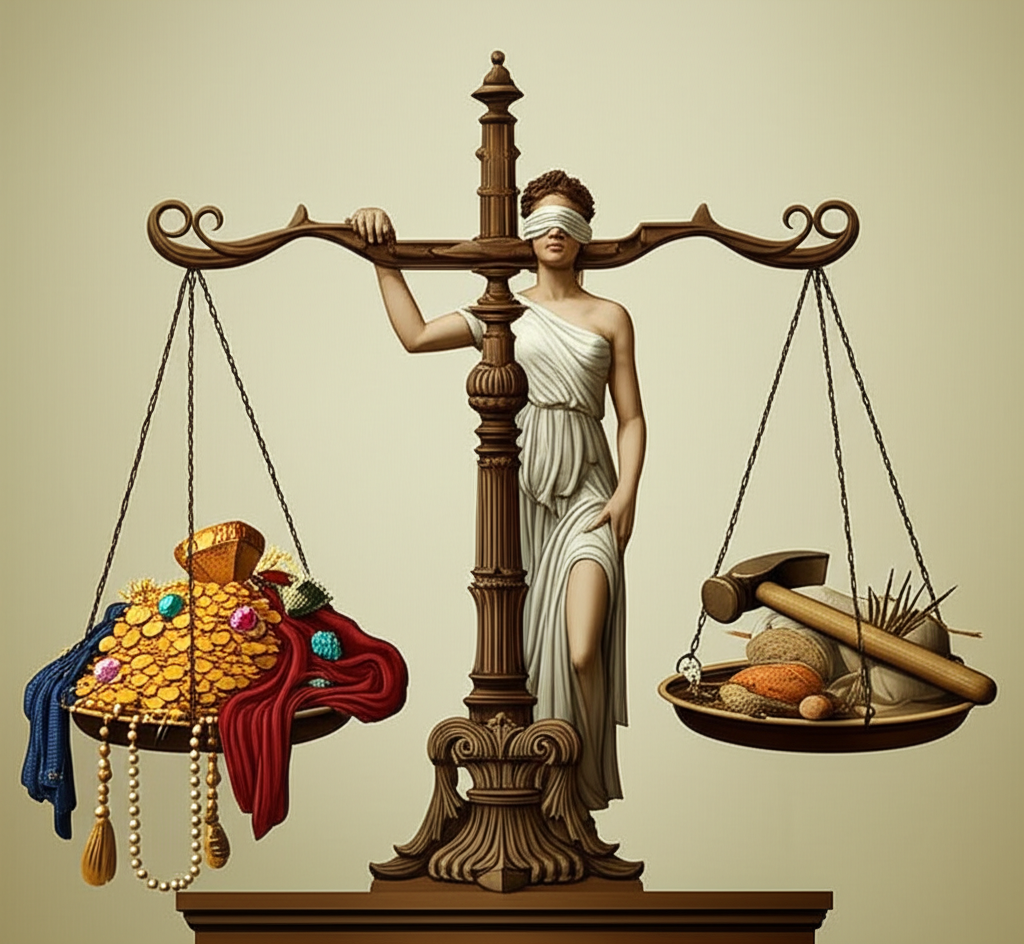
Modern Philosophical Approaches to Distributive Justice
The 20th century witnessed a resurgence of rigorous philosophical inquiry into distributive justice, seeking to provide systematic frameworks for a fair society.
-
John Rawls (1921–2002): In A Theory of Justice, Rawls proposed a thought experiment: the "original position" behind a "veil of ignorance." Rational individuals, unaware of their own social standing, talents, or beliefs, would choose principles of justice that are fair to all. He argued they would select two principles:
- Equal Basic Liberties: Each person is to have an equal right to the most extensive scheme of equal basic liberties compatible with a similar scheme of liberties for others.
- Difference Principle: Social and economic inequalities are to be arranged so that they are both (a) to the greatest benefit of the least advantaged, and (b) attached to offices and positions open to all under conditions of fair equality of opportunity.
Rawls's theory provides a robust framework for a liberal welfare State that actively seeks to mitigate extreme inequalities while respecting individual freedoms.
-
Robert Nozick (1938–2002): In Anarchy, State, and Utopia, Nozick presented a libertarian counterpoint to Rawls. He argued for an "entitlement theory" of justice, which focuses on the historical legitimacy of holdings rather than patterned distribution. His three principles of justice are:
- Justice in Acquisition: How unowned things can be justly acquired.
- Justice in Transfer: How holdings can be justly transferred from one person to another (e.g., through voluntary exchange).
- Justice in Rectification: How to correct past injustices in acquisition or transfer.
Nozick concluded that any State more extensive than a minimal "night-watchman state" (which protects against force, fraud, and theft) is unjust because it necessarily involves coercive taxation to redistribute wealth, violating individual rights.
-
Amartya Sen (1933–): Sen's "capability approach" offers a different lens, moving beyond mere income or resource distribution to focus on what individuals are actually able to do and be. For Sen, justice requires ensuring that everyone has the real opportunities (capabilities) to achieve valuable functionings (e.g., being well-nourished, having self-respect, participating in public life). This approach highlights that equal distribution of resources doesn't necessarily lead to equal freedom or well-being, as individual circumstances and needs vary.
The Role of the State: From Minimal to Welfare
The role of the State is perhaps the most contentious aspect of discussions on wealth distribution.
| Philosophical Stance | Role of the State in Wealth Distribution | Key Mechanisms/Beliefs |
|---|
📹 Related Video: What is Philosophy?
Video by: The School of Life
💡 Want different videos? Search YouTube for: "Wealth Distribution and Economic Justice philosophy"