

The Enduring Question: Wealth Distribution and Economic Justice
The distribution of wealth within a society is not merely an economic concern; it is, at its core, a profound philosophical challenge deeply intertwined with our understanding of justice. From ancient city-states to modern global economies, thinkers have grappled with how resources should be allocated, who deserves what, and what role the State plays in mediating these complex relationships. This article delves into the historical philosophical perspectives on wealth distribution, drawing insights from the Great Books of the Western World to illuminate the timeless debate surrounding economic justice.
Unpacking the Foundations of Economic Justice
The concept of economic justice addresses the fairness of how goods, services, and opportunities are distributed. While "fairness" itself is a contested notion, the philosophical inquiry into wealth distribution seeks to establish principles that govern economic arrangements, often considering factors like merit, need, contribution, and equality. Is an unequal distribution inherently unjust, or can it be justified under certain conditions? What constitutes a 'just' share, and how does the concept of labor factor into our claims on wealth? These are questions that have echoed through centuries of philosophical discourse.
Ancient Perspectives: From Polis to Property
The earliest philosophical inquiries into wealth distribution often emerged within the context of the ideal State or polis.
-
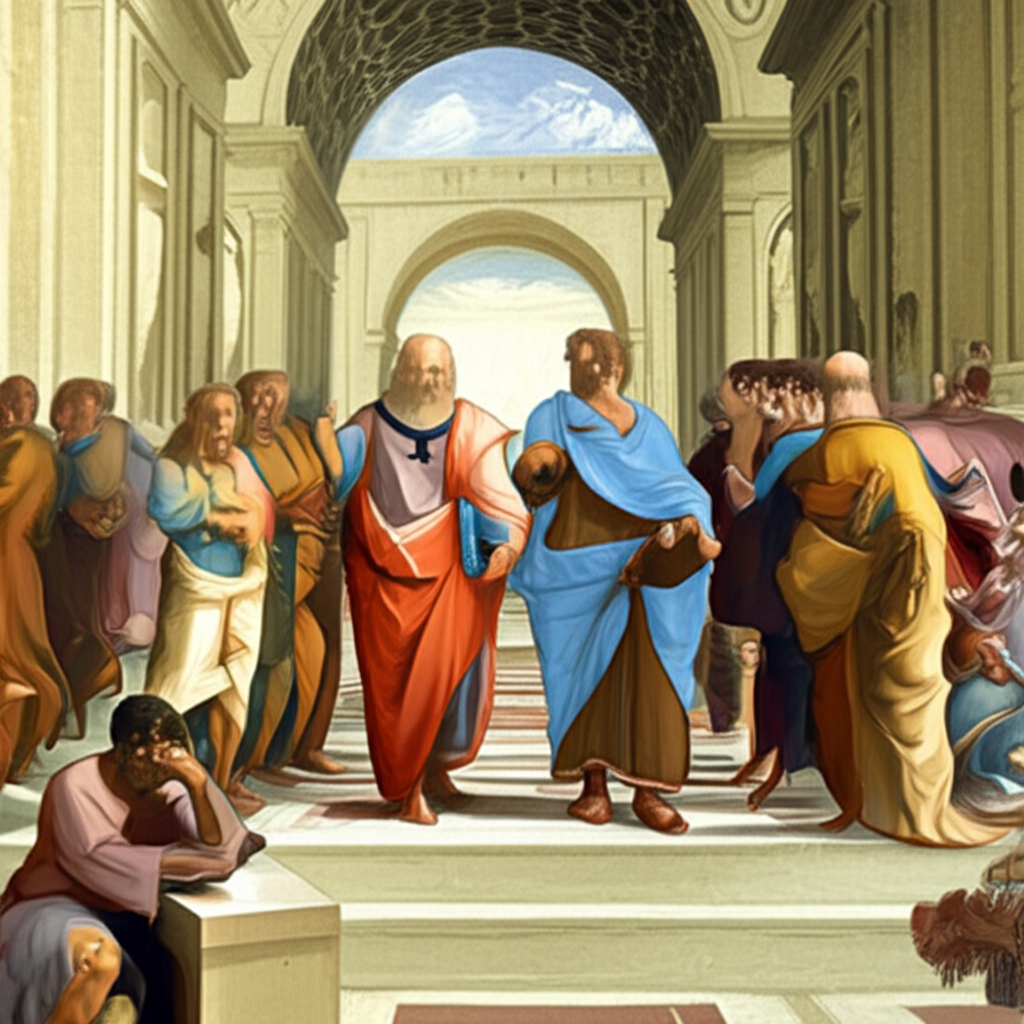
Plato's Vision of the Just State: In his seminal work, The Republic, Plato grapples with the ideal structure of society, where justice is paramount. For Plato, an extreme disparity in wealth is detrimental to social harmony. He suggests that the guardians and rulers should possess no private property or wealth, living communally to prevent corruption and self-interest from overriding their duty to the State. While not advocating for absolute economic equality for all citizens, Plato recognized the corrosive potential of unchecked wealth accumulation and the need for the State to regulate economic life for the common good. His focus was on the justice of the social order itself, rather than individual economic rights.
-
Aristotle on Distributive Justice and Property: Aristotle, in Nicomachean Ethics and Politics, provides a more nuanced view. He distinguishes between different forms of justice, including distributive justice, which concerns the fair allocation of honors, wealth, and other goods according to merit. For Aristotle, justice is not about absolute equality but about proportionality – treating equals equally and unequals unequally, in proportion to their relevant differences. He also defended private property as a practical necessity for human flourishing, arguing it provides incentive, fosters generosity, and prevents disputes more effectively than communal ownership. However, he also stressed the importance of temperance and the use of wealth for the common good, not just personal gain. The State, for Aristotle, plays a crucial role in ensuring that distribution aligns with the principles of justice and contributes to the overall stability and virtue of the community.
The Rise of Individual Rights and the Role of Labor
With the Enlightenment, the focus shifted towards individual rights and the origins of property.
-
John Locke and the Labor Theory of Property: In his Second Treatise of Government, John Locke profoundly influenced subsequent debates on wealth and justice. Locke argued that individuals have a natural right to their own person and, by extension, to the fruits of their labor. When an individual mixes their labor with unowned natural resources, those resources become their property. This "mixing labor" theory provided a powerful justification for private property, predating the formation of the State. However, Locke also introduced provisos: one must leave "enough, and as good" for others, and one should not waste what they acquire. The invention of money, he noted, complicated these provisos by allowing for greater accumulation of wealth without spoilage. For Locke, the State's primary role is to protect these natural rights, including the right to property, thereby establishing a framework for economic justice based on individual entitlement and labor.
-
Jean-Jacques Rousseau and the Origins of Inequality: In contrast to Locke, Jean-Jacques Rousseau, particularly in his Discourse on the Origin and Basis of Inequality Among Men, offered a scathing critique of private property as the root cause of social inequality and moral decay. For Rousseau, the first person to enclose a piece of land and declare "This is mine!" was the true founder of civil society, and thus, of all its subsequent injustices. He saw the accumulation of wealth and the establishment of property rights as leading to a departure from a more egalitarian "state of nature," creating dependence, servitude, and ultimately, an unjust social contract. While not offering a detailed economic blueprint, Rousseau's work powerfully questioned the legitimacy of existing wealth distributions and the very foundations of private property.
The State, Labor, and Modern Dilemmas
The interplay between individual labor, the accumulation of wealth, and the regulatory power of the State remains a central tension in contemporary discussions of economic justice.
| Philosophical Concept | Key Thinker(s) | Core Idea on Wealth/Justice
The State as Protector of Rights
The concept of the State's role in protecting individual rights and liberties, particularly in connection to property, finds a strong philosophical foundation in Locke. The idea that individuals, through their labor, have a right to acquire and own wealth is a powerful and enduring idea. However, the exact extent to which the State should intervene to ensure a just distribution, especially when the initial acquisition of wealth might lead to vast disparities, remains a battleground of political philosophy.
- Labor and Value: From Adam Smith's early insights into the division of labor creating wealth in The Wealth of Nations (though he also expressed concern for the poor), to Karl Marx's revolutionary critique in Das Kapital concerning the exploitation of labor and the unjust appropriation of surplus value by capital owners, the concept of labor has been central to understanding how wealth is generated and distributed. Marx argued that capitalism inherently leads to an unjust distribution because the value created by labor is not fully returned to the laborer, leading to the accumulation of wealth by the capitalist class and the impoverishment of the working class. His call for a State-controlled economy aimed at eliminating private property and ensuring justice for the proletariat was a radical reinterpretation of the State's role.
The Ongoing Quest for Economic Justice
The philosophical journey through the Great Books of the Western World reveals that the questions surrounding wealth distribution and economic justice are perennial. There are no easy answers, but a spectrum of thought that ranges from justifying private property and wealth accumulation based on labor and merit, to advocating for significant State intervention or even the abolition of private property to achieve greater equality. The core tension persists: how do we balance individual liberty and the right to acquire wealth with the collective good and the imperative for a just society?
Philosophers continue to debate:
- What constitutes a fair starting point? Is it enough to ensure equality of opportunity, or does justice demand some level of equality of outcome?
- What is the legitimate scope of State intervention? To what extent should the State redistribute wealth through taxation, social programs, or regulation to correct perceived injustices or prevent excessive disparities?
- How do we define "merit" and "contribution" in a way that is truly just? Does the market accurately reflect the value of labor and contribution, or are there systemic biases that lead to unjust rewards?
These questions, first articulated in the ancient world, continue to shape our political and economic debates today, reminding us that economic structures are not natural phenomena but moral and philosophical constructs that demand constant scrutiny and reflection. The quest for economic justice is, therefore, an ongoing philosophical endeavor, requiring us to continually re-evaluate our values and the systems we create.
YouTube: "Plato's Republic Wealth Distribution"
YouTube: "Locke Labor Theory Property Explained"
📹 Related Video: What is Philosophy?
Video by: The School of Life
💡 Want different videos? Search YouTube for: "Wealth Distribution and Economic Justice philosophy"