

The Enduring Philosophical Quest for Economic Justice: A Planksip Perspective
Summary: The question of wealth distribution and economic justice stands as one of philosophy's most persistent and complex challenges. From ancient Greece to modern thought, thinkers have grappled with how societies ought to allocate resources, define ownership, and ensure fairness in material well-being. This article delves into foundational perspectives from the Great Books of the Western World, examining how concepts of wealth, justice, labor, and the State intertwine in our pursuit of a morally sound economic order. We will explore classical ideals, the emergence of property rights, and radical critiques that continue to shape contemporary debates on economic equity.
Foundations of Fairness: Ancient Greece on Wealth and the State
The earliest systematic explorations of wealth distribution and justice emerge from the philosophical luminaries of ancient Greece. For them, economic arrangements were inextricably linked to the moral character and stability of the polis – the city-state.
- Plato's Ideal Republic: In his seminal work, The Republic, Plato envisions a society where justice is achieved through a strict division of labor and a hierarchical social structure. For the guardian class (rulers and soldiers), private wealth is largely abolished, and property is held in common. This radical proposal aims to prevent corruption and ensure that those governing are motivated solely by the collective good, not personal gain. Plato believed that excessive wealth for some and abject poverty for others would inevitably lead to societal discord and injustice. The State, in Plato's view, has a primary role in regulating economic life to foster virtue and harmony.
- Aristotle's Practical Justice: Aristotle, Plato's student, offered a more pragmatic yet equally profound analysis in Politics and Nicomachean Ethics. He distinguished between different forms of justice, particularly distributive justice, which concerns the fair allocation of common assets, and corrective justice, which rectifies imbalances in transactions. Aristotle argued that wealth should be distributed proportionally to merit or contribution, not equally, but also cautioned against the accumulation of excessive wealth through "unnatural" means like usury. He saw private property as natural and beneficial, fostering diligence and generosity, but stressed that its use should serve the common good. The State was essential for upholding laws that ensure fair exchange and prevent economic exploitation, thereby maintaining a balanced society.
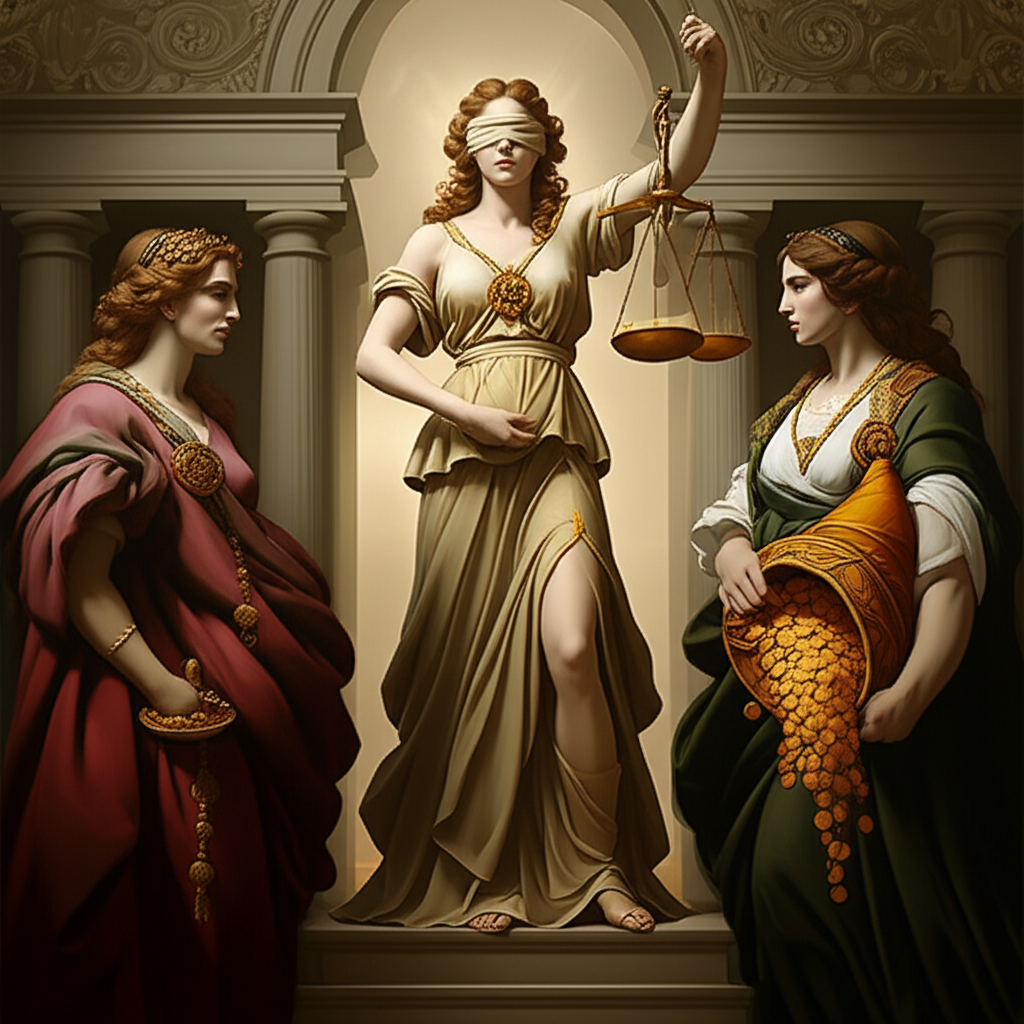 and "Poverty" (perhaps reaching out or in rags), with a classical Greek city-state in the background, subtly suggesting the state's role in mediation.)
The Social Contract, Labor, and Property: Enlightenment Perspectives
The Enlightenment era brought a renewed focus on individual rights, the origins of government, and the role of labor in creating wealth. Philosophers of this period fundamentally reshaped our understanding of property and its relation to justice.
- John Locke and the Labor Theory of Property: In his Two Treatises of Government, John Locke posited that individuals acquire property rights through their labor. By mixing one's labor with unowned natural resources, one makes them one's own. This groundbreaking idea established a moral justification for private property, arguing it precedes the State and is a natural right. However, Locke also introduced provisos: one should leave "enough, and as good" for others, and one should not waste what one takes. For Locke, the primary purpose of the State is to protect these natural rights, including the right to property, thereby ensuring justice in economic dealings.
- Jean-Jacques Rousseau and the Origins of Inequality: In stark contrast to Locke, Jean-Jacques Rousseau, particularly in his Discourse on the Origin and Basis of Inequality Among Men, viewed the establishment of private property as the root cause of societal inequality and moral corruption. He argued that while the first person to enclose a piece of land and declare "This is mine" might seem harmless, this act ultimately led to the formation of society, laws, and the State itself, all of which served to perpetuate and legitimize existing inequalities of wealth. For Rousseau, true justice might only be achievable by returning to a more natural state or through a radical social contract that prioritizes collective well-being over individual accumulation.
| Philosopher | Key Concept on Wealth & Justice | Role of Labor | Role of the State |
|---|---|---|---|
| Plato | Communal property for guardians; wealth regulated for societal harmony. | Specialized division of labor for efficiency. | Central regulator to ensure justice and prevent corruption. |
| Aristotle | Proportional distribution; private property beneficial if used for common good. | Means of production and acquisition; natural vs. unnatural wealth. | Upholds laws, ensures fair exchange, prevents exploitation. |
| Locke | Property rights derived from labor; natural right to accumulation. | Creator of property rights; mixes with nature to create value. | Protects natural rights, especially property rights. |
| Rousseau | Private property as the origin of inequality and corruption. | Initially a means of sustenance; later a tool for accumulation. | Perpetuates existing inequalities, legitimizes private property. |
The Radical Critique: Labor, Capital, and the State
The industrial revolution intensified debates about wealth distribution, leading to profound critiques of capitalist systems and the role of labor in generating wealth.
- Karl Marx and the Exploitation of Labor: Karl Marx, in Das Kapital and The Communist Manifesto, offered a scathing critique of capitalism. He argued that under capitalism, wealth is accumulated by the bourgeoisie (owners of capital) through the exploitation of the proletariat (workers). The value of a commodity, Marx asserted, is derived from the labor expended to produce it, yet workers are paid only a subsistence wage, while capitalists appropriate the "surplus value." This fundamental injustice, according to Marx, leads to class struggle and alienation. He envisioned a revolutionary transformation where private ownership of the means of production would be abolished, leading to a classless society where wealth is distributed "from each according to his ability, to each according to his needs." The State, in Marx's view, is an instrument of the ruling class, designed to protect its economic interests, and would ultimately wither away in a truly communist society.
Conclusion: An Ongoing Dialogue
The discourse on wealth distribution and economic justice is not merely an academic exercise; it is a living debate that shapes policy, fuels social movements, and defines the very character of societies. From Plato's ideal State to Marx's revolutionary call, the Great Books provide an indispensable framework for understanding the historical arguments, inherent tensions, and enduring moral questions surrounding how we organize our economic lives. The interplay of individual effort (labor), collective resources, and the regulating power of the State continues to be the crucible in which our ideals of justice are forged and tested. As we navigate the complexities of globalized economies and technological shifts, these foundational philosophical insights remain crucial for charting a path toward a more equitable future.
**## 📹 Related Video: PLATO ON: The Allegory of the Cave
Video by: The School of Life
💡 Want different videos? Search YouTube for: "Plato's Republic - Justice and the Ideal State Explained"**
**## 📹 Related Video: ARISTOTLE ON: The Nicomachean Ethics
Video by: The School of Life
💡 Want different videos? Search YouTube for: "Karl Marx - Economic Justice and the Critique of Capitalism"**