

War and Peace as States of Existence: A Philosophical Inquiry into Human Being
The concepts of War and Peace are not merely historical periods or political conditions; they represent fundamental states of human existence, shaping our individual consciousness and collective destiny. From the ancient battlefields of Heraclitus's cosmic strife to the intricate dance of Hegelian dialectics, philosophy has grappled with these opposing forces as intrinsic elements of what it means to be. This exploration delves into how these states manifest, the ceaseless change between them, and their profound implications for Life and Death, drawing insights from the enduring wisdom contained within the Great Books of the Western World. We shall see that rather than fixed points, war and peace are dynamic, often intertwined, conditions that define the very fabric of our being.
Table of Contents
- The Enduring Dichotomy: War and Peace in Philosophical Thought
- Existence as a Flux: The Nature of Change
- Life and Death: The Ultimate States
- The Individual and the Collective: Navigating War and Peace
- Beyond the Binary: A Dynamic Interplay
- Conclusion: The Perpetual Horizon
The Enduring Dichotomy: War and Peace in Philosophical Thought
From antiquity, philosophers have recognized the profound influence of War and Peace on human society and the individual soul. These are not merely external events but internal, shaping the very state of our being.
Ancient Perspectives: Conflict and Order
The pre-Socratic philosopher Heraclitus famously declared, "War is the father of all and king of all; some he has shown forth as gods and others as men, some he has made slaves and others free." For Heraclitus, strife (polemos) was not an aberration but the inherent principle of the cosmos, the dynamic force driving all change. This perspective suggests that conflict is an essential component of existence, bringing forth distinctions and defining identities.
Plato, in his Republic, sought to describe an ideal State where justice reigned, hinting at a form of internal and external peace achieved through rational order and a well-structured society. Yet, even his ideal state required guardians, ready for potential conflict. Aristotle, in his Politics, analyzed various forms of government, recognizing that the pursuit of political stability – a form of peace – was the ultimate aim, but acknowledged the perpetual threat of internal factionalism and external aggression. The good Life for the citizen was inextricably linked to the well-being of the polis, which often depended on its ability to navigate periods of both peace and war.
Medieval and Early Modern Views: Sin, Power, and Sovereignty
St. Augustine, in City of God, contemplated the nature of peace in a world scarred by original sin. He distinguished between earthly peace, which is always precarious, and the ultimate peace found in the divine. For Augustine, true peace was a spiritual state unattainable in its fullness within the temporal realm, making earthly War and Peace a constant oscillation.
The Renaissance saw a shift towards a more pragmatic view. Niccolò Machiavelli, in The Prince, advised rulers on the acquisition and maintenance of power, often through means that would be considered ruthless. For him, the prince must always be prepared for war, as peace was merely a temporary respite, a strategic pause in the perpetual struggle for dominance. The state of the ruler, and by extension the nation, was one of constant vigilance against internal and external threats.
Perhaps most starkly, Thomas Hobbes, in Leviathan, posited that in the absence of a strong sovereign, humanity would exist in a "state of nature," which is a "war of all against all." He argued that individuals surrender certain liberties to a powerful State to escape this terrifying condition, exchanging the chaos of perpetual War for the security of Peace. This social contract theory highlights peace as an artificial construct, a deliberate act to overcome a natural inclination towards conflict.
Existence as a Flux: The Nature of Change
The philosophical understanding of War and Peace is deeply intertwined with the concept of change. Nothing remains static; all existence is a dynamic process, and these two states are often points along a continuous spectrum rather than fixed endpoints.
Heraclitus Revisited: "Panta Rhei" and the Battlefield of Being
The Heraclitean dictum, "Panta Rhei" (everything flows), underscores the ceaseless motion of reality. If War is the "father of all," it is because it embodies this constant flux, the tension of opposites that creates and destroys. This perspective challenges us to see Peace not as an absence of change, but as a different state of dynamic equilibrium, a temporary harmony forged amidst ongoing forces. The individual's inner world, too, is a battlefield of desires, thoughts, and emotions, constantly shifting, never truly at rest.
Dialectical Processes: Hegel and the Synthesis of Opposites
Georg Wilhelm Friedrich Hegel introduced the concept of dialectics, where a thesis (an idea or state) encounters its antithesis (its opposite), leading to a synthesis that incorporates elements of both, thereby creating a new thesis. This process of change is central to historical development and the evolution of consciousness. One could view War as an antithesis to Peace, and their interaction as a driver of historical progress. The synthesis, perhaps, is a more nuanced, evolved understanding of human coexistence, or a new form of political organization. This constant struggle and resolution push societies forward, even if through brutal means.
Table: Philosophical Views on Change and Conflict
| Philosopher | Core Idea on Change/Conflict | Relevance to War & Peace |
|---|---|---|
| Heraclitus | Polemos (strife) as fundamental; Panta Rhei | War is inherent to existence; peace is temporary balance. |
| Plato | Rational order can overcome chaos; ideal forms | Peace is achieved through justice and ideal governance. |
| Hobbes | State of nature is "war of all against all" | Peace requires strong sovereign power and social contract. |
| Hegel | Dialectical progression (thesis-antithesis-synthesis) | War and peace are phases in historical development towards higher consciousness. |
Life and Death: The Ultimate States
The most profound states for any living being are Life and Death. War often accelerates the transition from one to the other, while Peace provides the conditions for Life to flourish. These are not merely biological conditions but deeply philosophical ones, imbued with meaning and consequence.
The Human Condition: Mortality and the Quest for Meaning
Our awareness of mortality, of the inevitability of Death, shapes our entire existence. Philosophers from Socrates to the existentialists have grappled with how this finite existence imbues Life with urgency and meaning. In times of Peace, we build, create, and cultivate, seeking to leave a legacy that transcends our individual Death. We engage in philosophical inquiry, artistic expression, and the pursuit of knowledge, all endeavors that require stability and freedom from immediate threat.
War as an Accelerator of Life and Death
War strips away the veneer of normalcy, bringing the proximity of Death into sharp focus. It forces individuals and societies to confront their fundamental values, often leading to profound acts of courage, sacrifice, or despair. In this extreme state, the value of Life can paradoxically be both diminished (through mass casualties) and heightened (through the intensity of survival and camaraderie). The philosophical questions of justice, duty, and the meaning of suffering become acutely relevant. The works of Leo Tolstoy, particularly his epic War and Peace, vividly portray the individual's struggle with these ultimate states amidst grand historical forces.
Peace as a Condition for Flourishing
Conversely, Peace is the state most conducive to human flourishing. It allows for the development of culture, science, and stable institutions. It provides the space for individuals to pursue self-actualization and for societies to progress. Without the constant threat of War, resources can be directed towards improving the quality of Life rather than its defense. This is the ideal envisioned by many social contract theorists, where a stable political State enables its citizens to lead fulfilling lives.
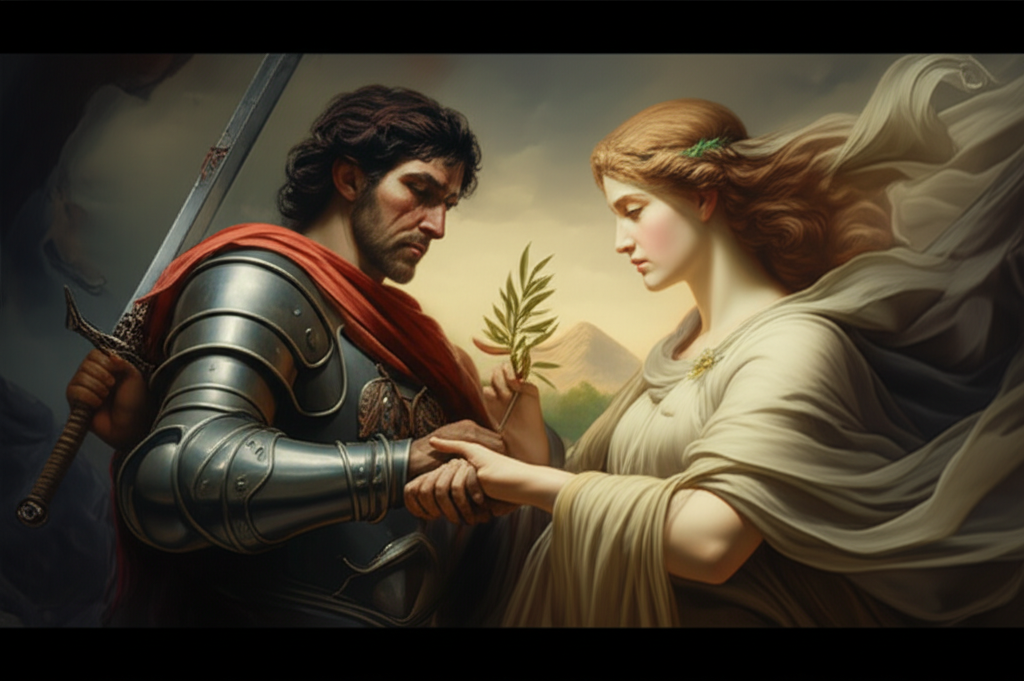
The Individual and the Collective: Navigating War and Peace
The experience of War and Peace is never purely individual nor purely collective; it is a complex interplay between the two. The moral choices of individuals shape the collective state, and the collective state profoundly impacts individual Life and Death.
Moral Agency in Conflict: Kant and the Categorical Imperative
Immanuel Kant's ethical philosophy, particularly his concept of the Categorical Imperative, demands that actions be judged by universalizable maxims. In the context of War, this raises profound questions about the morality of violence, the rights of combatants and non-combatants, and the pursuit of perpetual peace. Kant himself, in Perpetual Peace, outlined conditions for a global state of peace, arguing for republican constitutions and a federation of free states. His philosophy compels us to consider the ethical implications of our choices, even in the most extreme conditions of conflict.
Social Contracts and the Pursuit of Peace: Rousseau, Locke
Philosophers like John Locke and Jean-Jacques Rousseau explored how societies transition from a state of nature to a civil state through a social contract. For Locke, the contract primarily protects natural rights (life, liberty, property), establishing a government that ensures Peace and justice. Rousseau, in The Social Contract, argued that true freedom and peace come from individuals surrendering their individual will to the "general will," forming a collective body where each person is both ruler and ruled. These theories highlight that Peace is not just an absence of War, but a consciously constructed social and political state requiring collective agreement and adherence to laws.
The Role of Virtue: Aristotle and the Good Life
Aristotle's Nicomachean Ethics posits that the good Life (eudaimonia) is achieved through the cultivation of virtues. While Aristotle certainly recognized the necessity of military virtues for the defense of the polis, he ultimately saw peace as the condition for the highest human activities – contemplation, philosophy, and civic engagement. The virtuous citizen contributes to a stable and just State, thereby fostering the conditions for both individual and collective flourishing.
Beyond the Binary: A Dynamic Interplay
To view War and Peace as a simple binary opposition is to miss the profound philosophical complexity of their relationship. They are not merely "on" or "off" switches, but rather dynamic, often co-existing, states that continuously transform into one another.
Peace as an Absence of War vs. Positive Peace
A crucial distinction lies between "negative peace" – merely the absence of direct violence or War – and "positive peace," which encompasses the presence of justice, equity, development, and the full realization of human potential. Negative peace can be fragile and temporary, often masking underlying tensions. Positive peace, however, represents a more robust and sustainable state, requiring ongoing effort and societal transformation. This concept underscores that Peace is not a passive condition but an active, continuous endeavor.
The Continuous Change between States
History demonstrates that the state of War can emerge from periods of Peace, and vice versa. There is no permanent end-state. The forces of economic competition, ideological conflict, human ambition, and the pursuit of power ensure a constant possibility of change. Understanding this perpetual flux, rather than seeking an impossible stasis, is key to navigating the human condition. The philosophical challenge is to understand the mechanisms of this change, to anticipate its shifts, and to strive for the conditions that make positive peace more probable and enduring.
Conclusion: The Perpetual Horizon
War and Peace are more than mere events; they are profound states of existence, deeply embedded in the philosophical understanding of human nature, society, and the cosmos itself. From Heraclitus's eternal strife to Hobbes's Leviathan, and from Kant's perpetual peace to Hegel's dialectical unfolding, thinkers have sought to comprehend their genesis, their implications for Life and Death, and the ceaseless change they bring about.
We live in a world where these states remain in a delicate, often volatile, balance. The philosophical quest is not to eliminate one for the other entirely, for the seeds of conflict often lie dormant within peace, and the desire for peace can emerge from the ashes of war. Rather, it is to understand their dynamic interplay, to cultivate the virtues and institutions that favor positive peace, and to recognize that the human journey is a continuous navigation between these fundamental conditions of being. The pursuit of a more just and peaceful state is an unending philosophical and practical endeavor, a perpetual horizon towards which humanity strives.
📹 Related Video: What is Philosophy?
Video by: The School of Life
💡 Want different videos? Search YouTube for: ""Heraclitus War is the Father of All" philosophy explanation"
📹 Related Video: PLATO ON: The Allegory of the Cave
Video by: The School of Life
💡 Want different videos? Search YouTube for: ""Hobbes Leviathan Summary" social contract theory"