

War and Peace as States of Existence: A Philosophical Inquiry
Summary: War and Peace are often perceived as mere events, but philosophically, they represent profound and dynamic states of human existence. This article explores how these conditions fundamentally shape our understanding of reality, influence the ebb and flow of Change, and directly impact the sanctity of Life and Death. Drawing from the rich tapestry of thought found in the Great Books of the Western World, we contend that grappling with these dual states is essential for comprehending the human condition itself.
The Dual Nature of Existence: War and Peace as Fundamental States
To understand humanity is to grapple with its inherent duality: the capacity for immense destruction and profound harmony. War and Peace are not simply historical periods or political choices; they are deeply ingrained states of being, shaping individual consciousness and collective reality. From the ancient Greek tragedians to modern existentialists, philosophers have consistently sought to define, understand, and navigate these fundamental conditions.
Consider Heraclitus, who famously declared, "War is the father of all things," suggesting that conflict is the essential driver of change and creation. This perspective challenges the simplistic notion of peace as merely the absence of conflict, proposing instead that tension and opposition are intrinsic to the world's dynamic state. Conversely, figures like Plato, in his Republic, envisioned an ideal society founded on justice and order, a state of profound peace achieved through reason and virtue.
The Great Books of the Western World are replete with such explorations. Augustine's City of God grapples with the earthly city's perpetual struggles versus the heavenly city's eternal peace, highlighting the spiritual dimension of these states. Thomas Hobbes, in Leviathan, starkly portrays the "state of nature" as a "war of all against all," arguing that only a strong sovereign can establish a state of peace, however precarious. These thinkers remind us that the state of War and Peace is not external to us but woven into the fabric of our social, political, and psychological landscapes.
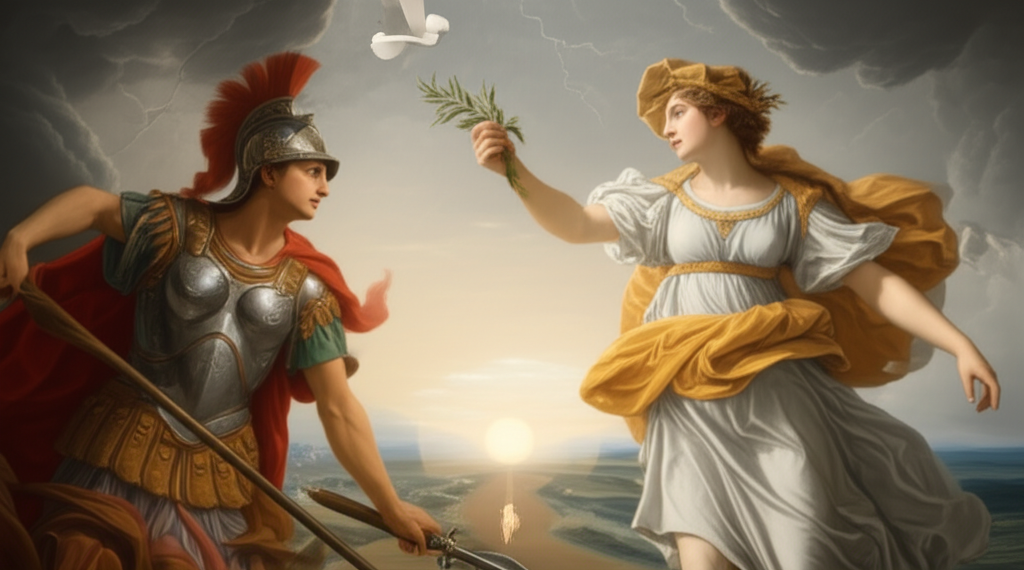
The Dynamics of Change: From One State to Another
The transition between War and Peace is perhaps the most dramatic form of societal change. These shifts are rarely instantaneous but are often the culmination of complex forces – ideological, economic, and cultural. Is peace merely the quiet interval between wars, or can it be a robust, actively cultivated state?
Philosophers like Immanuel Kant, in Perpetual Peace, posited that a lasting state of peace could be achieved through a federation of free states governed by international law. This vision emphasizes the active construction of peace, moving beyond the passive absence of conflict. It suggests that change towards peace requires deliberate effort, institutional design, and a shift in human consciousness.
| Aspect | State of War | State of Peace |
|---|---|---|
| Primary Goal | Victory, subjugation | Harmony, cooperation |
| Dominant Emotion | Fear, aggression, suspicion | Trust, security, empathy |
| Societal Structure | Centralized authority, militarization | Decentralized power, civil institutions |
| Focus of Energy | Destruction, defense | Construction, development |
| Value of Life | Instrumental, expendable | Intrinsic, cherished |
| Nature of Change | Rapid, destructive, forced | Gradual, constructive, consensual |
This table illustrates the stark contrasts, but also hints at the dynamic tension. The seeds of one state can often be found within the other, demonstrating the constant potential for change.
Life and Death in the Shadow of War and Peace
Nowhere is the impact of these states more profoundly felt than in the realms of Life and Death. War is the ultimate arbiter of Death, a brutal reminder of human fragility and mortality. It strips away the veneer of civilization, forcing individuals and societies to confront the raw reality of existence. The philosophical questions surrounding sacrifice, courage, and the justification of violence become acutely pressing in a state of war. What value does an individual Life hold when it is offered for a collective cause?
Conversely, peace provides the fertile ground for Life to flourish. It allows for creativity, intellectual pursuit, cultural development, and the nurturing of human relationships. In a state of peace, the focus shifts from mere survival to self-actualization, from collective defense to individual well-being. The value of each Life is elevated, and the pursuit of meaning beyond basic needs becomes possible.
Yet, even in peace, the specter of Death remains, not as a sudden, violent cessation, but as the inevitable conclusion of a full Life. Philosophies of existentialism, for instance, explore the individual's confrontation with mortality, a confrontation often magnified or distorted by the prevailing state of War and Peace. The Great Books offer countless narratives of individuals navigating these extremes, from Achilles' tragic heroism in Homer's Iliad to the philosophical serenity sought in Boethius's Consolation of Philosophy.
Concluding Thoughts: The Perpetual Inquiry
The philosophical journey through War and Peace as fundamental states of existence is far from over. These are not static conditions but dynamic forces that continuously shape and reshape human experience. Our understanding of change, the value we place on Life and Death, and the very essence of human nature are inextricably linked to how we perceive and navigate these profound states. As Daniel Fletcher, I contend that a deeper philosophical engagement with these concepts is not merely an academic exercise, but a vital step towards comprehending the ongoing human project.
YouTube Video Suggestions:
-
📹 Related Video: What is Philosophy?
Video by: The School of Life
💡 Want different videos? Search YouTube for: "The Philosophy of War and Peace: From Ancient Greece to Modern Thought"
2. ## 📹 Related Video: KANT ON: What is Enlightenment?
Video by: The School of Life
💡 Want different videos? Search YouTube for: "Hobbes' Leviathan: The State of Nature and Social Contract Explained"