

War and Peace: Inherent States of Existence
To contemplate "War and Peace" solely as alternating periods of conflict and its cessation is to miss a profound philosophical truth. Rather, these are not merely events or circumstances that befall humanity, but fundamental states of existence, deeply woven into the fabric of reality and the human condition itself. From the internal struggles of the individual soul to the grand narratives of civilizations, the oscillation between states of discord and harmony, destruction and creation, is a perpetual rhythm. This article delves into how War and Peace can be understood as inherent modes of being, dynamic conditions that shape our lives, reflecting the constant change that defines existence and echoing the ultimate transitions of Life and Death. Drawing from the enduring wisdom contained within the Great Books of the Western World, we explore this duality not as a choice between two external options, but as an intrinsic tension that defines our very being.
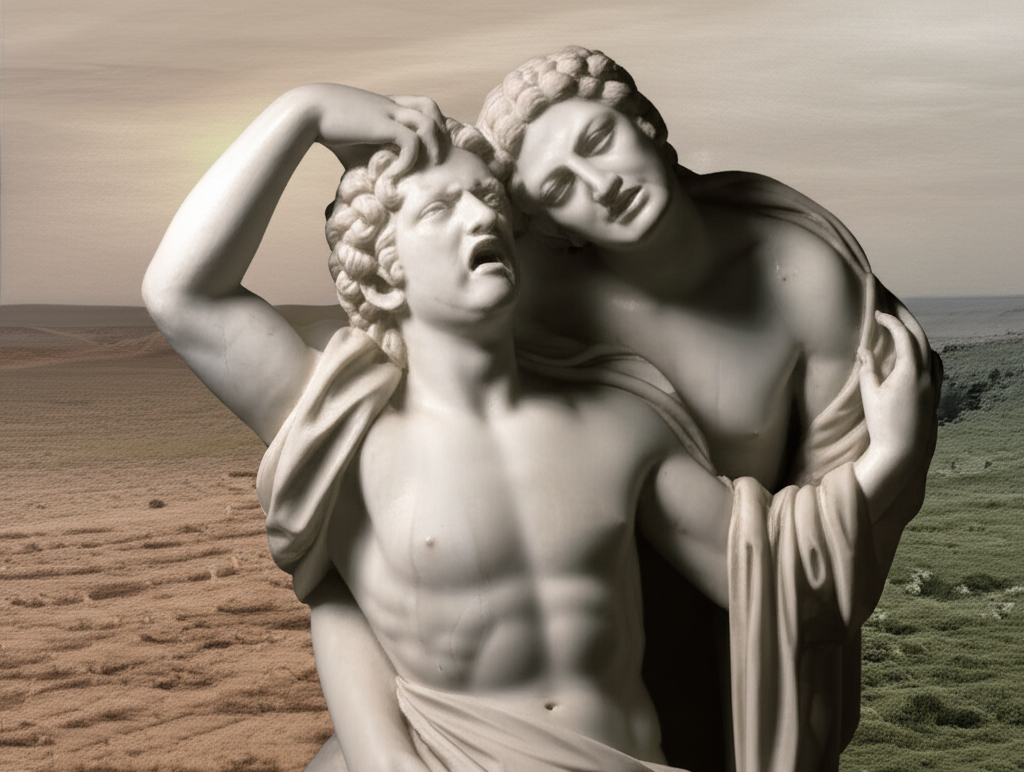
War and Peace: Beyond Mere Events
When we speak of War and Peace as states, we elevate the discussion beyond geopolitical maneuvering or the signing of treaties. We are probing the underlying conditions—psychological, social, and even metaphysical—that define a particular epoch or an individual's inner landscape. A nation might be "at peace" on paper, yet internally fractured by social injustice, economic disparity, or ideological strife, existing in a subtle, pervasive state of internal war. Conversely, an individual might find profound inner peace amidst external chaos. This perspective forces us to consider the nuanced ways these states manifest.
- War as a State: Not just armed conflict, but a condition of pervasive tension, competition, disunity, or active destruction. This can be economic war, cultural war, psychological conflict, or the internal struggle against one's own vices.
- Peace as a State: More than the absence of conflict, it's a condition of harmony, integration, flourishing, and creative potential. It implies a certain order, a balance that allows for growth and stability, whether in a society or within a person.
The Dynamic Nature of Existence: A Constant State of Change
The universe, as Heraclitus famously observed, is in a state of perpetual flux; "you cannot step into the same river twice." This inherent change is crucial to understanding War and Peace as states of existence. No state is static; it is always in motion, evolving, or giving way to its opposite. This constant oscillation is not a flaw in the system, but its fundamental engine.
Consider the human organism: a continuous battle against entropy, a delicate balance between catabolic (destructive) and anabolic (constructive) processes. This biological reality mirrors the larger philosophical truth. Societies, like organisms, are subject to cycles of growth and decay, unity and fragmentation. The state of war often arises from an inability to adapt to change, or as a violent catalyst for it. Peace, in turn, requires a constant, active maintenance, a willingness to adjust and evolve to preserve harmony.
Philosophical Perspectives on War and Peace as States
The Great Books of the Western World offer a rich tapestry of thought on this enduring duality. Philosophers across millennia have grappled with whether war is an aberration or an intrinsic part of the human condition, and what true peace entails.
Ancient Insights: Order, Chaos, and the Soul
- Plato: In The Republic, Plato explores the ideal state of a just society and the just individual. Injustice, for Plato, is a form of internal war within the soul or the polis, where different parts (reason, spirit, appetite) are in conflict. True peace is achieved through harmony and proper hierarchy, guided by reason. The state of war is a degeneration from this ideal.
- Thucydides: His History of the Peloponnesian War presents war as an almost inevitable consequence of human nature—driven by fear, honor, and interest. He portrays a state of international relations where peace is merely an interlude between conflicts, a fragile balance of power constantly threatened by ambition.
- Heraclitus: Famously stating "War is the father of all things," he saw conflict (πόλεμος) not just as physical strife, but as the underlying principle of all creation and change—the tension of opposites from which all things emerge. This suggests that a form of "war" or dynamic tension is a fundamental state of the cosmos itself.
Medieval and Early Modern Views: Sin, Sovereignty, and Society
- Augustine: In City of God, Augustine grapples with the fallen nature of humanity, positing that true, eternal peace is only possible in the heavenly city. On Earth, human societies are perpetually marred by sin, making a perfect state of peace unattainable. Earthly peace is a temporary, fragile truce, often maintained by force.
- Thomas Hobbes: In Leviathan, Hobbes famously described the "state of nature" as a "war of all against all" (bellum omnium contra omnes), where Life and Death are constantly at risk. For Hobbes, civil society and the absolute sovereign are necessary to lift humanity out of this brutal state of war and establish a fragile, artificial peace. The absence of a strong power leads inevitably back to the default state of conflict.
- Machiavelli: His The Prince implicitly treats the state of politics as one of perpetual struggle for power. Peace, when it exists, is a temporary outcome of skillful manipulation and decisive action, not a natural condition.
Modern Interpretations: The Human Spirit and the Grand Narrative
- Leo Tolstoy: His epic War and Peace is not just a historical novel, but a deep philosophical inquiry into the forces that shape human destiny. Tolstoy portrays war as a chaotic, irrational force that sweeps individuals into its currents, while peace is found in the quiet, mundane rhythms of life, family, and the search for spiritual truth. He examines how these states profoundly alter individual consciousness and societal fabric.
- Existentialism (e.g., Sartre, Camus): While not explicitly using "War and Peace," these thinkers explore the human condition as one of inherent struggle, anxiety, and the search for meaning in an indifferent universe. This internal "war" against absurdity and the quest for authentic existence can be seen as a deeply personal state of being.
Life, Death, and the Ultimate States
The most profound states of all are Life and Death. These ultimate transitions resonate deeply with the concepts of War and Peace. War, in its most brutal form, is the deliberate imposition of death, the cessation of life, the destruction of what has been built. It represents entropy, the breaking down of order. Peace, conversely, is intrinsically linked with the flourishing of life, with growth, creation, and sustenance. It is the condition under which individuals and societies can thrive, reproduce, and build.
The boundary between Life and Death is as absolute as it is permeable, a constant reminder of the fragility of existence. Similarly, the line between War and Peace is often blurred, with seeds of conflict lying dormant within periods of apparent calm, and moments of profound peace emerging even amidst the ravages of war.
| Aspect | War as a State | Peace as a State |
|---|---|---|
| Defining Quality | Conflict, destruction, disunity, tension | Harmony, creation, unity, equilibrium |
| Impact on Life | Threatens, diminishes, or ends life | Fosters, sustains, and enhances life |
| Societal Form | Fragmentation, oppression, struggle for power | Cooperation, justice, collective flourishing |
| Individual Form | Inner turmoil, anxiety, struggle, aggression | Inner calm, contentment, creativity, compassion |
| Nature of Change | Often violent, abrupt, forced transformation | Gradual, organic, adaptive evolution |
| Ultimate Outcome | Potential for destruction, death | Potential for growth, flourishing, continuity of life |
Navigating the Perpetual Oscillation
Understanding War and Peace as inherent states of existence, rather than mere external events, shifts our perspective. It implies that the quest for peace is not simply about avoiding conflict, but about actively cultivating conditions of harmony, justice, and understanding—both within ourselves and in our societies. It acknowledges that the internal "war" within the human spirit, the constant struggle against our baser instincts, is as real and significant as any geopolitical conflict. The wisdom of the Great Books reminds us that this oscillation is fundamental, a part of the grand tapestry of being. Our task, as thinking beings, is to understand these states, to navigate their inevitable change, and to strive for the flourishing of Life amidst the ever-present shadow of Death.
📹 Related Video: PLATO ON: The Allegory of the Cave
Video by: The School of Life
💡 Want different videos? Search YouTube for: ""Plato's Republic Justice and the Soul Explained""
📹 Related Video: PLATO ON: The Allegory of the Cave
Video by: The School of Life
💡 Want different videos? Search YouTube for: ""Hobbes Leviathan State of Nature Explained""