

The Ever-Shifting Sands: War and Peace as States of Existence
Beyond mere historical epochs or political conditions, War and Peace can be understood as fundamental states of existence – not only for nations but for the individual soul. This article delves into the philosophical implications of viewing these concepts as inherent conditions of our reality, ever-present forces that define and redefine the very fabric of life and death, perpetually in a dynamic state of change. It is a journey into the core of the human condition, seeking to understand the profound interplay between conflict and harmony as intrinsic aspects of being.
A Philosophical Lens on Conflict and Harmony
From the earliest myths to the grand philosophical treatises of the Great Books of the Western World, humanity has grappled with the dichotomy of conflict and serenity. Are these merely external circumstances, or do they reside deeper, woven into the very fabric of existence? To perceive War and Peace as states of existence is to acknowledge their pervasive influence, not just as events that unfold around us, but as conditions that shape our inner landscapes and collective destinies. This perspective invites us to look beyond the battlefield and the treaty table, into the quieter, more fundamental struggles and resolutions that define our being.
War as a Primal State: The Crucible of Existence
To consider War as a state of existence is to recognize the inherent struggle, the constant friction that characterizes much of life. It is not merely the clash of armies but the perpetual tension, the contest for resources, ideas, or even inner tranquility.
-
The Hobbesian Echo: Life as a State of Nature
Thomas Hobbes, observing the tumultuous human condition, famously posited a "state of nature" as a "war of every man against every man." This isn't necessarily a literal, constant battle, but rather a pervasive underlying insecurity, a lack of absolute peace where the threat of conflict looms large. In this view, civilization and its laws are but an attempt to mitigate this fundamental state of potential war. The individual, too, often finds themselves in a constant battle against external pressures, internal demons, or the relentless march of time, embodying a micro-cosmic struggle for survival and meaning. -
Internal Battlegrounds: The Soul's Unrest
Beyond the external, there exists an internal state of war. The individual mind is often a battleground of conflicting desires, moral dilemmas, and the struggle for self-mastery. Plato, in his Republic, speaks of the internal conflict between reason, spirit, and appetite. This inner discord, this ceaseless striving, can be as demanding and destructive as any physical conflict, shaping our character and determining our responses to the world. It is here that the concept of life and death takes on a metaphorical dimension – the death of old habits, the birth of new insights, all forged in the crucible of internal strife.
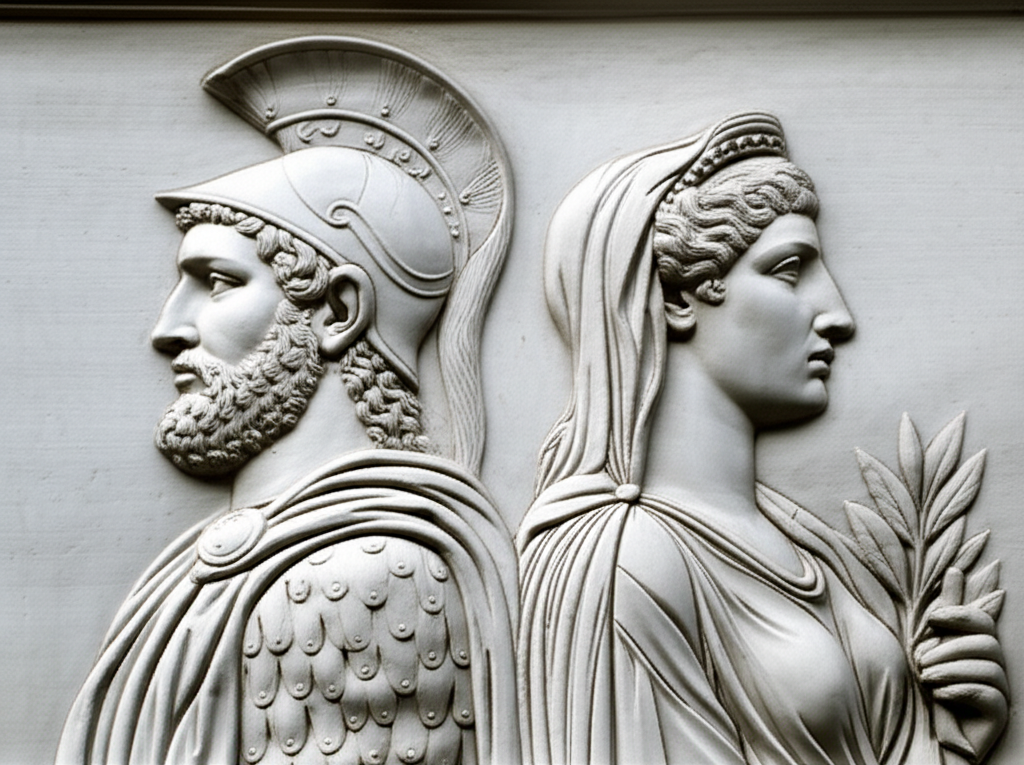
Peace as an Elusive Ideal: The Quest for Stasis
If war is a primal state, then Peace often appears as an aspiration, a desired end, or a fragile interlude. It represents harmony, order, and a cessation of struggle.
-
Plato's Republic and the Tranquil Polis
For many philosophers, from Plato to Augustine, the ideal society, the "City of God" or the "Republic," is one characterized by profound peace and justice. This is not merely the absence of war, but a positive state of flourishing, where each part (individual or societal class) performs its function harmoniously. Such a state of existence is often seen as requiring significant virtue, wisdom, and a deliberate ordering of priorities, suggesting that true peace is an achievement, not merely a default. -
The Fragility of Calm: Peace as an Interlude
Yet, history and personal experience often reveal peace to be a temporary reprieve, a lull between storms. Is absolute, permanent peace truly attainable, or is it merely an ideal towards which we perpetually strive? The Great Books often present peace as a precious but precarious commodity, easily disrupted by human nature, ambition, or unforeseen events. This perspective suggests that peace, rather than being a static state, is a dynamic equilibrium that requires constant vigilance and effort to maintain. It is in this delicate balance that the profound connection between life and death becomes apparent; the flourishing of life often depends on the sustained presence of peace, while its absence frequently ushers in destruction.
The Dynamic Interplay: Change as the Constant
The most profound philosophical insight into War and Peace as states of existence lies in their inherent impermanence and their dynamic relationship. They are not fixed poles but rather forces in a perpetual dance of change.
-
From Heraclitus to Hegel: The Dialectic of Being
Heraclitus famously declared that "everything flows," that "you cannot step into the same river twice." This ancient Greek insight into the nature of change resonates deeply with our understanding of War and Peace. They are not static conditions but phases, transformations, constantly giving way to one another. Later, Hegel's dialectic presented history as a process of thesis, antithesis, and synthesis – a continuous overcoming of contradictions. In this view, war (antithesis) might arise from a perceived imbalance in peace (thesis), leading to a new, albeit temporary, state of peace (synthesis). This constant flux means that the state of existence is never truly settled. -
Life and Death in the Grand Tapestry
This perpetual change is nowhere more evident than in the cycles of life and death. War brings death and destruction, but also, paradoxically, often catalyzes new forms of life, innovation, and social restructuring. Peace, while fostering growth and prosperity, can also lead to stagnation or the seeds of future conflict. These two fundamental states are inextricably linked, each defining the other, each emerging from the other. The very essence of existence, therefore, seems to be this ceaseless oscillation, this ongoing negotiation between conflict and harmony.
Embracing the Flux: Navigating the Human Condition
Understanding War and Peace as fundamental states of existence – perpetually in change, shaping our experiences of life and death – offers a profound lens through which to view the human condition. It suggests that our quest for ultimate peace is not a search for a static end-state, but rather an ongoing engagement with the dynamic forces of existence. The wisdom gleaned from the Great Books encourages us not to despair at this flux, but to understand its inevitability and to strive for balance, justice, and meaning within its ever-unfolding narrative.
YouTube:
- Philosophy of War and Peace: A Historical Overview
- Heraclitus: The Philosophy of Change and Flux Explained
📹 Related Video: What is Philosophy?
Video by: The School of Life
💡 Want different videos? Search YouTube for: "War and Peace as States of Existence philosophy"