

The Eternal Oscillations: War and Peace as Fundamental States of Existence
Summary: War and Peace are often perceived as mere historical epochs or transient events. However, a deeper philosophical inquiry reveals them as profound states of existence, fundamental modes of being that permeate individual lives, societal structures, and the very fabric of human experience. Far from being mutually exclusive endpoints, they represent a dynamic interplay, a perpetual change that defines our reality, perpetually shaping the conditions of life and death. This article delves into the philosophical underpinnings of these two opposing yet intrinsically linked conditions, drawing from the rich tapestry of Western thought.
Unpacking the Concept: States, Not Just Events
When we speak of "War and Peace," our minds typically conjure images of battlefields and treaties, conflict and resolution. Yet, to confine these monumental forces to mere occurrences misses their profound philosophical weight. What if, instead, we understood them as persistent states – conditions that define the essential nature of a given moment, a society, or even an individual? This perspective, deeply embedded in the Great Books of the Western World, invites us to consider war not just as an act of aggression, but as a state of nature, and peace not merely as an absence of conflict, but as a meticulously constructed state of order.
The Primacy of Conflict: War as a Default State
Many foundational thinkers have grappled with the notion that conflict, or a potential for it, is inherent to human existence. Heraclitus, for instance, famously declared, "War is the father of all things," suggesting that opposition and struggle are fundamental to creation and change. This resonates through the centuries, finding a stark articulation in Thomas Hobbes's Leviathan. Hobbes posited that without a sovereign power to enforce order, humanity exists in a "state of war of every man against every man."
In this Hobbesian "state," there is:
- Constant Fear: The perpetual threat of violence and death.
- Absence of Industry: No progress, culture, or societal development.
- Solitary, Poor, Nasty, Brutish, and Short Lives: A direct consequence of insecurity and the struggle for bare survival.
This perspective challenges us to see War not as an aberration, but as a default condition that society must actively strive to overcome. It is a raw, untamed state where the immediate concerns of life and death dominate every decision.
The Aspiration for Order: Peace as a Constructed State
If war is a potential default, then peace emerges as a deliberate achievement, a cultivated state requiring constant vigilance and effort. Peace, in this philosophical sense, is far more than simply the cessation of hostilities. It is the establishment of a just order, a tranquil arrangement where individuals and societies can flourish. St. Augustine, in The City of God, speaks of peace as the "tranquillity of order," a state where things are rightly arranged.
Consider the characteristics of a true State of Peace:
- Rule of Law: Predictable justice and governance.
- Security: Freedom from fear of arbitrary violence.
- Cooperation: The ability to pursue common goods and collective endeavors.
- Flourishing: The opportunity for intellectual, artistic, and moral development beyond mere survival.
Immanuel Kant, in his essay Perpetual Peace, outlines the arduous path towards a global state of peace, predicated on republican constitutions, international law, and a commitment to rational discourse. For Kant, peace is an ethical imperative, a teleological goal towards which humanity must continually strive, recognizing the profound change required from a state of nature to a state of enlightened coexistence.
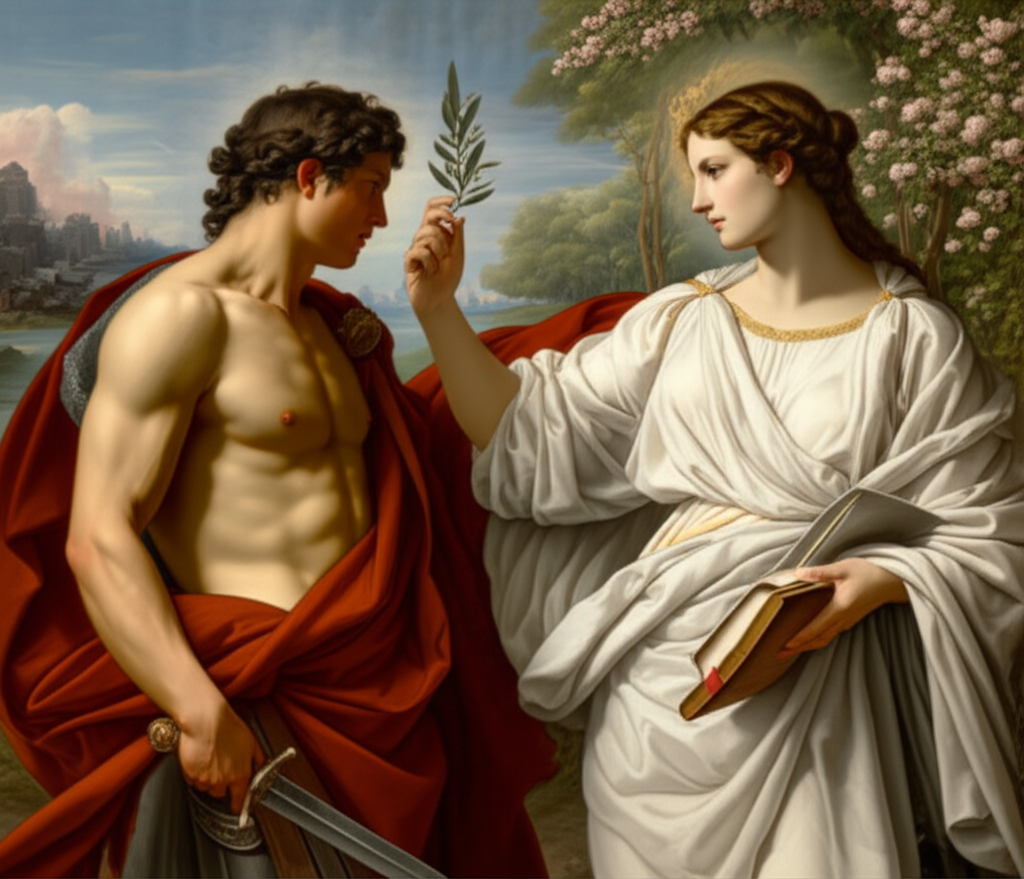
The Dynamic Interplay: Change and the Cycles of Existence
The enduring lesson from the Great Books is that neither war nor peace is a static endpoint. They are perpetually in flux, a testament to the ceaseless change that defines human history and individual experience. Societies oscillate between these states, often with devastating consequences for life and death. A period of relative peace can sow the seeds of future conflict through complacency or injustice, just as the exhaustion of war can create a desperate longing for stability.
Table: Contrasting States of Existence
| Feature | State of War | State of Peace |
|---|---|---|
| Primary Focus | Survival, Conflict, Domination | Order, Cooperation, Flourishing |
| Human Condition | Fear, Scarcity, Anarchy | Security, Abundance (potential), Governance |
| Values Emphasized | Power, Strength, Sacrifice | Justice, Reason, Harmony |
| Impact on Life | Fragile, Brutal, Risk of early Death | Stable, Productive, Potential for long-term growth |
| Driving Force | Competition, Self-preservation, Ideology | Diplomacy, Law, Shared Values |
| Change Agent | Revolution, Conquest, Catastrophe | Reform, Education, Ethical Evolution |
This dynamic relationship means that the work of philosophy, politics, and ethics is never truly done. We are always navigating the transition, striving to maintain the fragile state of peace or, when necessary, to understand and emerge from the ravages of war. The very act of living, in many respects, is a constant negotiation between these two fundamental poles.
Beyond Nations: Internal Battles, Internal Peace
The concepts of war and peace extend beyond the geopolitical. Within the individual, there exists a profound internal struggle, a personal state of being that mirrors the larger societal conflicts. The "war within" might manifest as a struggle against one's own vices, doubts, or destructive impulses. Conversely, inner peace is a cultivated state of tranquility, self-acceptance, and harmony with oneself and the world. Philosophers from Plato's tripartite soul to Stoic doctrines of apatheia have explored this internal dimension, recognizing that the external state of a society often reflects the aggregate internal states of its citizens. The pursuit of wisdom, in many traditions, is ultimately the pursuit of this inner peace, a condition essential for a meaningful life and death.
Conclusion: The Enduring Philosophical Challenge
Understanding War and Peace as fundamental states of existence, rather than isolated events, offers a profound lens through which to view human history and our own lives. They are the twin pillars of our reality, constantly shifting, perpetually influencing the conditions of life and death. The ceaseless change between them demands ongoing philosophical reflection, ethical deliberation, and political action. As we navigate the complexities of the 21st century, the insights gleaned from the Great Books remind us that the struggle for peace is an eternal endeavor, a continuous effort to build and maintain a just order against the ever-present shadow of conflict. It is a testament to humanity's capacity for both profound destruction and sublime creation.
YouTube Video Suggestions:
- YouTube: "Hobbes Leviathan State of Nature Explained"
- YouTube: "Kant Perpetual Peace Philosophy Summary"
📹 Related Video: What is Philosophy?
Video by: The School of Life
💡 Want different videos? Search YouTube for: "War and Peace as States of Existence philosophy"