

The Enduring Enigma: Unpacking the Limits of Human Knowledge and Experience
A Glimpse Beyond Our Grasp
Despite humanity's monumental strides in science, philosophy, and art, our pursuit of understanding invariably confronts an unyielding frontier: the inherent limits of human knowledge and experience. From the very mechanisms of our perception to the vast, incomprehensible expanse of the universe, we are continually reminded that our grasp is finite, tethered by the very nature of our being. This article delves into these profound limitations, exploring how our senses, our cognitive frameworks, and the sheer concept of infinity define the boundaries of what we can truly know and experience. It is a journey into the philosophical heart of our intellectual humility, drawing insights from the timeless inquiries preserved in the Great Books of the Western World.
The Sensory Veil: How Experience Shapes, and Limits, Our Reality
Our primary interface with the world is through our senses. Sight, sound, touch, taste, and smell form the bedrock of our experience, providing the raw data from which we construct our understanding. Yet, this very foundation is also our first great limitation.
- Physiological Constraints: Our eyes perceive only a narrow band of the electromagnetic spectrum; our ears register sounds within a specific frequency range. What lies beyond these thresholds—ultraviolet light, infrasound, or entirely different modes of perception possessed by other creatures—remains outside our direct experience.
- The Phenomenal World: As philosophers like Immanuel Kant meticulously argued, we do not experience reality as it is in itself (the noumenon), but rather reality as it appears to us (the phenomenon), filtered and structured by our innate cognitive categories. Our senses act not merely as windows but as active interpreters, shaping the raw influx of data into a coherent, but ultimately subjective, world.
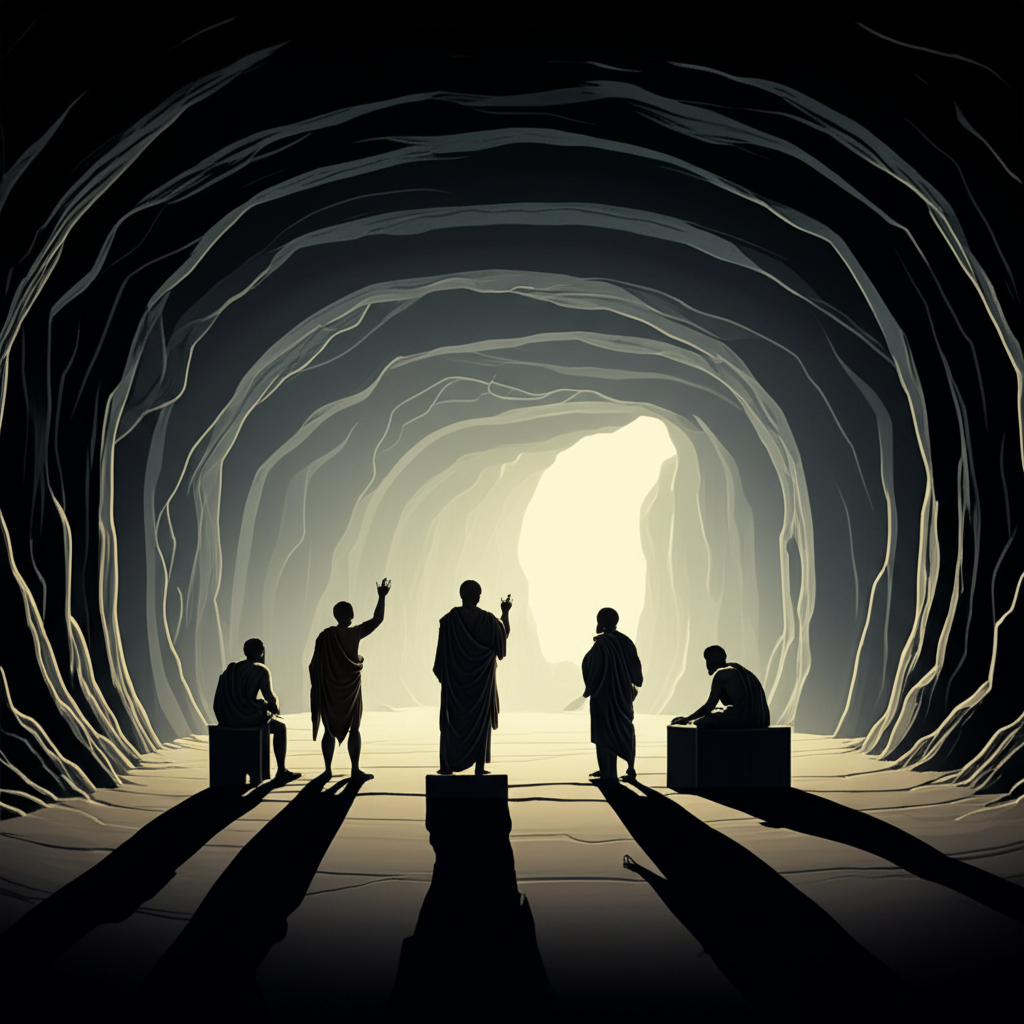
- Plato's Cave Revisited: Consider Plato's timeless allegory of the cave. The prisoners, chained and facing a wall, perceive only shadows cast by objects passing behind them. For them, these shadows constitute their entire reality, their complete knowledge of the world. We, too, might be prisoners of our own sensory apparatus, mistaking the shadows of our perception for the true forms of reality.
The Mind's Architecture: Reason and Its Epistemic Horizons
Beyond the immediate data of the senses, our capacity for reason allows us to analyze, synthesize, and infer. Yet, even the most powerful intellect encounters its own set of boundaries.
Limitations of Conceptualization:
- Language as a Container: Our thoughts are often structured and constrained by language. Concepts that fall outside the scope of our linguistic frameworks can be extraordinarily difficult, if not impossible, to articulate or even fully conceive. How do we describe a color we've never seen, or an emotion for which no word exists?
- Cognitive Biases and Heuristics: Our minds, in their effort to make sense of a complex world, employ shortcuts and inherent biases. While often efficient, these can lead to systemic errors in judgment and perception, subtly distorting our pursuit of objective knowledge.
The Problem of First Principles:
Philosophers from Aristotle to Descartes grappled with the search for undeniable first principles—foundational truths from which all other knowledge could be logically derived. Yet, even these pursuits often lead to an acknowledgement of something unproven, something accepted on faith or intuition, revealing a fundamental limit to purely rational deduction.
The Shadow of Infinity: Confronting the Unknowable
Perhaps the most profound limit to human knowledge and experience is the concept of infinity. It looms over our intellectual landscape, a vast and irreducible unknown.
Mathematical vs. Existential Infinity:
While mathematics can elegantly manipulate symbols representing infinity, our minds struggle to truly grasp it in an experiential sense.
| Type of Infinity | Description | Human Comprehension |
|---|---|---|
| Mathematical | An abstract concept representing a quantity without bound (e.g., the set of natural numbers). | Can be manipulated logically and symbolically, but direct experience or visualization is impossible. We can define properties of infinite sets, but not truly see or feel them. |
| Existential | The boundless nature of the universe, time, or the potential for states of being and events. | Evokes awe and wonder, but also a sense of insignificance and incomprehension. We cannot experience the beginning or end of time, nor the full extent of cosmic space, making true knowledge of it perpetually out of reach. |
| Epistemic | The infinite number of facts, perspectives, or potential knowledge domains that exist beyond our current understanding. | Represents the perpetual incompleteness of our knowledge. No matter how much we learn, there will always be an infinity of things we do not know, or even know that we don't know. |
The Horizon of the Unknown:
Every scientific discovery, every philosophical insight, often reveals not just answers but new questions, pushing back the horizon of the known to reveal an even larger expanse of the unknown. The more we learn, the more we become aware of the sheer scale of what remains to be understood, reaffirming the boundless nature of the things we cannot fully comprehend.
Navigating the Epistemic Abyss: Embracing Our Finitude
Acknowledging the limits of human knowledge and experience is not an admission of defeat, but rather an invitation to a deeper form of wisdom. It cultivates intellectual humility, fosters open-mindedness, and encourages a sustained, rigorous inquiry into the boundaries themselves.
- Socrates' Wisdom: The ancient Greek philosopher Socrates famously claimed that the only thing he knew was that he knew nothing. This profound insight underscores the importance of recognizing our limitations as the first step towards genuine knowledge.
- The Ongoing Quest: Despite these limits, the human spirit's drive to understand, to explore, and to push the boundaries of what is known remains unquenchable. Philosophy, science, and art are testaments to this enduring quest, even if the ultimate destination of absolute knowledge remains an elusive infinity.
Conclusion: The Humility of Knowing Our Limits
The journey through the limits of human knowledge and experience reveals a profound truth: our understanding, while remarkable, is inherently circumscribed. Our senses filter reality, our minds structure it through finite frameworks, and the sheer vastness of infinity reminds us of the endless unknown. Yet, it is within these very limitations that the true power of philosophical inquiry lies. By understanding what we cannot fully grasp, we learn to appreciate the preciousness of what we can know, fostering a more thoughtful, humble, and ultimately, more profound engagement with the mysteries of existence.
📹 Related Video: PLATO ON: The Allegory of the Cave
Video by: The School of Life
💡 Want different videos? Search YouTube for: ""Plato's Allegory of the Cave explained" and "Kant's Critique of Pure Reason simplified""