

The Unseen Horizon: Navigating the Limits of Human Knowledge and Experience
Friends, fellow travelers on this philosophical journey, let's be honest with ourselves: for all our grand pronouncements and scientific marvels, there's a vast ocean of reality that remains beyond our grasp. This article delves into that profound, often humbling, truth: the inherent limits of human knowledge and experience. Drawing deeply from the intellectual currents of the Great Books of the Western World, we'll explore how thinkers across millennia have grappled with the boundaries of what we can know, what we can sense, and how we interpret a universe that often stretches towards infinity. Ultimately, understanding these limits isn't a defeat; it's the very foundation of wisdom and the ongoing quest for deeper understanding.
The Ancient Echoes: Shadows, Forms, and the Primacy of Experience
Our journey into the limits of human understanding begins with the ancients, whose insights continue to resonate. From the very beginning, philosophers recognized that our direct access to reality is mediated and, therefore, limited.
Plato's Cave: A World of Shadows
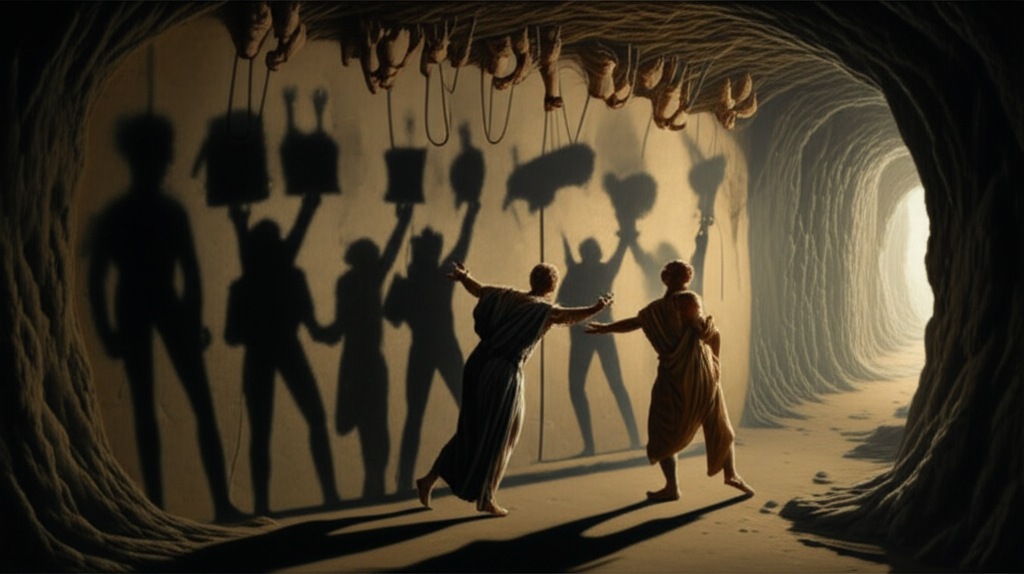
In Plato's Republic, we find the enduring allegory of the Cave, a powerful metaphor for the limitations of our sense perception. Imagine prisoners chained, able to see only shadows cast on a wall, mistaking these fleeting images for ultimate reality. True knowledge, Plato argues, lies beyond this sensory deception, in the realm of immutable Forms. Our experience of the world, based on what our senses relay, is inherently flawed and incomplete. It's a profound reminder that what we perceive might be but a pale imitation of what truly is.
Aristotle and Empirical Foundations
While Plato sought truth beyond the senses, his student Aristotle, in works like Metaphysics and Nicomachean Ethics, laid the groundwork for empiricism. For Aristotle, experience is the starting point for knowledge. We learn through observation, through interacting with the world. Yet, even Aristotle recognized that while experience provides the raw material, true wisdom—understanding why things are, not just that they are—requires reason to move beyond mere accumulated experience. There's a limit to how much knowledge pure experience can deliver without further intellectual processing.
The Modern Turn: Doubt, Sensation, and Skepticism
The Enlightenment brought a renewed, often more radical, focus on the sources and limits of our knowledge.
Descartes' Radical Doubt: The Shaky Ground of Sense
René Descartes, seeking absolute certainty in his Meditations on First Philosophy, famously doubted everything, including the reliability of his senses. He noted how often our sense perceptions deceive us—dreams feel real, optical illusions trick the eye. For Descartes, the only unshakable foundation for knowledge was the act of thinking itself: "Cogito, ergo sum" (I think, therefore I am). This realization highlighted that our experience of the external world, conveyed through our senses, is perpetually open to doubt, placing a significant limit on its capacity to deliver unquestionable truth.
Locke, Hume, and the Boundaries of Experience
John Locke, in An Essay Concerning Human Understanding, famously posited the mind as a tabula rasa—a blank slate—at birth, filled entirely by experience through sensation and reflection. All our knowledge originates here. This seems expansive, but it also implies a fundamental limit: we can only know what we have experienced or what can be derived from experience.
David Hume took this empiricist line to its skeptical extreme in An Enquiry Concerning Human Understanding. He argued that our experience only shows us constant conjunctions, not necessary connections. We experience that fire burns, but we don't sense the necessity of the burn. Our knowledge of cause and effect, therefore, is a habit of mind, not a direct perception of reality. This places a severe limit on our ability to derive certain knowledge about the future or about underlying causal mechanisms based solely on past experience.
Kant's Revolution: The Mind as Architect of Reality
Perhaps no philosopher grappled with the limits of knowledge and experience more profoundly than Immanuel Kant. In his Critique of Pure Reason, Kant proposed a "Copernican Revolution" in philosophy.
He argued that our minds are not passive recipients of sensory data but active shapers of our experience. We possess innate categories of understanding (like causality, unity, time, and space) that structure how we perceive and make sense of the world.
Key Kantian Limitations:
- Phenomenal vs. Noumenal: We can only know the phenomenal world—the world as it appears to us, filtered and structured by our minds and senses. The noumenal world—"things-in-themselves," independent of our perception—remains forever beyond our grasp. This is a fundamental, inescapable limit to human knowledge.
- Limits of Reason: When pure reason attempts to apply its categories beyond the realm of possible experience (e.g., to concepts like God, the soul, or the universe as a whole), it falls into contradictions, or "antinomies." This demonstrates that our rational faculties, powerful as they are, have defined boundaries.
Grappling with Infinity: The Ultimate Test of Comprehension
The concept of infinity serves as a stark reminder of our cognitive limits. Whether contemplating the infinity of space, time, or the potential for knowledge, our finite minds struggle.
- How can we truly sense or experience something without end?
- How can our knowledge fully encompass something that by definition transcends all boundaries?
Philosophers from Augustine contemplating the infinity of God to Kant wrestling with the antinomies of the universe's beginning or extent, have found infinity to be a concept that pushes the very boundaries of human understanding. It's a conceptual horizon that our minds can point to, but never fully traverse or contain.
Why These Limits Matter: A Call to Intellectual Humility
Understanding the limits of our knowledge and experience is not a counsel of despair, but an invitation to intellectual humility and a more nuanced engagement with the world. It reminds us:
- The Subjectivity of Perception: Our individual experience and sense of reality are uniquely filtered.
- The Incompleteness of Knowledge: There will always be more to learn, more to question.
- The Value of Diverse Perspectives: Acknowledging our individual limits encourages us to seek out and value different viewpoints.
- The Ongoing Philosophical Quest: The very recognition of these limits fuels the eternal philosophical inquiry, prompting us to refine our methods, question our assumptions, and strive for deeper insights, even if ultimate knowledge remains elusive.
Ultimately, the Great Books of the Western World teach us that to be human is to be finite, to grapple with the unknown, and to find profound meaning in the ongoing journey of understanding, even when faced with the boundless expanse of infinity.
**## 📹 Related Video: KANT ON: What is Enlightenment?
Video by: The School of Life
💡 Want different videos? Search YouTube for: ""Kant Critique of Pure Reason Explained""**
**## 📹 Related Video: PLATO ON: The Allegory of the Cave
Video by: The School of Life
💡 Want different videos? Search YouTube for: ""Plato's Allegory of the Cave Explained""**