

The Enigmatic Edges of Our Understanding: The Limits of Human Knowledge and Experience
A Daniel Fletcher Philosophical Inquiry
In our ceaseless quest to understand the universe and our place within it, humanity often encounters an humbling truth: our knowledge and experience, though vast and ever-expanding, are inherently bound by profound limits. This article delves into the philosophical exploration of these boundaries, tracing how thinkers from the Great Books of the Western World have grappled with what we can truly know and perceive. From the shadows of Plato's Cave to Kant's noumenal realm, we will examine how our sense perceptions, the very structure of our minds, and the elusive concept of infinity conspire to define the frontiers of human comprehension, ultimately fostering a deeper appreciation for intellectual humility and the ongoing journey of inquiry.
I. Defining the Frontiers: What Are Knowledge and Experience?
Before we can speak of limits, we must first define the territories themselves. Knowledge is often categorized into various forms: propositional (knowing that something is true), procedural (knowing how to do something), and acquaintance (knowing a person or place). For our purposes, we primarily focus on propositional knowledge, often derived from justified true belief.
- Experience, on the other hand, is the raw material from which much of our knowledge is built. It encompasses everything we perceive through our sense organs (sensory experience) as well as our internal mental states, emotions, and reflections (introspective experience). It is the direct apprehension of reality, or at least, reality as it appears to us.
The interplay between knowledge and experience is fundamental. Is all knowledge derived from experience? Or are there forms of knowledge that transcend it? This very question has shaped centuries of philosophical debate and points directly to the limits we seek to explore.
II. Ancient Echoes: Plato, Aristotle, and the First Glimpses of Limitation
The earliest philosophical inquiries into the nature of knowledge and experience already hinted at their inherent boundaries.
Plato's Cave and the Limits of Sense
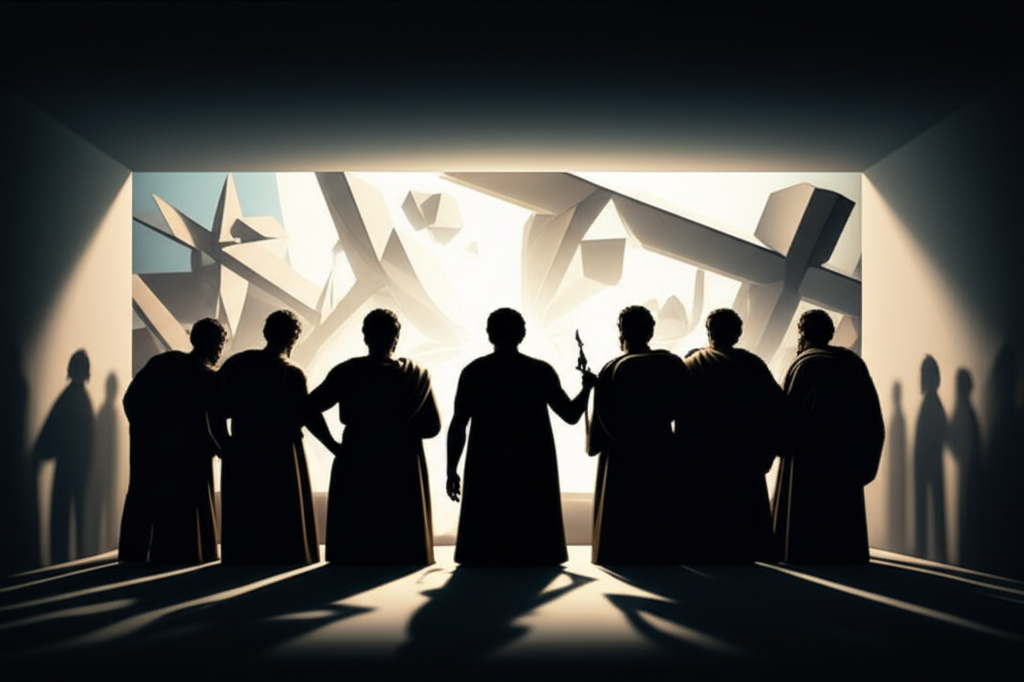
In Plato's Republic, the famous Allegory of the Cave vividly illustrates the limitations of sense perception. Prisoners, chained since birth, perceive only shadows cast on a wall, believing these to be ultimate reality. Their entire experience is confined to these fleeting images. For Plato, this world of shadows represents our everyday sense experience – imperfect, transient, and misleading. True knowledge (episteme) lies beyond, in the realm of the Forms, accessible only through reason and intellectual insight, not through the unreliable data of the senses. The journey out of the cave is an arduous ascent towards a deeper, more profound, and perhaps infinitely complex truth.
Aristotle's Empiricism and the Finite Cosmos
Aristotle, while more grounded in observation and experience than his teacher Plato, also recognized limits. In works like Metaphysics and Nicomachean Ethics, he emphasized the importance of empirical investigation and logical reasoning based on what we can perceive. However, even Aristotle's comprehensive system, which categorized knowledge and analyzed the natural world, acknowledged ultimate causes (the Prime Mover) that transcended direct human experience. The cosmos, though vast, was finite in his conception, but the knowledge of its ultimate origins remained beyond immediate human grasp.
III. Medieval Meditations: Faith, Reason, and the Divine Divide
The medieval period introduced new dimensions to the limits of knowledge, particularly concerning the divine.
Augustine's Inner World
St. Augustine, in his Confessions, explored the limits of external experience in understanding God and the self. He argued that true understanding often requires an inward journey, where faith illuminates reason. While our senses provide information about the material world, they are insufficient for grasping spiritual truths or the infinity of God. The knowledge of God, for Augustine, transcends purely human experience and rational faculties alone.
Aquinas's Synthesis: Reason's Reach and Revelation's Grasp
Thomas Aquinas, in his Summa Theologica, meticulously synthesized Aristotelian reason with Christian theology. He posited that reason, grounded in experience, could prove the existence of God and understand many natural phenomena. However, he also clearly delineated the limits of reason: certain divine truths (like the Trinity or the Incarnation) were beyond human rational comprehension and required divine revelation. Our finite experience and intellect, no matter how keen, could not fully grasp the infinite nature of God without the aid of faith.
IV. The Modern Mind's Quandary: From Certainty to Skepticism
The Enlightenment brought a renewed focus on the individual mind and the sources of knowledge, leading to both ambitious claims and profound doubts about human capacity.
Descartes and the Pursuit of Indubitable Knowledge
René Descartes, in his Meditations on First Philosophy, famously doubted everything that could be doubted, including the reliability of his senses. He sought a foundation of knowledge that was absolutely certain. His "Cogito, ergo sum" ("I think, therefore I am") provided such a foundation – the knowledge of one's own existence as a thinking thing. However, establishing the reality of the external world and the existence of God required further intricate arguments, highlighting the difficulty of moving beyond immediate subjective experience to objective knowledge. The very idea of an infinite God, perceived by a finite mind, became a key element in his proofs.
The British Empiricists: Experience as the Sole Gateway
- John Locke's Tabula Rasa: In An Essay Concerning Human Understanding, Locke famously argued that the mind is a "tabula rasa" (blank slate) at birth. All knowledge comes from experience – either through sense perception of external objects or reflection on our internal mental operations. This radical empiricism sets a clear limit: we cannot know what we have not experienced. Our knowledge is thus circumscribed by the reach of our senses and inner awareness.
- George Berkeley's Immaterialism: Taking Locke's empiricism to an extreme, Berkeley, in A Treatise Concerning the Principles of Human Knowledge, argued that "esse est percipi" – to be is to be perceived. This means that physical objects exist only insofar as they are perceived by a mind. If a tree falls in the forest and no one is around, does it make a sound? For Berkeley, its existence depends on perception, often by God. This position places an even more profound limit on objective knowledge independent of sense experience.
- David Hume's Radical Skepticism: Hume, in A Treatise of Human Nature and An Enquiry Concerning Human Understanding, pushed empiricism to its logical, skeptical conclusion. He argued that our knowledge is limited to impressions (vivid sense data) and ideas (faint copies of impressions). Crucially, he found no rational basis in experience for concepts like cause and effect or the existence of a continuous self. Our belief in causation, for example, is merely a psychological habit formed by constant conjunction, not a necessary truth derived from experience. Hume's philosophy represents a potent challenge, suggesting that many of our deeply held beliefs about the world fall outside the bounds of justified knowledge derived from experience.
V. Kant's Copernican Revolution: Structuring the Limits
Immanuel Kant, in his monumental Critique of Pure Reason, offered a revolutionary synthesis, acknowledging the insights of both rationalists and empiricists while establishing definitive limits to human knowledge.
The Phenomenal and Noumenal Worlds
Kant argued that our minds are not passive recipients of experience but actively structure it. We can only know the world as it appears to us (the phenomenal world), shaped by our innate categories of understanding (e.g., causality, substance, unity) and forms of intuition (space and time). The "thing-in-itself" (the noumenal world), the world as it truly is independent of our perception, remains forever unknowable to us. This is a fundamental limit: we cannot experience or gain knowledge of reality as it is, only as it is filtered and organized by our cognitive apparatus.
The Interplay of Sense and Understanding
Kant famously stated, "Thoughts without content are empty, intuitions without concepts are blind." This highlights the crucial role of both sense experience (providing the raw content) and the understanding (providing the conceptual framework) in generating knowledge. Neither can function alone. Our senses provide the data, but our minds organize it, and this organization itself imposes limits on what can be known.
VI. The Unfathomable: Infinity as the Ultimate Limit
Across these philosophical epochs, the concept of infinity consistently emerges as a profound boundary to human knowledge and experience.
| Philosophical Era | Concept of Infinity | Implication for Human Limits |
|---|---|---|
| Ancient Greece | Plato's Forms, Aristotle's Prime Mover | True reality/ultimate cause transcends finite human sense and experience. |
| Medieval Theology | God's Omnipotence, Eternity | Divine knowledge and being are infinite, fundamentally unknowable by finite human reason alone. |
| Modern Rationalism | Descartes' Infinite God | The idea of an infinite being in a finite mind points to a source beyond oneself. |
| Modern Empiricism | Hume's infinite regress of causation | Experience cannot justify concepts like infinity or necessary connections, highlighting limits of inductive knowledge. |
| Kantian Critique | Antinomies of Pure Reason (e.g., world is infinite/finite) | Human reason inevitably falls into contradictions when trying to apply its categories to concepts beyond possible experience, such as the infinity of the universe. |
Whether it's the infinity of divine attributes, the boundless expanse of the cosmos, or the endless regress of philosophical problems, the human mind, bound by finite experience and a finite lifespan, struggles to truly grasp or fully comprehend the infinite. This struggle itself is a testament to the inherent limits of our cognitive faculties.
VII. Embracing the Boundaries: A Philosophical Posture
The exploration of the limits of human knowledge and experience is not an exercise in futility or despair. On the contrary, acknowledging these boundaries is a crucial step towards intellectual humility and a more realistic understanding of our capabilities. It encourages us to:
- Refine our inquiries: By understanding what we cannot know, we can better focus on what we can know.
- Appreciate the role of faith or intuition: For some, limits of reason open pathways for other modes of understanding.
- Foster intellectual modesty: Recognizing that our perspective is inherently limited guards against dogmatism and promotes open-mindedness.
- Continually push the boundaries: Even within limits, there is infinite room for discovery and deeper understanding of the phenomenal world.
The journey of philosophy, as illuminated by the Great Books, is a testament to humanity's enduring drive to understand, even when confronted by the vast, unknowable expanse that lies beyond the reach of our senses and our finite intellect.
**## 📹 Related Video: PLATO ON: The Allegory of the Cave
Video by: The School of Life
💡 Want different videos? Search YouTube for: ""Plato's Allegory of the Cave explained" or "Kant's Critique of Pure Reason simplified""**