

The Unseen Horizon: Navigating the Limits of Human Knowledge and Experience
In our relentless pursuit of understanding, humanity has charted stars, deciphered genetic codes, and built towering edifices of thought. Yet, for all our triumphs, there remains an unyielding truth, a profound philosophical bedrock: the inherent limits of human knowledge and experience. This is not a lament but a foundational insight, a recognition that true wisdom often begins with understanding what we cannot grasp, what lies beyond the reach of our sense and intellect. From the ancient Greeks to modern phenomenologists, thinkers have grappled with the boundaries that define our mental and perceptual world, revealing a universe far vaster and more intricate than our faculties can ever fully comprehend. Embracing these limits isn't a surrender to ignorance but an invitation to humility, wonder, and a more profound appreciation for the mysteries that persist.
The Socratic Paradox: Knowing What We Don't Know
The journey into the limits of knowledge often begins with Socrates. His famous assertion, "I know that I know nothing," isn't an admission of intellectual bankruptcy but a profound statement on the nature of understanding. Socrates, as chronicled in Plato's dialogues, demonstrated that many who claimed knowledge often held beliefs without true justification or comprehensive understanding. His method of questioning exposed the superficiality of much human certainty, revealing that genuine wisdom might lie in the recognition of one's own ignorance. This ancient insight from the Great Books of the Western World remains startlingly relevant: the first step towards expanding our understanding is often acknowledging its boundaries.
The Empirical Cage: Limits of Our Senses and Experience
Our primary gateway to the world is through our senses. Sight, sound, touch, taste, and smell form the bedrock of our experience and, consequently, much of our empirical knowledge. However, these very gateways are also formidable filters, inherently limiting our perception.
Consider the following limitations:
- Sensory Spectrum: We perceive only a tiny sliver of the electromagnetic spectrum (visible light). Vast realms of reality—radio waves, X-rays, ultraviolet, infrared—exist around us, shaping our world in ways we cannot directly sense. Animals, like bats or bees, operate with entirely different sensory arrays, experiencing a reality fundamentally alien to ours.
- Scale of Perception: Our senses are calibrated for the mesoscopic world—the human scale. We struggle to directly experience the infinitesimally small (quantum particles) or the astronomically large (the infinity of space). Microscopes and telescopes extend our reach, but they are tools, not extensions of our inherent sensory apparatus.
- Subjectivity of Experience: As philosophers like John Locke and David Hume explored, all our knowledge begins with experience, yet that experience is subjective. The "redness" of an apple is an interpretation by our brain, not an inherent property existing independently in the same way for all observers. This raises questions about the objective reality of our perceptions.
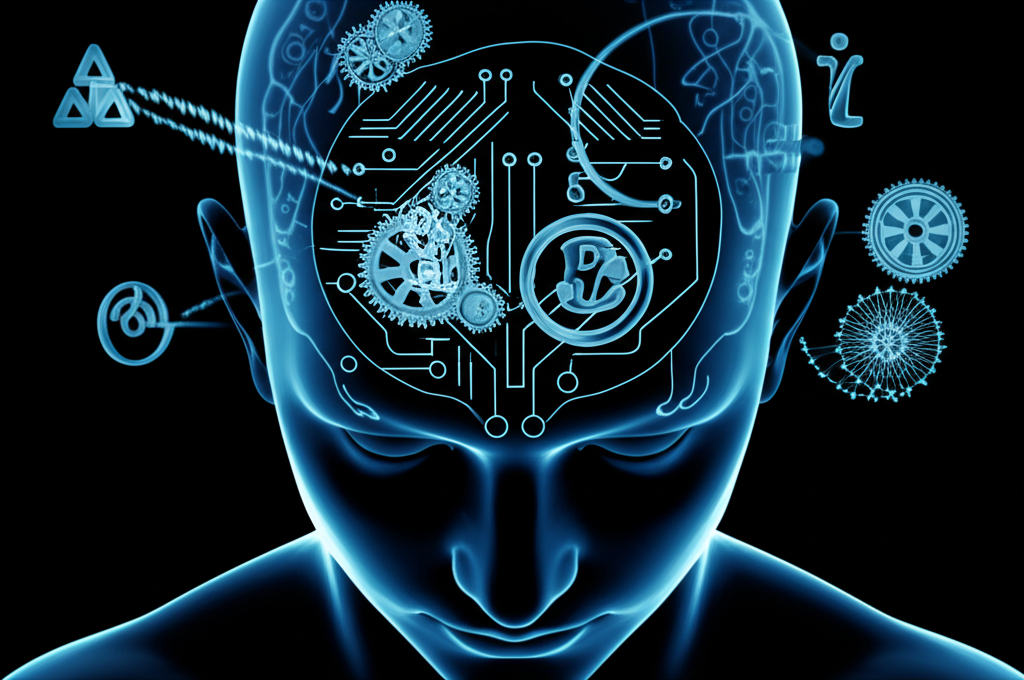 , others bouncing off an invisible barrier surrounding the head, suggesting external reality that cannot penetrate human perception. A faint, swirling nebula of unknown elements is visible in the background, hinting at the vastness of the cosmos beyond human grasp.)
The Rational Horizon: The Unknowable and the Infinite
Beyond the limits of our senses, our very capacity for reason and conceptualization encounters its own frontiers. Immanuel Kant, another titan from the Great Books, articulated a profound distinction between the phenomenal world (the world as it appears to us, structured by our minds) and the noumenal world (the world as it is in itself, independent of our perception). We can only ever access the phenomenal; the noumenal remains forever beyond our direct knowledge. This doesn't mean it doesn't exist, only that it is inherently unknowable to us.
Furthermore, the concept of infinity presents a fascinating challenge to our rational faculties. We can define infinity mathematically, we can conceive of an endless universe, or an unending sequence of numbers, but we can never truly experience or fully comprehend infinity in its totality. Our minds, rooted in finite experience, struggle to grasp that which has no bounds. This is evident in the philosophical problems of cosmology, where questions about the universe's ultimate size or origin often lead to conceptual impasses.
Key Philosophical Hurdles to Infinite Knowledge:
- The Problem of Induction (Hume): Our knowledge of the future relies on past experience (e.g., the sun has always risen, so it will rise tomorrow). However, there's no logical guarantee that future experience will mirror the past. This fundamental limit means absolute certainty about empirical laws is beyond us.
- Gödel's Incompleteness Theorems: In mathematics, Gödel showed that within any consistent axiomatic system powerful enough to describe arithmetic, there will always be true statements that cannot be proven within that system. This suggests inherent limits even to formal logical systems, implying that absolute, all-encompassing knowledge may be a conceptual impossibility.
- The Unfathomable Complexity of Reality: Even seemingly simple systems, when examined deeply, reveal layers of complexity that challenge our ability to model and predict them fully. From weather patterns to human consciousness, the intricate interplay of countless variables often surpasses our analytical capabilities.
Embracing the Mystery: A Call to Philosophical Humility
Recognizing the limits of human knowledge and experience is not a deficit, but a profound strength. It fosters intellectual humility, guards against dogmatism, and cultivates a sense of wonder. It reminds us that our models of reality are just that—models—and not the entirety of reality itself.
To truly engage with philosophy, one must accept this inherent bounded nature of our existence. It encourages continuous inquiry, not for the sake of ultimate, exhaustive knowledge (which may be unattainable), but for the journey of deeper understanding, for the refinement of our tools of inquiry, and for the appreciation of the vast, beautiful, and often mysterious universe we inhabit. The greatest philosophers, those who populate the Great Books, were often the ones most acutely aware of the boundaries of their own minds, pushing against them while respectfully acknowledging their presence.
YouTube Video Suggestions:
-
📹 Related Video: KANT ON: What is Enlightenment?
Video by: The School of Life
💡 Want different videos? Search YouTube for: ""Kant's Noumenal and Phenomenal World Explained""
2. ## 📹 Related Video: KANT ON: What is Enlightenment?
Video by: The School of Life
💡 Want different videos? Search YouTube for: ""The Problem of Induction Explained Hume""