

Understanding Revolution as Political Change: A Philosophical Journey
Summary: Revolution, far more than mere rebellion, represents a profound and often violent upheaval in the established order of a government and society. This article delves into the philosophical and historical dimensions of revolution as a catalyst for political change, drawing insights from the Great Books of the Western World. We will explore its causes, consequences, and the enduring questions it poses about justice, power, and the very nature of human governance, examining how thinkers across history have grappled with its complexities.
The Unsettling Truth of Political Upheaval
From the ancient polis to the modern nation-state, the specter of revolution has haunted the corridors of power, serving as both a terrifying threat and a beacon of hope for radical political change. But what exactly constitutes a revolution, and how does it fundamentally alter the fabric of a government? It's more than just a riot or a coup; a true revolution signifies a complete, often violent, overthrow of an existing political system, leading to a new social and political order. It's a seismic event that redefines the relationship between the governed and their governors, frequently driven by deep-seated grievances, ideological fervor, or profound economic disparities.
Voices from the Past: Revolution in the Great Books
The Great Books of the Western World offer an unparalleled intellectual lineage for understanding the concept of revolution. Philosophers and historians across millennia have grappled with its causes, justifications, and ultimate outcomes.
Ancient Wisdom: Cycles of Governance
- Plato's Republic & Aristotle's Politics: These foundational texts, though not explicitly detailing "revolution" in our modern sense, extensively discuss the change and decay of political systems. Plato, in his Republic, outlines a cyclical degeneration of ideal states into timocracy, oligarchy, democracy, and finally tyranny, each transition representing a form of internal political upheaval. Aristotle, in his Politics, meticulously categorizes different forms of government and the causes of their instability, noting that revolutions often arise from inequality or the desire for equality, whether in wealth or honor. He observed that rulers who govern arbitrarily or oppress the populace invite sedition, highlighting the internal pressures that lead to radical shifts.
The Right to Resist: Enlightenment Thinkers
The Enlightenment era brought a new philosophical lens to revolution, framing it as a potential right of the people rather than just a historical inevitability.
- John Locke's Second Treatise of Government: Locke's work is a cornerstone for understanding the justification of revolution. He argued that government derives its legitimacy from the consent of the governed, and that if a government acts against the trust placed in it by the people – particularly by infringing upon their natural rights to life, liberty, and property – the people have a right, indeed a duty, to dissolve that government and establish a new one. This concept profoundly influenced the American Revolution.
- Jean-Jacques Rousseau's The Social Contract: Rousseau explored the idea of the "general will" and the social contract. While his work primarily focuses on legitimate governance, it implicitly provides a framework for understanding when a government ceases to represent the general will, thereby losing its legitimacy and potentially inviting popular uprising.
Economic Determinism: Marx and the Class Struggle
- Karl Marx's Das Kapital & The Communist Manifesto: Marx offered a revolutionary new perspective, positing that history is fundamentally a history of class struggle. For Marx, revolutions are not merely political events but the inevitable outcome of inherent contradictions within economic systems, particularly capitalism. He predicted that the proletariat would eventually rise in a violent revolution to overthrow the bourgeoisie, leading to a classless society. This view radically reframed the understanding of revolution, emphasizing economic drivers over purely political or ideological ones.
The Anatomy of Revolution: Triggers and Types
Revolutions are complex phenomena, rarely attributable to a single cause. However, common threads emerge throughout history:
- Economic Distress: Widespread poverty, food shortages, and extreme wealth inequality often fuel discontent.
- Political Oppression: Lack of representation, tyrannical rule, and suppression of civil liberties.
- Ideological Ferment: New ideas about justice, rights, and governance that challenge the existing order.
- Military Weakness/Defeat: A government's inability to defend its borders or maintain internal order can embolden revolutionaries.
Revolutions can also be categorized by their aims:
| Type of Revolution | Primary Goal | Example |
|---|---|---|
| Political | Overthrow of the ruling regime/system | Glorious Revolution (1688) |
| Social | Fundamental restructuring of society | Russian Revolution (1917) |
| Economic | Redistribution of wealth/resources | Cuban Revolution (1959) |
| Ideological | Imposition of a new belief system | Iranian Revolution (1979) |
The Aftermath: Unintended Consequences and Enduring Change
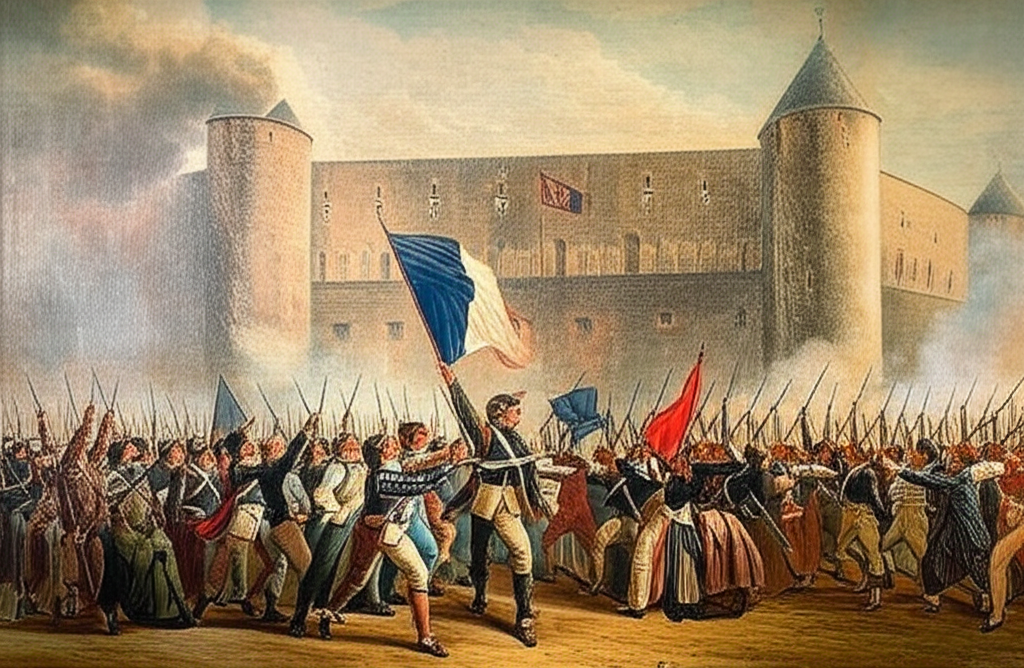
While revolutions promise profound change and often deliver it, their outcomes are rarely neat or predictable. The path from overthrow to a stable new order is frequently fraught with further conflict, internal divisions, and the rise of new forms of authoritarianism. The French Revolution, for instance, transitioned from the promise of liberty, equality, and fraternity to the Reign of Terror and eventually the Napoleonic Empire. This illustrates a crucial philosophical question: Does the end justify the means, especially when the means involve widespread violence and instability?
Ultimately, understanding revolution as political change requires a deep dive into history, philosophy, and the complex interplay of human agency and structural forces. It compels us to ask difficult questions about the nature of power, the rights of the individual, and the legitimacy of government itself.
YouTube:
-
📹 Related Video: PLATO ON: The Allegory of the Cave
Video by: The School of Life
💡 Want different videos? Search YouTube for: ""Great Books of the Western World on Revolution""
2. ## 📹 Related Video: ARISTOTLE ON: The Nicomachean Ethics
Video by: The School of Life
💡 Want different videos? Search YouTube for: ""John Locke Social Contract Theory Explained""