

Tyranny and the Abuse of Government: A Philosophical Reckoning
The specter of tyranny, the ultimate abuse of government power, has haunted political thought since antiquity. At its core, tyranny represents the perversion of legitimate authority, where the rule of law is subverted, and the common good is sacrificed for the self-interest of the ruler or a select few. This article explores the philosophical underpinnings of tyranny, tracing its conceptualization through the "Great Books of the Western World," examining how the erosion of virtue and vice within both rulers and citizens paves the path for oppressive regimes, and considering the enduring struggle to safeguard freedom against governmental overreach.
Defining Tyranny: A Perversion of Legitimate Rule
Tyranny is not merely harsh rule; it is a fundamental corruption of the very purpose of government. Philosophers from Plato to Locke have grappled with its definition, consistently identifying it as a form of governance where power is exercised arbitrarily, without the consent of the governed, and primarily for the benefit of the ruler rather than the ruled. It's a system where law becomes an instrument of oppression, rather than a framework for justice and order.
The Philosophical Roots of Tyranny: Insights from the Great Books
The "Great Books" offer a rich tapestry of analyses regarding the emergence and nature of tyranny, often linking it directly to moral failings and the structural decay of political systems.
Plato's Degeneration of Forms
In his seminal work, The Republic, Plato outlines a cyclical degeneration of political forms, with tyranny as the final, most debased stage. He posits that an ideal aristocracy (rule by the best) can devolve into timocracy (rule by honor), then oligarchy (rule by wealth), followed by democracy (rule by the people), and finally, tyranny. For Plato, the tyrannical soul, driven by insatiable desires and utterly devoid of reason and moderation, mirrors the tyrannical state. The tyrant, enslaved by his own vices, enslaves his citizens.
Aristotle's Classification and Deviation
Aristotle, in Politics, similarly categorizes governments and identifies tyranny as a deviation from monarchy. While monarchy is rule by one for the common good, tyranny is rule by one for the ruler's self-interest. He meticulously details the methods by which tyrants maintain power: fostering distrust among citizens, impoverishing the populace, and engaging in perpetual warfare. Aristotle emphasizes that good government is characterized by adherence to law and the pursuit of the common good, traits conspicuously absent in tyrannical regimes.
Locke's Breach of Trust
Centuries later, John Locke, in his Two Treatises of Government, provided a foundational argument for the right to resist tyrannical government. For Locke, legitimate government derives its power from the consent of the governed, existing to protect natural rights: life, liberty, and property. When a ruler or government acts contrary to this trust, violating the fundamental law of nature and the established civil laws, they put themselves into a state of war with the people. This abuse of power, this breach of trust, constitutes tyranny, justifying the people's right to rebellion.
The Role of Law: From Safeguard to Instrument of Oppression
The relationship between law and tyranny is paradoxical. In a just society, law serves as a bulwark against arbitrary power, ensuring fairness, predictability, and the protection of rights. It is the embodiment of reason and collective will. However, under tyranny, law is twisted into a tool of control and oppression.
Table: Law in Just vs. Tyrannical Government
| Feature of Law | Just Government | Tyrannical Government |
|---|---|---|
| Source of Authority | Derived from reason, consent, and common good | Arbitrary will of the ruler or ruling faction |
| Purpose | To protect rights, maintain order, ensure justice | To enforce obedience, consolidate power, suppress dissent |
| Application | Impartial, consistent, publicly known | Selective, unpredictable, often secret |
| Effect on Citizens | Fosters security, freedom, and civic engagement | Instills fear, subservience, and disempowerment |
When the law itself becomes an instrument of injustice, when due process is abandoned, and when rights are selectively applied or denied, the path to tyranny is laid bare.
Virtue and Vice: The Moral Compass of the State and Citizen
The philosophical discourse on tyranny invariably circles back to the moral character of both rulers and the ruled. The presence of virtue and the prevalence of vice are decisive factors in the rise and fall of oppressive regimes.
The Tyrant's Vices
A tyrant, according to Plato and Aristotle, is characterized by an abundance of vices: insatiability, hubris, paranoia, cruelty, and a profound lack of self-control. They prioritize personal gain, power, and pleasure above all else, seeing their subjects as means to an end. This moral corruption at the top inevitably seeps into the fabric of society, eroding public trust and fostering an environment of fear and moral decay.
The Citizen's Virtues
Conversely, the resistance to tyranny often hinges on civic virtues: courage, justice, prudence, moderation, and a commitment to the common good. Citizens who possess these virtues are less likely to succumb to fear, more likely to demand accountability from their government, and prepared to act when fundamental rights are threatened. The cultivation of these virtues, often through education and a robust public sphere, is a perennial defense against the creeping tendrils of authoritarianism.
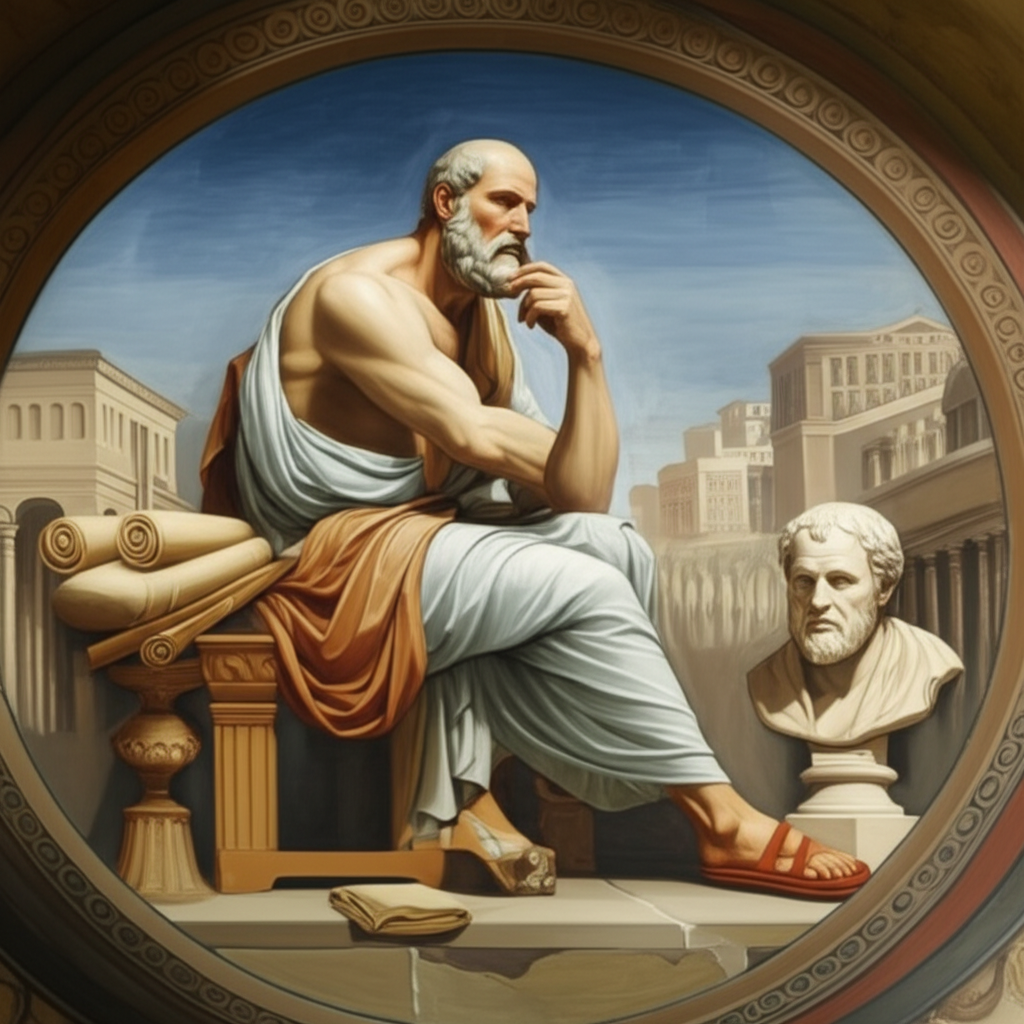 and a shadow of tyranny (darkened, chaotic figures). The philosopher's expression is one of serious reflection on the nature of governance.)
Resisting the Abusive Government
The "Great Books" not only diagnose tyranny but also offer pathways for resistance. From the Stoic emphasis on inner freedom and moral integrity to Locke's explicit justification for revolution, the idea that an abusive government can and should be challenged is a recurring theme. The challenge lies in discerning when a government has crossed the line from legitimate authority to tyrannical oppression, a judgment often made based on its adherence to law and its respect for fundamental human dignity and rights.
Conclusion
The study of tyranny is a timeless exercise in political philosophy, serving as a constant reminder of the fragility of freedom and the perpetual need for vigilance. The insights gleaned from the "Great Books of the Western World" — from Plato's dissection of the tyrannical soul to Locke's defense of natural rights — underscore that the battle against the abuse of government is fundamentally a moral one, waged in the realm of virtue and vice, and codified in the integrity of law. Understanding these philosophical underpinnings is crucial for any society seeking to preserve liberty and prevent the descent into oppression.
📹 Related Video: PLATO ON: The Allegory of the Cave
Video by: The School of Life
💡 Want different videos? Search YouTube for: ""Plato Republic Tyranny Analysis""
📹 Related Video: ARISTOTLE ON: The Nicomachean Ethics
Video by: The School of Life
💡 Want different videos? Search YouTube for: ""John Locke Two Treatises Government Abuse Power""