

The Relentless Urge: Exploring the Will to Power and Human Desire
Summary
The concept of the Will and Desire stands as a foundational pillar in understanding the human condition, an internal engine driving Man towards action, creation, and even destruction. While often associated with Friedrich Nietzsche's provocative "Will to Power," this exploration delves into how the fundamental impulse to grow, overcome, and assert oneself, rather than merely survive, intertwines with our deepest Desires. From ancient philosophical inquiries into the nature of the soul's appetites to modern critiques of morality, we trace how these primal forces shape our perception of Good and Evil, ultimately defining who we are and what we strive to become.
Introduction: The Undeniable Current Within
There is an undeniable current that runs through the very core of human existence, a restless energy that propels us beyond mere subsistence. It is the architect of our grandest achievements and the fuel for our most profound struggles. This current, which philosophers have grappled with for millennia, manifests itself as both the Will and Desire. Are these two distinct forces, or two facets of a singular, overarching drive? And how does this drive, particularly as conceived by Nietzsche as the "Will to Power," shape not just our individual aspirations, but the very fabric of our societies and our understanding of Good and Evil?
This pillar page will journey through the philosophical landscape, examining how various thinkers, from the ancient Greeks to the modern era, have sought to understand this potent inner force. We will explore how the human Desire for more – for knowledge, for love, for mastery – is intrinsically linked to a deeper Will that seeks to expand, to overcome, and to affirm life itself.
Unpacking the Will and Desire: A Fundamental Human Equation
At first glance, "will" and "desire" might seem interchangeable, yet they carry distinct philosophical weight.
- Desire: Often understood as a longing or craving for something absent, a pull towards an object or state perceived as beneficial or pleasurable. It is typically directed outwards.
- Will: More profoundly, the faculty of consciousness that initiates action, makes choices, and directs the organism towards a goal. It is the inner resolve, the power to choose and to act.
For many philosophers, Desire is a component of the Will, or at least a powerful influence upon it. Our will often acts to fulfill our desires. However, Nietzsche's "Will to Power" posits a more radical interpretation, suggesting that all desires are merely expressions or symptoms of a more fundamental, underlying Will that seeks growth and overcoming.
The Genesis of Desire: From Ancient Greece to Modern Man
The contemplation of human Desire is as old as philosophy itself, a constant theme within the Great Books of the Western World.
Plato and the Tripartite Soul
In Plato's Republic, Man's soul is divided into three parts: the rational, the spirited, and the appetitive. The appetitive part, responsible for our basic bodily Desires like hunger, thirst, and sexual urges, must be governed by reason. Here, desires are seen as potentially unruly forces needing control for the sake of individual and societal harmony.
Aristotle's Teleology of Desire
Aristotle, in works like Nicomachean Ethics, viewed Desire (orexis) as a natural impulse towards a perceived good. Human action is teleological, meaning it aims at an end, and the ultimate end is eudaimonia, or human flourishing. Our Desires, when properly cultivated through virtue, lead us towards this ultimate Good. The Will, in this context, is the rational faculty that directs these desires towards their proper ends.
Augustine and the Direction of the Will
Saint Augustine, in Confessions, placed immense emphasis on the Will as the core of human agency and morality. For Augustine, the Will is fundamentally a form of love, and its direction—towards God or towards worldly pleasures—determines one's spiritual state. The "fallen" Will is often swayed by errant Desires, leading to sin and a turning away from the ultimate Good. Here, the struggle between a rightly directed Will and misguided Desires is central to Man's spiritual journey.
Hobbes's Mechanistic Appetites and Aversions
Thomas Hobbes, in Leviathan, offered a more mechanistic view. Human Desire is reduced to "appetites" (motions towards something) and "aversions" (motions away from something). The Will is simply the "last appetite in deliberating," the final motion that leads to action. In this materialist framework, Man's actions are determined by these fundamental Desires for self-preservation and power, rather than a higher moral or spiritual calling.
Nietzsche's Radical Reinterpretation: The Will to Power as the Primal Drive
It is against this rich tapestry of philosophical thought that Friedrich Nietzsche introduces his most audacious concept: the "Will to Power." For Nietzsche, this is not merely a psychological drive but a metaphysical principle underlying all life.
- Beyond Survival: Unlike earlier thinkers who saw Desire as primarily geared towards survival or pleasure, Nietzsche argued that the Will to Power is a drive for growth, overcoming, and mastery. It is not about preserving oneself, but about enhancing oneself, about becoming more.
- Value Creation: This Will is the fundamental impulse to create, to impose meaning, and to overcome resistance. It is the force that generates all values, including our concepts of Good and Evil.
- A Non-Moral Force: Crucially, the Will to Power itself is amoral. It precedes and underpins all moral systems. It is the raw, creative energy of life seeking to assert itself.
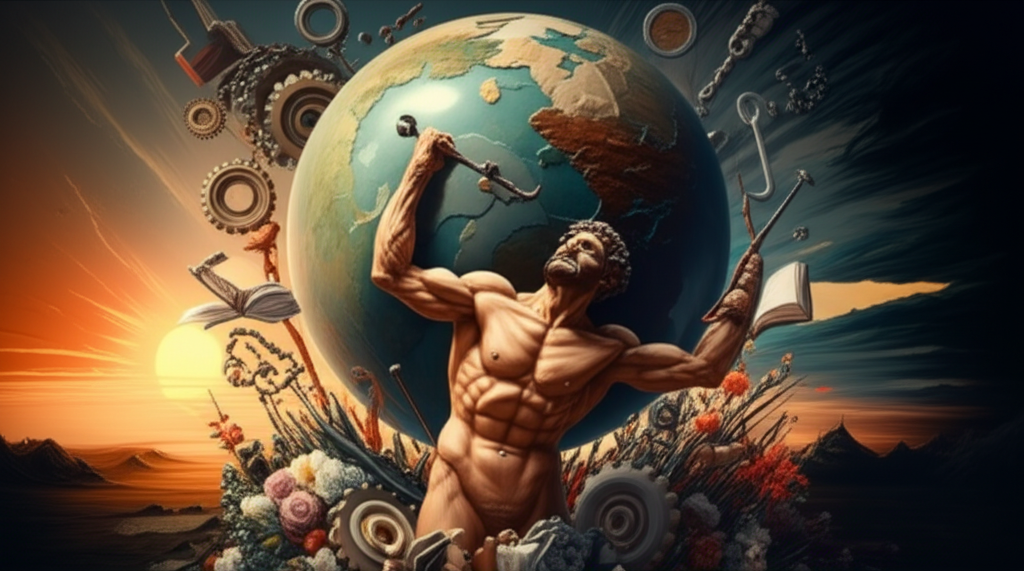
The Interplay of Will, Desire, and the Construction of Good and Evil
Nietzsche's concept profoundly impacts our understanding of Good and Evil. If the Will to Power is the fundamental drive, then morality is not divinely ordained or rationally deduced, but rather a human creation, an expression of particular wills.
- Master Morality: Arises from the "nobles," those strong individuals who affirm life and their own power. For them, "good" means noble, strong, powerful; "bad" means weak, common, slavish.
- Slave Morality: Developed by the oppressed and weak as a reaction to master morality. It inverts values: "good" becomes humility, compassion, patience; "evil" becomes pride, strength, selfishness. This is a will to power that manifests as resentment, seeking to negate the values of the strong.
Thus, our concepts of Good and Evil are not universal truths but are deeply rooted in the underlying Will and Desires of different types of Man, reflecting their struggle for dominance or self-preservation.
Manifestations of the Will to Power in Human Endeavor
The Will to Power is not confined to grand philosophical theories; it manifests in countless ways in the daily lives and pursuits of Man.
| Domain | Manifestation of Will to Power / Desire |
|---|---|
| Art & Creativity | The artist's relentless Desire to express, to impose their vision, to overcome the blank canvas or silent score. It is a will to make something new, to leave a mark, to reshape perception. |
| Science & Discovery | The scientist's insatiable Desire for knowledge, to uncover the secrets of the universe, to overcome ignorance. It is a will to master understanding, to expand the boundaries of what is known. |
| Politics & Leadership | The leader's Will to govern, to organize, to influence others, to shape society according to a vision. It is a drive for control, for impact, for the imposition of order or ideology. |
| Personal Relationships | The Desire for love, for connection, for intimacy, but also the subtle (or overt) will to influence, to be valued, to overcome loneliness or emotional distance. It's the will to define and assert one's place within the social fabric. |
| Self-Improvement | The individual's Desire to overcome personal limitations, to learn new skills, to become stronger, wiser, or more virtuous. It is a direct manifestation of the will to grow and master oneself. |
| Economic Ambition | The entrepreneur's Will to build, to innovate, to compete, to expand their enterprise. It is a drive to create wealth, influence markets, and overcome economic challenges. |
Critiques and Nuances: Beyond the Overt Drive
While Nietzsche's concept offers a potent lens, it has not been without its critics and alternative interpretations. Some argue that reducing all human motivation to a "Will to Power" oversimplifies the complex interplay of emotions, altruism, and genuine love that also drive Man. Others point to the dangers of misinterpreting the concept as a justification for aggression or unfettered individualism, rather than a drive for self-overcoming and cultural creation.
Other philosophers, even within the Great Books, offer different perspectives on the primacy of Will and Desire. Schopenhauer, for instance, saw the Will as a blind, irrational force leading to suffering, a stark contrast to Nietzsche's life-affirming interpretation. Freud's psychoanalytic theories, while acknowledging deep drives, differentiated between the id's pleasure principle and the ego's reality principle, offering a different topography of human Desire.
Conclusion: The Enduring Question of Our Inner Drive
The journey through the philosophical landscape of the Will to Power and human Desire reveals an enduring and multifaceted quest to understand what truly moves Man. From the ancient Greek pursuit of virtue and the Augustinian struggle for spiritual alignment, to Hobbes's mechanistic appetites and Nietzsche's radical affirmation of life-as-overcoming, philosophers have continuously sought to grasp the fundamental forces that shape our existence.
Whether we view the Will as a faculty of choice, a blind cosmic force, or a primal drive for growth, its interplay with our manifold Desires remains central to our understanding of ourselves. It is this potent combination that sculpts our values, defines our pursuit of Good and Evil, and ultimately determines the trajectory of human civilization. To truly know ourselves, we must first confront the relentless urge that resides within.
Further Exploration
📹 Related Video: KANT ON: What is Enlightenment?
Video by: The School of Life
💡 Want different videos? Search YouTube for: "Nietzsche Will to Power Explained"
📹 Related Video: What is Philosophy?
Video by: The School of Life
💡 Want different videos? Search YouTube for: "History of the Concept of Will in Philosophy"